Ingram Micro Ransomware Breach Exposed Employee Data for 42,000 People, and the Fallout Is Bigger Than the Number
The Ingram Micro ransomware breach leaked SSNs and financials for over 42,000 people. What happened, who is Safepay, and what you should watch for.

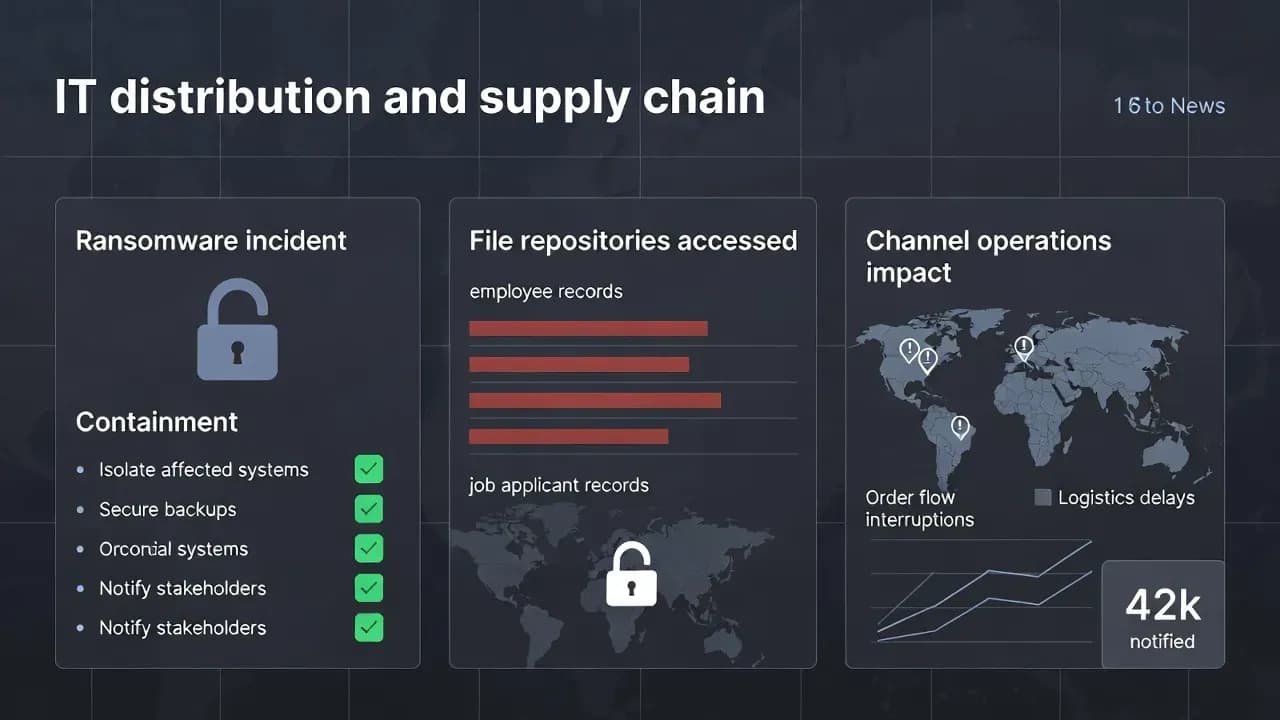
The Ingram Micro ransomware breach is a reminder that breach impact cannot be measured only by the number of people notified. Ingram Micro says a July 2025 attack exposed files tied to employee and job applicant records, triggering notifications to roughly 42,000 individuals. But Ingram Micro is not just another company dealing with ransomware. It sits in the middle of the global IT channel, and when a distributor's systems go down, operational shockwaves can hit vendors, resellers, MSPs, and downstream customers who rely on ordering, licensing, and provisioning platforms to function. The strategic risk is clear: attackers increasingly target high-dependency intermediaries because even short disruptions can translate into real revenue loss, stalled deployments, and a long tail of identity and fraud exposure.
What Happened: The Technical Breakdown and Timeline
The timeline described across filings and reporting points to a fast-moving intrusion with both data theft and ransomware deployment. Ingram Micro says it detected a cybersecurity incident on July 3, 2025, and determined an unauthorized party removed certain files from internal file repositories between July 2 and July 3, 2025. The company's investor-facing statement from early July 2025 confirms ransomware was identified on some internal systems, and that Ingram Micro proactively took certain systems offline as part of containment and remediation. Reuters reported the same general posture at the time: systems were taken offline, outside experts were engaged, and law enforcement was notified.
Operationally, that "systems offline" decision is often the unavoidable cost of stopping an encryption event from spreading laterally. But it also explains why the incident quickly became an availability crisis for customers. Public reporting at the time described a major outage affecting internal systems and the company's public web presence, with a push for employees to work from home. Axios similarly noted multi-day disruption that prevented customers from placing orders, underscoring how quickly a security event becomes a commercial continuity issue when it hits a major supply chain node.
From an incident response perspective, the critical detail is that the event appears to have included both data access and ransomware execution. That means the breach should be treated as a double-impact scenario: confidentiality loss (employee and applicant data exposure) plus operational disruption (platform and ordering outage). Ingram Micro's early statement focused on restoration and continuity, which is typical during the acute phase of a ransomware incident. The later notification wave, reported in January 2026, shows the longer arc: investigation, file review, legal assessment, and regulated consumer notifications once the exposed datasets could be defined.
What Data Was Exposed: Why HR and Applicant Records Create Long-Term Risk
Ingram Micro's notification language described in reporting indicates the compromised files were tied largely to employment and job applicant records. The categories of data reported as exposed include names, contact information, dates of birth, and government-issued identification numbers, including Social Security numbers, driver's license numbers, and passport numbers. Employment-related information, including work-related evaluations, was also described as part of the affected dataset.
This specific mix of data is particularly attractive for identity fraud because it combines stable identifiers with contextual details that strengthen impersonation attempts. Social Security numbers and government ID numbers are not just "PII." They are account-opening fuel for credit fraud, tax fraud, and synthetic identity construction, especially when paired with dates of birth and address history. Even employment evaluation data, while less obviously monetizable, can be weaponized for targeted extortion or harassment if it contains performance notes, internal identifiers, or managerial commentary. The risk profile is therefore broader than "watch your credit." It includes increased likelihood of targeted social engineering, employment verification scams, and account recovery abuse where helpdesks still rely on static identifiers.
There is also a second-order enterprise risk: HR and applicant datasets often map to privileged enterprise identities. Job applicants may later become employees. Employees may hold administrative roles. If attackers can correlate identity data across leaked sources, they can build high-confidence phishing pretexts that bypass user suspicion because the attacker appears to "know" internal facts. In other words, HR data breaches can silently increase the success rate of future credential theft campaigns, even if the ransomware incident itself is fully remediated.
Attribution and the SafePay Question: What's Confirmed vs Reported
Ingram Micro has not publicly named the ransomware operation responsible in its own disclosures. However, multiple reports connect the incident to the SafePay ransomware group. BleepingComputer notes it previously reported SafePay as behind the attack, and later reporting references SafePay's claim and the leak-site posting. SecurityWeek similarly states that while Ingram Micro did not name the gang, SafePay listed the company on its Tor-based leak site and claimed theft of 3.5TB of data. The Register's coverage echoes that SafePay claimed responsibility and that the incident centered on employee and applicant records.
This split between "not named by the victim" and "reported attribution" is common in ransomware cases for two reasons. First, legal teams often advise against definitive attribution unless the company has direct evidence that would stand up to scrutiny. Second, threat actors routinely exaggerate or distort breach details to increase pressure, and victims do not want to validate claims that could amplify extortion leverage. That said, when multiple outlets converge on a specific group and leak-site evidence is consistent, defenders should treat the reported attribution as a serious lead, not a certainty.
One additional nuance matters for readers tracking the impact: leak-site dynamics are messy. SecurityWeek reports that SafePay made allegedly stolen data publicly available in early August, implying non-payment. The Register adds that a claimed published dataset may not have been easily retrievable. The practical takeaway is that "leaked" is not binary. Data can be partially leaked, selectively leaked, re-sold privately, or used purely as leverage without a stable public download. For affected individuals and organizations, the safest assumption is still that exposed identifiers may circulate, regardless of whether a leak portal link is currently functional.
Why This Incident Hits the Channel Hard: Supply Chain Availability as the Real Battleground
For many ransomware cases, the "breach affects X people" headline understates the business reality. Ingram Micro is a distributor embedded in enterprise procurement and provisioning workflows, with scale measured in tens of thousands of employees and over a hundred thousand customers. When platforms used for ordering, licensing, and inventory visibility go offline, partners may not be able to provision services, renew licenses, or ship hardware on schedule. Axios framed the event in exactly those terms: a ransomware attack that forced operational disruption and prevented customers from placing orders for several days.
This matters because channel operations run on tight timing. A delayed license provisioning request can stall a customer rollout. A paused hardware shipment can create cascading project delays. A "temporary" outage can therefore become a real breach of SLA and a reputational event for upstream vendors and downstream service providers, even if their own systems were never compromised. This is why attackers increasingly choose intermediaries. They provide leverage through disruption, not just through data theft.
The incident also highlights a structural weakness in many supplier ecosystems: companies often do not have an operational fallback when a major distributor goes down. Even organizations with strong internal security can find themselves unable to execute routine IT operations if the ordering and delivery pipeline stalls. The defensive lesson is not merely "patch faster." It is to build resilience into procurement, provisioning, and third-party dependency mapping. If your business cannot function when one upstream node is unavailable, your risk is not just cyber risk. It is systemic operational risk.
How Organizations Can Respond: Tactical Steps for Enterprises, Partners, and Individuals
A ransomware breach of HR and applicant data creates two response tracks: enterprise operational controls and individual identity protection. Both need to happen quickly, and both need to be sustained because identity abuse often shows up months later.
For individuals who received notifications, the baseline response is straightforward but must be executed rigorously. Use the offered monitoring and identity protection services if provided, and treat them as a supplement rather than a guarantee. Ingram Micro is offering 24 months of credit monitoring and identity protection services. People should also lock down high-risk accounts that are commonly compromised after identity exposure: email, mobile carrier, financial portals, and government services. Strong MFA, preferably phishing-resistant methods, reduces the risk of a follow-on takeover even when an attacker has rich identity context.
For enterprises and channel partners, the bigger work is in authentication and fraud-prevention hardening. Assume attackers now have data useful for spearphishing and impersonation. That means tightening HR and helpdesk processes where "known information" is still used as identity proof. If your support desk still resets accounts based on static identifiers, you should treat this type of breach as a trigger to raise the bar immediately. Require step-up verification for account recovery, restrict high-risk administrative changes, and add monitoring for unusual password reset patterns.
From a supply chain resilience standpoint, the incident is also a prompt to pressure-test continuity plans. Identify which distributor-dependent workflows would break if your primary supplier goes dark for several days. Create procurement alternates for critical items, pre-stage essential licenses where possible, and formalize escalation channels with distributors for outage periods. Many organizations spend heavily on endpoint security but do not map the operational reality that "procurement and provisioning is part of production."
Lessons Learned and Industry Implications
The Ingram Micro ransomware breach reinforces a trend that has been building for years: ransomware is as much about supply chain leverage as it is about data. Distributors, MSPs, and shared service providers are attractive because they concentrate dependency. Even when exposed personal records are limited to employees and applicants, the operational disruption alone can create large downstream impact.
It also highlights why "unconfirmed attribution" still matters operationally. If SafePay is the actor behind this campaign as reported, the double-extortion model remains intact: steal data, then encrypt systems, then pressure the victim with disruption and leak-site claims. That pattern should shape your controls. You cannot assume ransomware is a pure encryption event. You must assume data theft is part of the playbook and build detection around staging, repository access anomalies, and outbound transfer indicators.
Lastly, the notification cycle shows the long tail of ransomware events. Even after systems are restored, the organization must handle legal filings, notifications, and support for affected individuals. This is a multi-quarter cost center, not a one-week crisis. Security teams that focus only on "restore operations" risk underestimating the compliance and reputational burden that follows.
The Ingram Micro ransomware breach is the kind of incident that looks contained when you only track notification counts, but its real impact sits in dependency and time. A distributor breach creates a two-front problem: identity exposure for thousands of individuals and operational friction across an ecosystem that depends on the distributor to deliver and provision technology. For security leaders, the takeaways are pragmatic: assume double extortion, instrument repositories so you can prove what was accessed, and treat supplier availability as a first-class resilience requirement. The organizations that prepare for "supplier down" scenarios and harden identity verification paths will absorb the next supply-chain ransomware hit with less chaos and less long-term harm.
Frequently Asked Questions
It was both. Reporting based on notification letters indicates attackers removed files from internal repositories, and the company also confirmed ransomware on internal systems.
The exposed data described in reporting includes identity and employment-related information such as names, dates of birth, Social Security numbers, passport and driver's license numbers, and employment evaluation data.
No public statement from the company definitively names a ransomware group. However, multiple reports connect the incident to SafePay based on prior reporting and leak-site claims.
Not necessarily. Leak-site availability can be inconsistent, and data can circulate privately even if public links break. Treat identity exposure as durable risk and take preventive steps regardless.
Model distributor outages as a business continuity scenario, not just a cyber event. Build alternates for critical procurement and licensing paths, and tighten identity verification and account recovery controls because HR datasets can boost spearphishing success.
Comments
Want to join the discussion?
Create an account to unlock exclusive member content, save your favorite articles, and join our community of IT professionals.
New here? Create a free account to get started.