Konni Hackers Target Blockchain Engineers With AI Generated PowerShell Malware and OneDrive Themed Persistence
Blockchain engineering teams are now being targeted with a blend of old tradecraft and a new productivity multiplier: an AI assisted PowerShell backdoor that looks unusually well documented for malware. The campaign is attributed to the North Korea linked Konni cluster (TA406/Opal Sleet). The operation aims at developer environments that hold infrastructure credentials, API secrets, signing keys, and wallet access.

Blockchain engineering teams are now being targeted with a blend of old tradecraft and a new productivity multiplier: an AI assisted PowerShell backdoor that looks unusually well documented for malware. The campaign is attributed to the North Korea linked Konni cluster, also tracked as TA406 and aligned with Microsoft's Opal Sleet naming. What makes this operation operationally dangerous is not novelty in exploitation, but the way it aims at developer environments that hold the keys to everything: infrastructure credentials, API secrets, signing keys, and wallet access. If your security model assumes endpoints are messy but your build chain is sacred, this is the kind of intrusion that invalidates that comfort.
What happened: the technical breakdown
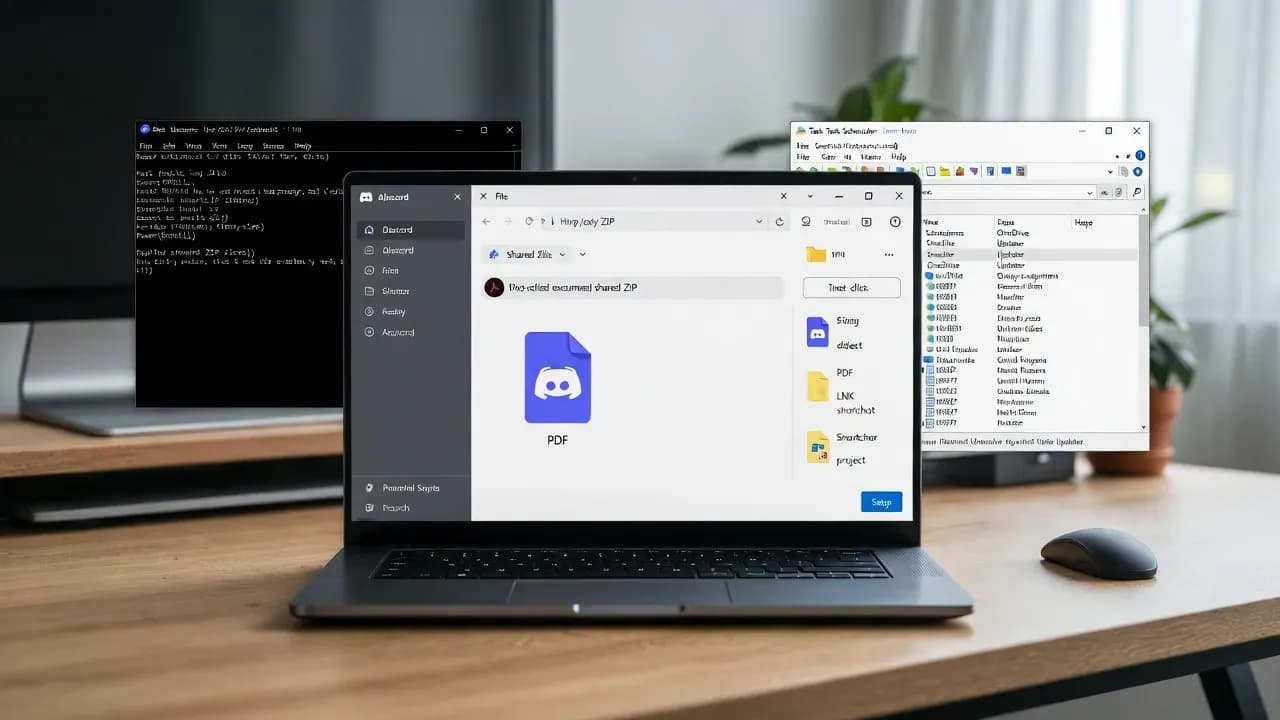
The initial delivery is engineered for click through, not stealth. Victims are directed to a Discord hosted link that serves a ZIP archive containing a decoy document and a malicious LNK shortcut. Once launched, the LNK executes an embedded PowerShell loader which drops a DOCX lure and a CAB archive that bundles multiple components, including a PowerShell backdoor and supporting batch scripts. The visible DOCX is there to keep the victim calm, while the batch scripts do the real work in the background.
Persistence is implemented in a way that will feel familiar to defenders who have cleaned up commodity infections on Windows fleets. A scheduled task is created and disguised as a OneDrive related startup task. It runs on a recurring basis and is designed to pull an encrypted PowerShell payload from disk, decrypt it, and execute it in memory. The chain attempts to reduce forensic residue by deleting the initial script after execution, which complicates post incident attribution if you do not already have process and command line telemetry.
Under the hood, the backdoor uses heavy obfuscation techniques that are common in PowerShell threats but executed with an unusual degree of structure. Strings are encoded using arithmetic operations that reconstruct character values at runtime, the final logic is assembled dynamically, and execution is performed through Invoke Expression. In addition, the malware performs environment vetting before it commits to full execution, including checks intended to detect analysis tooling and sandbox conditions, and user activity tests that reduce the success rate of automated detonation environments.
Why the "AI generated" detail matters to defenders
Calling malware "AI generated" can become hype unless it changes how you defend. In this case, the value is not that the implant is more advanced, but that it signals faster iteration and lower friction for operators who already know what works. The analysis cited unusually polished documentation at the top of the script, modular layout, and a highly instructive placeholder comment that reads like something a code assistant would produce to guide a human in customizing a template. That combination matters because it implies the actor can produce variants quickly, tune wording per target, and modify the backdoor without the typical sloppiness that sometimes creates easy detection anchors.
For blue teams, this shifts the balance toward behavior based detection and hardening. Signature hunting still has value, but campaigns like this will increasingly vary surface artifacts while keeping the same runtime behaviors: LNK launching PowerShell, staged payload execution from ProgramData, scheduled task persistence under benign names, in memory script blocks, and periodic beaconing.
Target profile and likely intent
The lures are not optimized for generic credential theft. They are themed around developer and engineering work, and the reporting explicitly calls out an intent to compromise development environments and the sensitive assets they expose. That intent aligns with a long running North Korean pattern: monetize access to crypto or financially valuable infrastructure, collect intelligence, or both, depending on the operator and target.
The observed targeting indicators point to Asia Pacific activity, including submissions associated with Japan, Australia, and India. This does not mean the campaign is geographically limited, but it does suggest the actor is investing in regionalized targeting where blockchain development talent and crypto adjacent engineering teams are concentrated.
The strategic risk is straightforward. A compromised engineer workstation can be a stepping stone into source repositories, CI runners, cloud control planes, secret stores, and production signing workflows. Even if the initial backdoor is "just" reconnaissance and remote command execution, it can enable a second stage that is tailored to the victim's build and release processes, which is where the true blast radius lives.
Detection and prevention strategies that actually fit dev environments
Defending developer fleets requires acknowledging reality: engineers will install tools, open archives, and run scripts. The goal is not to prohibit that behavior, but to surround it with guardrails that make attacks like this expensive.
Start with PowerShell visibility and control. If you do not have full command line telemetry for PowerShell and process lineage from LNK to script interpreter, you are choosing to be blind at the point of initial execution. Tighten PowerShell policies where feasible, and make sure that suspicious patterns such as encoded commands, hidden windows, and in memory execution paths generate high priority alerts when they originate from user initiated file launches.
Second, treat scheduled task creation as a persistence boundary. In many environments, scheduled tasks are under monitored, but they remain a common persistence mechanism precisely because they can be made to look boring. Create detections that focus on tasks created by user context shortly after archive extraction, tasks that execute PowerShell inline, tasks that read and decode content from ProgramData, and tasks whose names mimic popular enterprise tooling like OneDrive.
Third, reduce the secret density on endpoints. The most valuable thing on a developer workstation is often not the workstation itself, it is what it can access without friction. Short lived credentials, tighter scopes, hardware backed keys where possible, and explicit separation between development environments and production access materially reduce the value of a foothold.
Finally, focus on containment readiness. If you find one infected engineer endpoint, assume the actor attempted credential harvesting, repo enumeration, and cloud token discovery quickly. Your response plan should include rapid token revocation workflows, forced rotation for developer secrets, and a clear method to audit recent access to source control, CI, and cloud consoles.
Lessons learned for security and engineering leadership
This campaign is a reminder that developer targeting is no longer a niche espionage tactic. It is a pragmatic route to high value compromise because the modern enterprise runs on code and secrets. Security teams that treat dev endpoints as "special" and therefore exempt from standard controls often end up with the worst of both worlds: high privilege machines with low monitoring.
The most effective posture is a partnership model where engineering keeps flexibility but agrees to non negotiables: visibility on script execution, restrictions on unsigned automation from untrusted origins, controlled privilege boundaries for scheduled tasks, and fast incident response playbooks that do not require debate in the middle of an intrusion.
Conclusion
Konni's latest wave is less about exotic exploitation and more about economic targeting: compromise the people closest to secrets and production workflows, then let the environment do the rest. The AI assisted backdoor detail matters because it suggests a future where attackers can ship cleaner, faster variants without leaving the usual low quality fingerprints. If you want to be resilient against this class of intrusion, the practical answer is governance and visibility: treat PowerShell and scheduled tasks as security boundaries, reduce secret exposure on endpoints, and make token revocation a routine muscle, not an emergency improvisation.
Frequently Asked Questions
It is primarily a social engineering and execution chain issue. The attack relies on convincing the target to open a malicious archive and execute a shortcut that launches PowerShell. Patch hygiene still matters, but this intrusion path bypasses the "exploit and patch" loop.
Because their endpoints often hold privileged access to infrastructure, API credentials, signing keys, and wallet operations. A single engineer account can provide a route into code, CI pipelines, and production systems that are difficult to penetrate directly.
Lack of high fidelity visibility into script execution and persistence creation on developer endpoints. Without PowerShell command line telemetry and scheduled task auditing, the early stages can look like ordinary user activity.
Make tokens short lived, constrain scopes, and centralize secret storage so local theft yields less value. Your incident response should include rapid revocation for cloud sessions, source control tokens, and CI secrets, not only endpoint remediation.
Not necessarily. The value to the attacker is speed and polish: faster iteration, fewer mistakes, and easier customization per target. Defenders should treat it as a signal to rely more on behavior based detections and hardening.

Comments
Want to join the discussion?
Create an account to unlock exclusive member content, save your favorite articles, and join our community of IT professionals.
New here? Create a free account to get started.