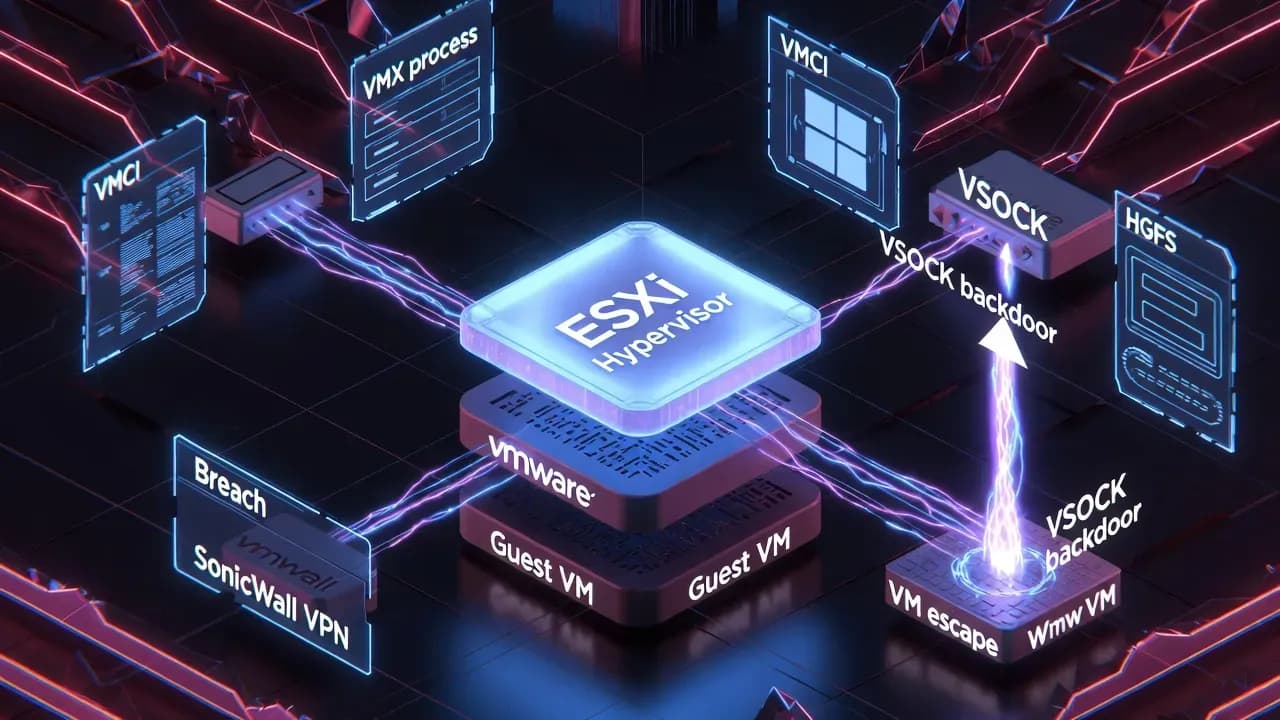
Chinese-Linked Hackers Exploit VMware ESXi Zero-Days for VM Escape After SonicWall VPN Access, Deploying a VSOCK Backdoor on Hypervisors
This threat report is a reminder that "virtual machine isolation" is a security boundary only until the hypervisor is proven vulnerable. Investigators tracking an intrusion in late 2025 describe a suspected Chinese-speaking actor leveraging access to a SonicWall VPN device to pivot into a VMware environment and deploy a VM-escape exploit chain against ESXi.

Three zero-days chained for the VM escape exploit
Coverage claimed for the toolkit across versions 5.1 through 8.0
Opening: A Reminder That VM Isolation Is Only as Strong as the Hypervisor
This threat report is a reminder that "virtual machine isolation" is a security boundary only until the hypervisor is proven vulnerable. Investigators tracking an intrusion in late 2025 describe a suspected Chinese-speaking actor leveraging access to a SonicWall VPN device to pivot into a VMware environment and deploy a VM-escape exploit chain against ESXi.
The end state is the scenario defenders fear most: compromise of the hypervisor itself and a stealthy persistence channel that can be controlled from inside any guest VM, bypassing many traditional network monitoring assumptions. For enterprises that still treat virtualization as infrastructure plumbing rather than an attack surface, this incident is a practical wake-up call: patch velocity, host-guest feature hardening, and hypervisor-level telemetry matter as much as endpoint controls.
What Happened: From Edge Access to Hypervisor Control
The reported intrusion begins with a pattern defenders see constantly and too often underestimate: initial access through an edge device, followed by a surgical pivot toward high-value infrastructure. In this case, investigators attribute early access to a compromised SonicWall VPN appliance, which gave the attacker a foothold to move deeper into the environment without needing to immediately burn noisy exploits on endpoints. That choice is rational. If you can enter through the "front door" of remote access, you can take your time mapping the virtualization layer and selecting the host that offers the biggest blast radius.
Attack observation window cited by incident responders
Once inside, the attacker's objective appears to shift from ordinary compromise to infrastructure dominance. The toolkit described in research reporting is designed to break out of a guest VM and execute on the ESXi host, which is the point where one compromised workload can become many. The danger is structural: hypervisors sit beneath authentication boundaries that normally separate servers, application tiers, and business units. If the ESXi layer falls, every VM on the host becomes a downstream exposure, and the attacker can choose whether to steal data quietly, implant persistence, or stage disruptive operations.
The most important operational lesson is that the sophistication of the VM escape did not replace the need for basic hygiene. It was layered on top of basic access. That should influence prioritization for security leaders: harden the edge, yes, but also treat the hypervisor patch cycle and management plane monitoring as first-class controls, because advanced actors increasingly treat virtualization as the shortest path to broad control.
The Technical Breakdown: How a VM Escape Toolkit Becomes a Repeatable Capability
The reporting describes an exploit toolkit that chains multiple weaknesses to cross the VM boundary and ultimately install a backdoor on the ESXi host. While exploit chains can look exotic in isolation, the attacker logic is consistent with modern intrusion engineering: collect a reliable information leak, convert that into a stable memory corruption primitive, and then pivot into a privileged escape that leaves the sandbox behind.
At a conceptual level, the toolkit is built to operate where defenders are weakest: between the guest VM and the hypervisor. The VMX process on ESXi, which exists per VM and handles a range of host-guest interactions, becomes a focal point because it processes inputs that originate from inside the VM. If an attacker can influence VMX behavior in a controlled way, they can bridge from "guest admin" to "host impact," which is exactly what a VM escape seeks to achieve.
Control path from a guest VM to the ESXi backdoor—traffic does not traverse the traditional network stack
What makes this incident particularly relevant for defenders is that the final persistence mechanism is not just "a file on the ESXi host." The research describes a VSOCK-based backdoor (a channel intended for fast communication between guests and the hypervisor) that can be interacted with from inside a Windows guest VM. That design has a stealth advantage: traffic over VSOCK does not traverse the traditional network stack in the way TCP traffic does, which means network sensors and perimeter tools can have blind spots. In practice, that shifts the detection burden to the host itself.
A separate and subtle signal in the reporting is development maturity. Indicators embedded in tooling artifacts suggest the attackers may have had components in development well before public disclosure of the relevant ESXi vulnerabilities. If accurate, that implies a resourced developer capability and a long horizon for weaponization, not opportunistic copy-paste exploitation. For defenders, that reinforces a hard truth: once high-impact vulnerabilities exist in foundational infrastructure, the clock is usually already ticking.
Vulnerability Context: Why the March 2025 ESXi Zero-Days Still Matter in 2026
The vulnerabilities tied to this story are significant not only because they were exploited, but because they affect the trust model of virtualization itself. When a vulnerability allows code execution in the VMX process or enables an escape from a VMX sandbox into the ESXi kernel, it directly challenges the assumption that a compromised workload remains "contained." That assumption is often baked into segmentation decisions, backup strategies, and even incident response playbooks that focus on rebuilding the affected VM rather than validating the host.
VMware advisory date for the ESXi zero-days
This is where patch governance becomes existential rather than administrative. Hypervisor patching tends to move slower than endpoint patching because it is tied to maintenance windows, workload scheduling, and fear of downtime. Attackers understand that. A functional VM escape chain turns patch lag into a strategic advantage, because a single successful compromise can yield disproportionate control and create a staging platform for lateral movement that is harder to observe.
Defenders should also read this incident as an argument for reducing unnecessary host-guest integration features. VM escapes frequently exploit the frictionless "quality of life" mechanisms that administrators like because they make management easy: file transfer conveniences, integration channels, and tool-assisted communication surfaces. You do not have to eliminate these features everywhere, but you should treat them as attack surface. Where workloads are high sensitivity, policy should lean toward minimum feature exposure and explicit justification for anything that expands the guest-to-host interface.
Impact and Risk: The Real Blast Radius of Hypervisor Compromise
The reason hypervisor compromise is a board-level risk is straightforward: it can collapse segmentation. In many enterprises, critical systems that would never be placed on the same physical server are co-resident as VMs because virtualization abstracts the hardware boundary. That is cost-efficient and operationally convenient, but it also creates systemic risk when the abstraction is broken. An attacker who controls the hypervisor can potentially access VM disks, memory artifacts, snapshots, and management interfaces in ways that bypass many controls that are effective at the guest OS layer.
There is also an incident response pitfall here. If responders treat the event as "a VM infection" and rebuild the guest without validating the ESXi host, they can leave the persistence layer intact. That is the attacker's ideal outcome: defenders do the work, service is restored, and the hypervisor implant quietly survives as a re-entry point. For organizations with ransomware exposure, this matters because hypervisor-level access can accelerate both encryption and disruption by enabling the attacker to impact multiple VMs rapidly.
Finally, the VSOCK angle introduces a detection challenge that many teams have not operationalized. If the backdoor command channel does not look like normal network traffic, the absence of network indicators does not equal safety. Mature response requires hypervisor-level process inspection, integrity validation, and explicit monitoring for unexpected binaries or socket behaviors on ESXi hosts. In other words, virtualization security requires its own telemetry mindset, not a copy of endpoint monitoring assumptions.
How Organizations Can Respond: Containment, Validation, and Hardening Steps That Work
Organizations responding to a suspected ESXi VM escape scenario should prioritize three outcomes: stop attacker control, validate hypervisor integrity, and reduce the probability of recurrence. Containment begins with isolating affected ESXi hosts from management networks and limiting administrative access until integrity is established. In parallel, review VPN and identity logs tied to the initial access path, because hypervisor-level compromise is often downstream of credential access, device compromise, or exposed management interfaces. Treat the "edge-to-core" chain as one incident, not separate events.
Treat ESXi hosts like critical servers: enumerate running processes, review recently modified binaries, and look for unexpected persistence mechanisms that survive reboots.
Validation must be hypervisor-centric. Many IR teams are strong on Windows forensics but weaker on ESXi host triage. That is a gap attackers exploit. The practical approach is to treat ESXi hosts like critical servers: enumerate running processes, review recently modified binaries in temporary and system locations, and look for unexpected persistence mechanisms that survive reboots. If your environment supports it, capture a forensic image or memory artifacts under guidance, because VM escape incidents are high-value intelligence events that can inform broader defensive posture.
Hardening should focus on removing the attacker's easy wins:
- Patch aggressively according to vendor guidance for ESXi, even if it requires uncomfortable maintenance planning
- Tighten access to management planes and require strong authentication for administrative entry points
- Segment the management network so that compromise of a single access path does not immediately expose virtualization control surfaces
- Reduce exposure of host-guest integration features on high-value workloads
- Ensure logging and monitoring include ESXi host telemetry, not only guest OS signals
Lessons Learned: Virtualization Security Is No Longer Optional Infrastructure Hygiene
This incident fits a broader trend: attackers are moving down the stack. When defenders harden endpoints and SaaS identity, the next logical target is the infrastructure layer that aggregates power. Virtualization hosts and their management planes are exactly that layer. The organizations that handle this shift well will be those that treat ESXi as a tier-zero asset, with dedicated patch SLAs, explicit telemetry requirements, and architecture decisions that minimize shared fate between unrelated workloads.
Security programs should also update their threat models. "VM admin inside a guest" is a meaningful security boundary only if the hypervisor is robust and patched. If you assume VM escape is impossible, your containment and recovery strategy may be built on sand. A better model is to assume that high-value adversaries will attempt to cross boundaries when the economics make sense, and to design monitoring and response accordingly.
Treat ESXi as a tier-zero asset with dedicated patch SLAs, explicit telemetry requirements, and architecture decisions that minimize shared fate.
Finally, this incident should push teams to review edge device posture with a harsher lens. Sophisticated intrusions still begin with basic entry. If an attacker can compromise remote access infrastructure and then deploy an advanced VM escape, the defender's job is to reduce both probabilities: make initial access harder, and make infrastructure exploitation less viable through patching and hardening. Defense in depth remains the only strategy that scales.
Closing
The most uncomfortable message from this incident is also the most actionable: advanced exploitation succeeds fastest when basic access controls already failed. A compromised edge device opened the door, and a VM escape toolkit amplified that foothold into hypervisor-level control with a persistence channel designed to evade traditional network visibility. For defenders, the response is not to panic about exotic exploitation, but to treat virtualization as a tier-zero security domain: patch ESXi with urgency, harden host-guest interfaces where feasible, restrict management plane reachability, and build monitoring that can detect abnormal ESXi host activity even when network signals are quiet. As attackers continue moving down the stack, organizations that operationalize hypervisor security as a core discipline will reduce both blast radius and recovery cost.
Frequently Asked Questions
Because it can collapse segmentation. A hypervisor compromise can expose multiple VMs and workloads that would otherwise be isolated, enabling faster lateral movement, data access, and disruptive actions. It also complicates recovery because rebuilding a guest VM may not remove host-level persistence.
Not necessarily. The reporting describes initial access through a compromised edge VPN device, followed by internal pivoting into VMware infrastructure. The key risk factor is reachable management and virtualization surfaces once an attacker is inside, not only direct exposure of ESXi to the internet.
It can reduce network visibility because VSOCK communication does not behave like conventional TCP traffic that perimeter tools are built to observe. Defenders may see fewer network indicators even while the attacker maintains persistent control. This increases the importance of host-level monitoring and integrity validation on ESXi.
If you patched consistently, your exposure to the specific CVEs is materially reduced, but the broader lesson remains: virtualization interfaces and host-guest features are recurring attack surfaces. Organizations should verify patch compliance, validate hypervisor baselines, and ensure monitoring can detect unusual ESXi host behaviors.
Treat the ESXi host as the primary crime scene, not only the guest VM. Validate host integrity, look for persistence at the hypervisor layer, and review management plane access and edge device logs that may explain initial entry. Recovery should include assurance that the host is clean before restoring workloads.


Comments
Want to join the discussion?
Create an account to unlock exclusive member content, save your favorite articles, and join our community of IT professionals.
New here? Create a free account to get started.