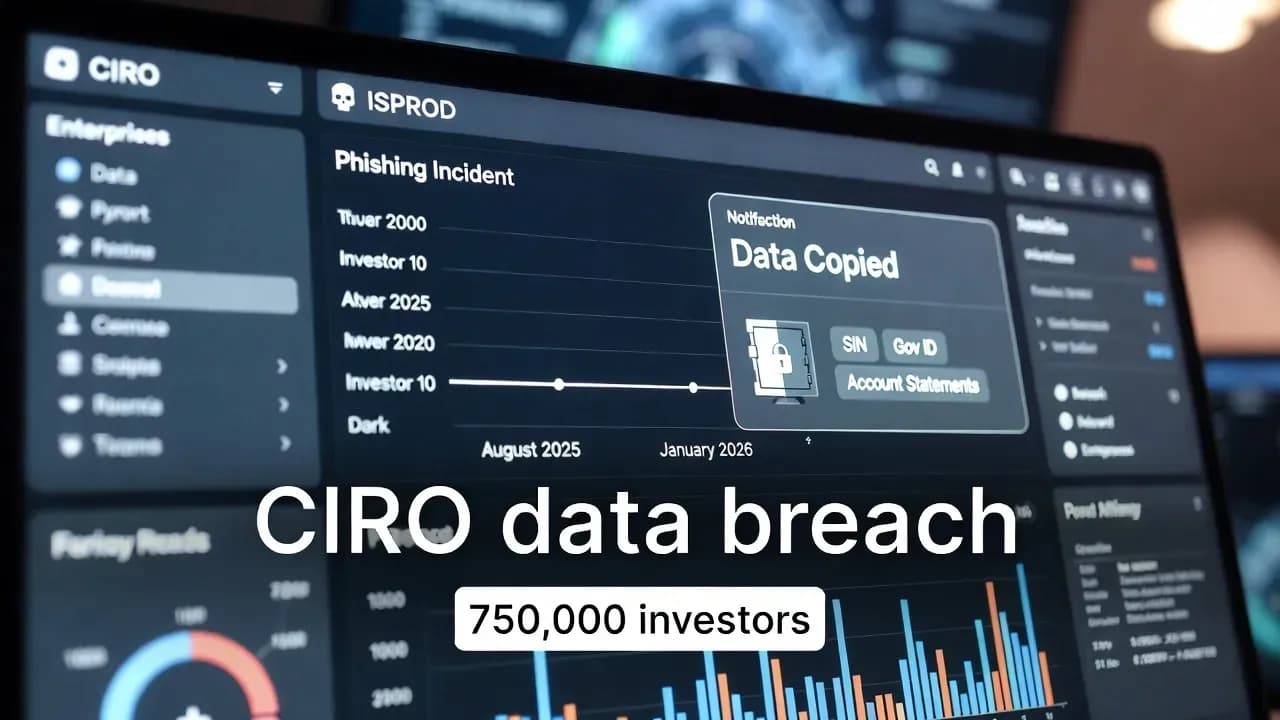
CIRO data breach confirmed to impact 750,000 Canadian investors after August 2025 phishing attack
CIRO says a sophisticated phishing attack first disclosed in August 2025 led to unauthorized copying of a limited subset of investigative, compliance, and market surveillance data, affecting roughly 750,000 Canadian investors. Exposed data may include SIN, government ID numbers, investment account numbers, and account statements, but CIRO says it does not hold passwords or PINs. Notification letters began January 14, 2026, with two years of credit monitoring offered.

Canadian investors impacted
Forensic examination effort
Credit monitoring offered
The CIRO data breach is a reminder that regulators and oversight bodies often hold some of the most sensitive datasets in the financial ecosystem, even if they are not the institution where Canadians log in to trade or bank. CIRO says a sophisticated phishing attack first disclosed in August 2025 led to unauthorized copying of a subset of regulatory data, and it now estimates roughly 750,000 Canadian investors were impacted. For affected individuals, this is not a theoretical privacy event: CIRO says exposed data may include Social Insurance Numbers, government issued ID numbers, investment account numbers, and account statements.
For security teams, the "why now" is equally important. CIRO is describing an incident that began months ago, with the scope only confirmed after a lengthy forensic review. That time gap is where secondary harm tends to appear: criminals can use breach narratives to run follow on scams, and victims may struggle to separate legitimate notifications from impersonation attempts. CIRO says it does not store passwords, PINs, or security questions, but the data categories it does hold are enough to fuel identity fraud, account takeover attempts at other institutions, and highly targeted social engineering.
What happened: CIRO data breach timeline and confirmed scope
CIRO's update frames the incident as a sophisticated phishing attack that it first disclosed in August 2025, with the final impact confirmed in January 2026 after what CIRO describes as more than 9,000 hours of forensic examination. This is a common pattern in data theft investigations involving complex datasets: an initial containment phase provides preliminary conclusions, but determining exactly which records were copied can take months once e-discovery and forensic scoping begins.
SecurityWeek reports that the phishing driven intrusion resulted in some systems being shut down, but CIRO says the incident did not impact its critical functions. That detail matters because it suggests CIRO prioritized operational continuity while handling containment, which is typical for organizations that perform market oversight and investigative work. It also highlights why regulators are attractive targets: even partial disruption can create trust shockwaves across a sector, and attackers know that a regulator's communications channels will be amplified by media, member firms, and downstream institutions.
CIRO says only some clients or former clients of CIRO dealer members were impacted, not every Canadian investor. That distinction is operationally important for readers because it means the only definitive indicator is direct notification from CIRO. CIRO states that impacted individuals were to be contacted starting January 14, 2026 via email or regular mail, and the organization notes it may take several weeks for letters to arrive. CIRO also published an investor focused FAQ explaining what the letters look like, which email addresses are legitimate, and what steps to take if you receive a notification.
What data was exposed and why it raises real identity risk
CIRO's list of potentially impacted data categories should be read as a high risk combination rather than a set of independent fields. The organization says the copied data may include dates of birth, phone numbers, annual income, Social Insurance Numbers, government issued ID numbers, investment account numbers, and account statements. This is exactly the type of dataset that enables both classic identity fraud and "precision social engineering" where criminals can reference plausible investment context to make scams feel legitimate.
It is also important to separate "no passwords were exposed" from "you are safe." CIRO says it does not collect account login details such as passwords, security questions, or PINs, so those were not at risk from this incident. That reduces the likelihood of immediate credential stuffing against a broker or bank, but it does not eliminate the risk of account compromise through alternate routes. In 2026, many high impact fraud attempts rely on convincing the victim or a call center agent to bypass authentication using personal data, document numbers, and believable storylines. Government ID numbers and investment account statements increase that risk because they provide both identity proofing material and context that can be used to pressure victims.
Another subtle risk is secondary targeting of older or higher net worth investors. Even without explicit portfolio balances, account statements and income fields can help criminals prioritize victims, tailor recovery scams, and craft "advisor impersonation" messages that exploit trust in the financial ecosystem. For defenders, the best mental model is that exposed regulatory data can act like a targeting feed, not just a static leak.
Why CIRO had the information and why regulators are sensitive data concentrators
CIRO explains that it received this information in the normal course of its regulatory mandate, including investigative, compliance assessment, market regulation, and market surveillance work. The investor FAQ adds a key detail: the forensic investigation determined that a limited subset of those datasets, including some investor information, was copied from CIRO's systems. This is where the incident becomes bigger than a single breach headline, because it exposes how much personal and financial detail can be accumulated outside the institutions that investors interact with directly.
From a governance and risk perspective, regulators often become "shadow processors" of sensitive data. They may not be the primary custodian, but they hold enough detail to create harm if compromised. That changes how organizations should think about shared data pipelines: a dealer firm might harden customer portals, but if the same customer data appears in oversight datasets, investigative case files, or surveillance logs, the effective exposure footprint expands. When attackers breach a regulator, they can gain access to cross firm datasets that may be richer than any single dealer's view.
The incident also illustrates why phishing remains effective even against high profile organizations. A sophisticated phishing attack rarely means a single trick email. It typically implies some combination of impersonation, context harvesting, targeted messaging, and exploiting the reality that regulated bodies must interact with many external parties. Every relationship creates an identity surface, and every identity surface can be weaponized if the organization's authentication and verification controls are inconsistent across teams and systems.
What investors should do now: practical steps that reduce fraud exposure
CIRO's investor guidance is straightforward: if you receive a letter or an email from the stated CIRO address, follow the instructions to enroll in free credit monitoring and identity theft protection, and remain vigilant for suspicious outreach. CIRO also emphasizes that it will not contact you by text message or social media, ask for access to your bank or investment accounts, or request payment. Those are the exact boundaries criminals are likely to test with impersonation campaigns.
For impacted individuals, two action tracks matter. The first is monitoring and controls: activate the offered credit monitoring, review credit files for new accounts, and watch for unusual activity across financial relationships. The second is scam resilience: expect criminals to reference the breach to manufacture urgency, and treat "helpful" callers offering to secure your accounts as high risk until independently verified. The most dangerous moments often come after a breach is in the news, when victims are primed to believe they are speaking to a legitimate representative.
A final operational point is that breach driven scams often pivot to the investor's broker or bank, not the breached organization. Attackers may contact victims posing as a dealer firm, claiming they need to "re-verify" account numbers, SIN, or identity documents. If criminals already have some of those fields, they can use them as proof to earn trust and extract the missing pieces. The defensive response is to never use contact details provided in the suspicious message. Use official phone numbers from account statements or institution websites, and initiate the call yourself.
What firms and regulators should learn: reducing "copied dataset" blast radius
The CIRO data breach also carries lessons for broker dealers, mutual fund dealers, marketplaces, and any organization that shares data with oversight bodies. Many security programs focus on perimeter controls and endpoint tooling, but breach harm is often determined by data architecture: what datasets exist, how long they persist, and whether sensitive identity elements are necessary in that form for that long. If a regulator needs some personal data to fulfill a mandate, the next question is whether that data can be tokenized, minimized, or stored with stronger compartmentalization so a single compromise does not expose a broad cross section of individuals.
Phishing resistant authentication and identity governance should be treated as mandatory for systems that store investigative, compliance, and surveillance datasets. In practice that means phish resistant MFA for privileged access, strict device based access controls, and continuously validated session security. It also means operational guardrails: separate administrative access paths from user productivity email, enforce secure workflows for approving access to sensitive datasets, and add friction for actions that involve exporting or copying large volumes of records.
Detection also deserves a regulator specific lens. Organizations holding sensitive public interest datasets should assume that threat actors will attempt data copying, not only disruption. That implies monitoring for unusual database queries, atypical export jobs, and abnormal access patterns by accounts that normally perform narrow duties. If the compromise path is phishing, the defender's job is to ensure that a single stolen session does not immediately translate into broad data access. Segmentation, least privilege, and just in time access are the controls that turn a phishing success into a limited incident rather than a mass exposure event.
Closing
The CIRO data breach is not just a story about a phishing campaign succeeding. It is a story about how sensitive financial identity data concentrates in places most investors rarely think about, and how long it can take to precisely measure the blast radius once investigators confirm that data was copied. CIRO's statement that passwords and PINs were not at risk will help limit panic, but the exposed data categories still create a real threat surface for identity fraud and breach themed impersonation. For investors, the priority is verification and monitoring, not reacting to inbound urgency. For firms and regulators, the priority is reducing how much sensitive identity data exists in reusable forms, and ensuring that a single phished session cannot translate into broad dataset access again.
Frequently Asked Questions
CIRO says impacted individuals will receive a notification letter by email or regular mail starting January 14, 2026, and it may take several weeks for letters to arrive. If you received a CIRO notification, the letter should describe which categories of your data were impacted. If you did not receive a letter but believe you should have, CIRO provides a process to request confirmation.
CIRO says impacted data may include dates of birth, phone numbers, annual income, Social Insurance Numbers, government issued ID numbers, investment account numbers, and account statements. CIRO also states it does not store account login details such as passwords, PINs, or security questions, so those were not at risk in this incident.
No. Even without passwords, exposed identity and account information can be used for targeted phishing, impersonation, and identity fraud. The practical risk is that criminals can use personal details to convince victims or support staff to reveal additional information or authorize changes.
CIRO recommends enrolling in the free credit monitoring and identity theft protection offered, reviewing accounts periodically for unusual activity, and being vigilant about emails, texts, or calls asking for sensitive information. CIRO also states it will not request payments, ask for account access, or contact victims by text or social media, which are common scam tactics.
CIRO states the final scope was confirmed after a lengthy forensic and e-discovery process, describing more than 9,000 hours of examination to determine what information was impacted. This is consistent with data theft cases where investigators must validate which records were accessed or copied across multiple datasets.
Treat regulatory and oversight datasets as high value targets and build for containment. That means minimizing sensitive fields where possible, enforcing phishing resistant identity controls, segmenting access, and monitoring for data copying behaviors rather than only service disruption.
Comments
Want to join the discussion?
Create an account to unlock exclusive member content, save your favorite articles, and join our community of IT professionals.
New here? Create a free account to get started.