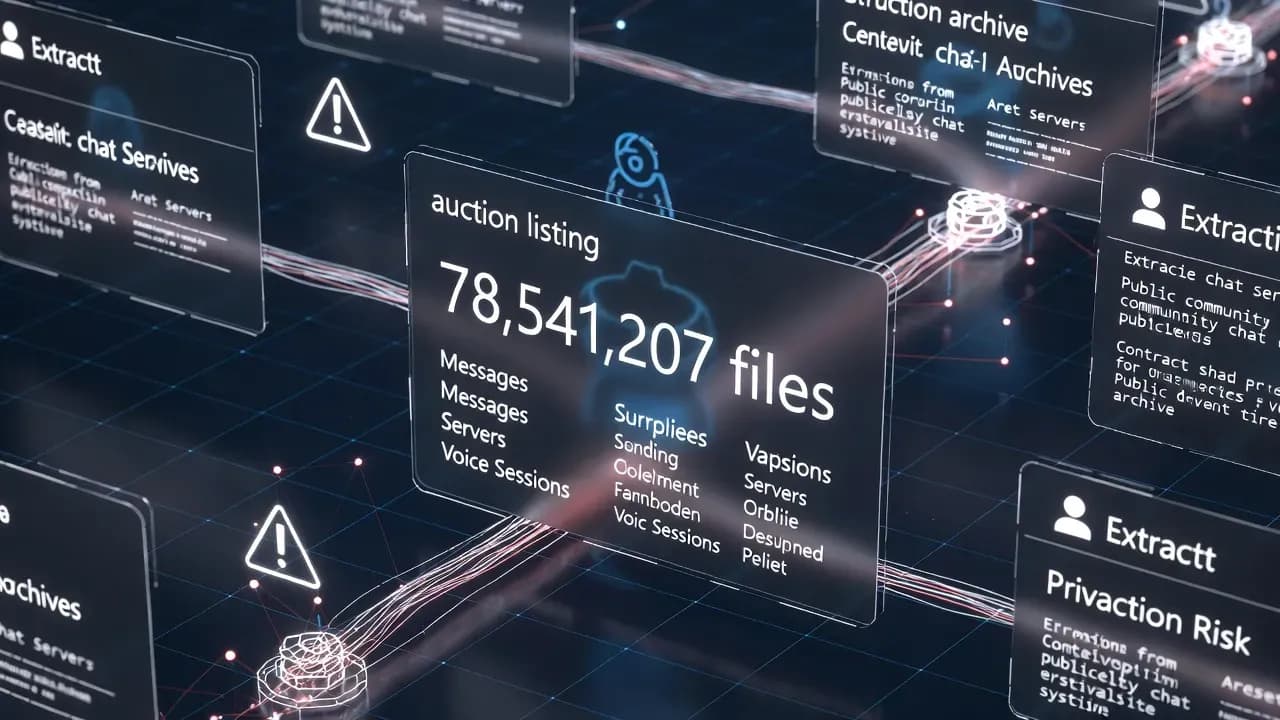
Discord "Breach" Claim Looks Like Mass Scraping: HawkSec Auctions 78,541,207-File Dataset From Public Servers
A new "Discord breach" claim circulates as HawkSec promotes an auction of 78,541,207 files. Early indicators suggest large-scale scraping of public Discord content rather than a platform compromise.

Files in HawkSec's claimed Discord dataset (unverified)
Prior public listing of scraped Discord messages from nearly 1,000 public servers
Opening: The "Discord Breach" That Probably Is Not
A new "Discord breach" claim is circulating after a threat actor known as HawkSec promoted an auction-style sale of a dataset described as 78,541,207 files. The more important question is not whether the dataset exists, but what it actually represents. Early indicators point toward large-scale scraping and aggregation of public Discord content, not a direct compromise of Discord's internal systems. That distinction matters because scraping can still create real-world harm at scale: it turns scattered public messages into searchable dossiers, enabling re-identification, harassment, targeted phishing, and long-term profiling. In practical risk terms, an "only public data" event can still become a security incident for individuals, communities, and even enterprises if employees discuss sensitive topics in public servers.
What Happened: The Technical Breakdown Behind the "78 Million Files" Claim
HawkSec's pitch is framed like a breach, but the details read like collection and packaging. The dataset is promoted as a structured archive split into categories such as messages, voice sessions, actions, and servers, allegedly originating from an abandoned OSINT or CSINT effort. That is a familiar pattern in the underground economy: a project begins as monitoring, intelligence enrichment, or "community analytics," then gets monetized once the operator realizes the dataset has resale value.
The key technical nuance is that large Discord datasets can be assembled without breaking into Discord. Public servers and channels are intentionally accessible to broad audiences, and server owners can opt into discoverability. If a collector can join or index public-facing communities at scale, they can extract content through automated tooling and API-driven workflows, then normalize it into data products designed for search, correlation, and resale. What makes the claim credible enough to take seriously is not the headline number, but the way the dataset is described: it mirrors how a scraper would model Discord at scale, collecting message objects, server identifiers, and metadata, then storing them as a file-based corpus.
This is also why you should treat the "file count" carefully. A large file total can represent many things, including chunked exports, per-channel partitions, message batches, metadata snapshots, and voice-session records that may be nothing more than logs and timestamps rather than raw audio. Without an independent sample and validation, the only defensible stance is that a dataset is claimed to exist, and that it likely relates to public server content rather than a high-impact platform compromise. The operational risk remains, but the narrative should be precise: this is best understood as commoditized aggregation of public content, not necessarily a breach of private messages, passwords, or Discord authentication systems.
Breach vs Scrape: Why the Label Matters, Even When the Harm Is Real
Security teams often dismiss scraping because it does not match the mental model of "intrusion." That is a mistake. A breach implies unauthorized access to protected systems or data. A scrape can be fully automated, performed from normal user accounts, and still produce outcomes that look like breach damage to victims. The harm comes from aggregation and indexing: content that was previously hard to search becomes instantly queryable and correlatable across servers, time periods, and identities.
There is also a second-order effect that defenders routinely underestimate: re-identification. Even if a dataset contains only public messages, those messages often include behavioral fingerprints, repeated phrases, time patterns, cross-posted links, usernames reused across platforms, and casual disclosures like employer names, project details, travel plans, and screenshots. Attackers do not need private DMs if they can stitch together identity from public traces. This is particularly relevant for minors, creators, moderators, and highly visible community members who have a higher probability of being targeted for harassment and extortion.
For enterprises, the risk is not theoretical. Public servers are common in developer, gaming, Web3, AI, open-source, and product communities. Employees routinely discuss troubleshooting, infrastructure details, vendor deployments, and roadmaps in public channels. When scraped and indexed, those discussions can become reconnaissance material. A collector does not need to compromise an endpoint if they can harvest operational context, email patterns, partner names, and internal tooling references from public conversations. The boundary between "community chat" and "information exposure" is thinner than most organizations assume.
Why This Keeps Happening: The Business Model of "Community Data Commoditization"
HawkSec's claim fits an established market dynamic: converting free public content into paid intelligence products. The model is simple. Collect at scale, organize the data into a searchable structure, then sell access or dump archives in batches. The value proposition is not the raw messages. The value is the ability to query history and connect identities across servers quickly, something that ordinary Discord UI workflows do not enable at scale.
This is also why sellers repeatedly highlight structure: "messages," "servers," "actions," "voice sessions." Buyers want datasets that can be integrated into tooling, not a chaotic dump. The more normalized the archive, the more valuable it becomes for harassment campaigns, doxxing operations, targeted phishing, and influence activity. In practice, the dataset becomes a multiplier for attackers who already have partial information about a target. If they can locate older posts, identify patterns, and extract external handles, they can move from generic phishing to tailored pretexting that feels personally plausible.
Historically, sellers also exploit confusion between scraping and breach to increase attention and price. "Discord breach" sounds more valuable than "public dataset." That framing drives urgency in social media discussions and improves the seller's bargaining position. From a defensive communications perspective, the correct approach is to de-escalate the hype while escalating the practical mitigations: treat it as a high-scale data exposure problem, even if it is not a platform compromise.
Who Is Most Exposed: Public Server Admins, Community Moderators, and High-Visibility Users
The highest-risk group is not the average Discord user. It is people who participate heavily in large public servers and those whose identity is stable over time. Moderators, creators, power-users, and community operators leave the richest trails and are most likely to be targeted for harassment, extortion, or reputational manipulation. Public server administrators are exposed because their announcements, moderation actions, and policy discussions are often discoverable and can be replayed out of context.
Users who treat Discord as a semi-private workplace space are also exposed. Some communities discuss vulnerability disclosures, bug bounty workflows, infrastructure incidents, and product issues in channels that are technically public. Even when content is not sensitive by itself, it becomes sensitive in aggregate. A single post about a vendor incident, a stack trace, or a support escalation can become a useful clue in an attacker's broader campaign.
There is also a specific exposure pattern tied to voice and event metadata. If "voice sessions" are part of the dataset in any form, even without audio, the metadata can still be used for profiling: who spends time together, when community leaders are active, and which time zones and usage patterns appear. That can support social engineering and targeted harassment, especially when combined with public profiles on other platforms.
How Organizations Can Respond: A Practical Playbook for Enterprises and Community Owners
The fastest risk reduction step is to stop treating public Discord participation as "free of consequence." If your organization has employees active in public servers, define a policy for what can and cannot be discussed. The goal is not to ban Discord, but to prevent operational leakage: internal IPs, incident details, access patterns, customer names, screenshots with sensitive UI, and roadmap information should never appear in public chat. If teams rely on Discord for work, route sensitive discussions into controlled environments where access and retention are governed.
For server owners, the priorities are discoverability, retention, and moderation discipline. Review whether your server needs to be discoverable at all. If you operate a community where people discuss sensitive topics, consider limiting public access, tightening invite controls, and restricting who can read history in certain channels. Treat long-term searchable history as a liability. Periodic cleanup of high-risk channels can reduce future exposure, even if it cannot remove what has already been scraped.
At the user level, the most effective protection is identity compartmentalization. Avoid reusing the same handle across platforms if you participate in controversial or highly targeted communities. Lock down connected accounts where possible, and assume that anything posted in a public channel can be indexed permanently. For users who are frequently targeted, consider migrating sensitive discussions to private channels with strict membership controls, and avoid sharing documents, screenshots, or personal identifiers in public threads.
Finally, prepare for abuse. Scraped datasets are typically used to power phishing and harassment waves. If you run a community, publish clear guidance for members: how moderators will contact users, where to report suspicious DMs, and what to do if someone threatens to "expose" their message history. The defensive win is to shorten attacker dwell time in the social layer, just as you would in technical incident response.
Lessons Learned: Discord's Real Breach History Shows Why Precision Matters
Discord has previously disclosed a confirmed security incident involving a third-party customer service provider, with a limited number of impacted users and specific data categories described publicly. That case is a useful contrast because it demonstrates what a breach disclosure looks like when scope, affected systems, and data types can be articulated. A scrape-driven dataset claim does not present that same evidence trail, and it should not be reported as equivalent.
The broader lesson is that community platforms have become part of the modern attack surface. Even when platforms are not compromised, public-by-design communication creates a durable intelligence stream for adversaries. The defensive response is not only technical. It is governance, user behavior, retention strategy, and clarity about what "public" actually means in an environment where everything can be copied, indexed, and resold.
Closing
The safest way to read the HawkSec claim is as a warning about scale, not a confirmation of intrusion. Public community content becomes dangerous when it is packaged into a searchable intelligence product that attackers can query in seconds. For users, that means being disciplined about what you share in public channels and separating identities when necessary. For server owners and enterprises, it means treating Discord like any other public surface: reduce discoverability where you can, tighten access to sensitive discussions, and assume anything public can be scraped and resold. Precision matters in the narrative, but urgency belongs in the mitigations.
Frequently Asked Questions
At this stage it should be treated as an unverified dataset sale claim. The description aligns more closely with large-scale scraping and aggregation of public server content rather than a compromise of Discord's internal systems. However, scraping at scale can still be harmful because it enables profiling, harassment, and targeted phishing.
Public content becomes risky when it is aggregated, indexed, and correlated across servers and time. That makes it easy to reconstruct identity, track behavior, and mine personal and operational details that were never intended to be searchable at scale. The threat is not only privacy, it is practical abuse.
The claim does not provide verifiable evidence of that. Most large Discord data-sale narratives historically revolve around public servers and public message content. Without an independent sample and validation, assume the dataset is largely public-facing content and metadata, not authentication data.
Treat Discord participation like any other public forum. Set rules for what can be discussed, prohibit sharing sensitive operational details, and route confidential support or incident discussions to controlled systems. The main risk is reconnaissance: attackers can use public conversations to plan technical intrusions.
Reassess discoverability, restrict access to high-risk channels, reduce retention of sensitive discussions, and educate members that public channels can be scraped. If your server does not need to be public, make it private and require trusted invites. Defense here is about limiting what can be collected at scale.



Comments
Want to join the discussion?
Create an account to unlock exclusive member content, save your favorite articles, and join our community of IT professionals.
New here? Create a free account to get started.