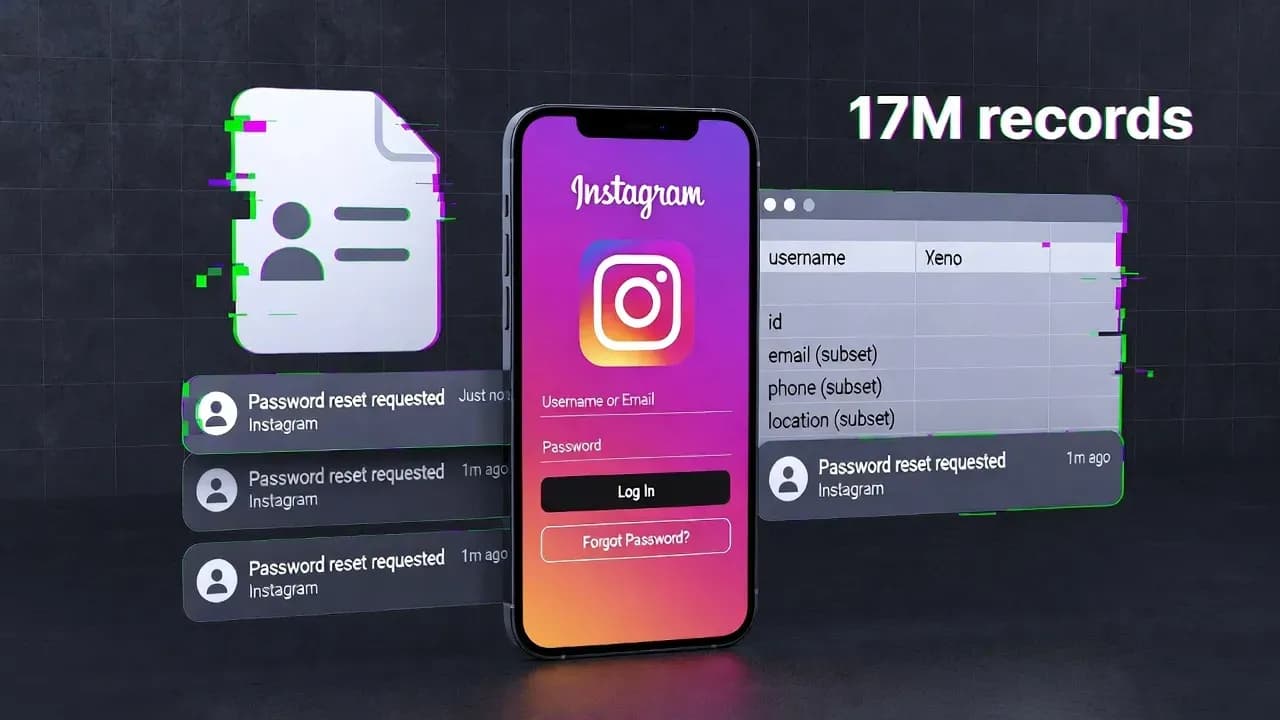
Instagram denies breach as 17M account "leak" claims collide with reset-email abuse
Instagram is pushing back on claims that its systems were breached after users worldwide reported a sudden spike in legitimate password reset emails. The timing is messy because the reset-email wave landed alongside renewed chatter about a dataset allegedly tied to roughly 17 million Instagram accounts being shared in cybercrime circles.

Records in the dataset being discussed online
Records with email addresses (per breach tracker reports)
Opening: Two Stories, One Headline
Instagram is pushing back on claims that its systems were breached after users worldwide reported a sudden spike in legitimate password reset emails. The timing is messy because the reset-email wave landed alongside renewed chatter about a dataset allegedly tied to roughly 17 million Instagram accounts being shared in cybercrime circles. For defenders and everyday users, this is exactly the kind of scenario attackers exploit: confusion, urgency, and a plausible security narrative that pressures people into clicking links and "verifying" accounts. The critical point is that two different stories are being blended into one headline, and that blending increases the risk of successful phishing and account takeovers even if Instagram's core infrastructure was not compromised. In practical terms, the security outcome depends less on what social media posts claim and more on what actions users take in the next 24 to 72 hours.
What Instagram Says Happened: Reset Emails Triggered Without a Breach
According to public reporting, Instagram says it fixed an issue that allowed an external party to trigger password reset emails for some users, and that there was no breach of its systems. That distinction matters: a flood of password reset emails can be caused by abuse of the account recovery workflow without granting the attacker access to the account itself. In other words, the email can be real and still be part of an attack pattern, because the attacker's goal might be to annoy users into taking unsafe actions, or to identify accounts that respond quickly and predictably to recovery prompts. The platform's statement also implies the vulnerability was in the reset request mechanism rather than in authentication or database integrity. Even when the underlying issue is resolved quickly, these events create fertile ground for secondary scams that mimic legitimate recovery flows.
From a threat perspective, once users start searching for answers, they are likely to click lookalike pages, fake support threads, or malicious "check if you're affected" portals. That is why a vendor statement that "accounts remain secure" does not automatically translate into lower user risk, because the highest risk period is the confusion window right after the incident goes viral. Attackers do not need to break into Instagram to profit from Instagram-themed panic; they only need to intercept users at the moment they are most likely to trust a link.
The Separate "17M Leak" Narrative: Scraping, Partial Contact Data, and Recycled Datasets
Parallel to the reset-email wave, researchers and trackers have discussed a dataset described as having around 17 million records associated with Instagram. That dataset is being characterized as scraped data, meaning collected through automated access to public or semi-public interfaces rather than extracted from a traditional internal database breach. The distinction is not a technicality: scraping can still expose real personal data at scale, but it often results in uneven coverage, partial fields, and a mix of public profile attributes plus contact details for only a subset of accounts. This matters when assessing risk because users may see headlines that imply passwords were leaked, when the dataset is more consistent with profile metadata and contact fields rather than authentication secrets.
Dataset characterized as profile metadata rather than traditional database breach
The strongest practical conclusion is that the dataset conversation and the reset-email abuse are not necessarily the same incident. One can be a workflow abuse issue in January 2026, and the other can be a dataset that originated earlier and resurfaced with new distribution. That is also consistent with how cybercrime markets work: data is frequently repackaged, rebranded, and re-released to create the appearance of novelty, especially when a public event makes people more likely to believe a "fresh breach" happened. For defenders, the right framing is "credible increased phishing risk" rather than "confirmed password compromise," unless and until the platform or a reliable breach verification source states otherwise.
Why This Is Dangerous Even If Instagram's Systems Were Not Breached
A breach denial does not end the incident from a user safety standpoint because the real-world harm often comes from second-order exploitation. When a reset-email wave becomes a trending topic, attackers get a near-perfect pretext to impersonate Instagram support, Meta security, or a "verification" service. The social engineering pattern is straightforward: a user receives unexpected reset emails, then receives a follow-up message offering help, urging immediate action, and presenting a link that looks like a legitimate Instagram domain. In this environment, users tend to lower their guard because they are primed to believe they are under attack, which makes them more likely to hand over credentials or approve a login prompt.
The alleged dataset adds another layer. If even a subset of accounts has emails or phone numbers linked to Instagram identifiers, that is enough to power highly targeted phishing campaigns, SIM swap attempts, or credential stuffing against other services where users recycle passwords. And because many people associate "Instagram hack" with account lockouts and lost access, they may be willing to respond quickly, especially creators and business accounts whose accounts have revenue impact. This is why the combination of confusion plus a plausible data narrative is one of the most effective catalysts for account takeover waves.
Practical Guidance for Users: What to Do If You Received Reset Emails
If you received password reset emails you did not request, the first priority is to avoid taking action through the email itself. The email may be legitimate, but the safest workflow is to open Instagram directly via the app or by typing the site manually, then review account security from within the platform. In the hours after a viral security story, inboxes and search results become saturated with lookalike scams, and a single click can reroute you to a phishing page that captures credentials or session tokens. The objective is to reduce your exposure to malicious intermediaries, not to "react fast" inside a crowded threat environment.
Critical window for phishing attempts following a viral security incident
A second priority is to harden authentication so that even if credentials are targeted, attackers cannot easily take over the account. Enable two-factor authentication, ideally using an authenticator app or hardware-backed method rather than SMS alone. Review your login activity, remove unknown devices, and rotate your password if it is reused elsewhere. Also check connected apps and third-party access, because account takeovers increasingly occur through compromised OAuth sessions rather than direct password theft. These steps are tedious, but they are the difference between a harmless nuisance and a real account loss when attackers scale follow-up campaigns.
Finally, treat any "support" outreach as hostile by default. If you are a brand or creator, brief your team and standardize a rule: no account actions via emailed links during an incident window, and all changes must be performed from trusted devices through official settings pages. This reduces the chances that a well-intentioned staff member becomes the attacker's entry point.
Guidance for Security Teams and Brands: How to Reduce the Blast Radius
Organizations that manage social accounts should treat this as a reminder that consumer platforms are part of the corporate attack surface. A compromised Instagram account can be used to run scams, distribute malicious links, and damage reputation quickly, especially when the brand is trusted. The immediate action is to enforce strong authentication on all social accounts and ensure recovery email addresses and phone numbers are controlled, monitored, and protected with their own MFA. Also ensure that shared credentials are eliminated; social accounts should use dedicated role-based access wherever available, with least privilege and audited admin actions.
Security teams should also anticipate phishing campaigns that use this incident as bait. Update user awareness messaging with one clear operational rule: do not click "security alert" links from emails or DMs, and instead navigate directly to the service's settings. If your organization runs phishing simulations, this is a moment to reinforce the "manual navigation" habit rather than generic advice. For high-risk executives and public-facing staff, consider extra monitoring of account changes, including profile edits, new links in bios, and new connected apps. These changes are often the first sign of takeover or preparation for fraud.
The long-term fix: adopt phishing-resistant authentication wherever Instagram supports it
The longer-term improvement is to adopt passkeys or phishing-resistant authentication wherever Instagram supports it and wherever your identity stack supports it for related accounts. The industry trend is moving away from passwords because password reset flows, credential reuse, and session theft remain reliable attacker paths. For brands, the reputational cost of one takeover often outweighs the effort required to implement stricter authentication and access governance. This incident is not unique, but it is a useful trigger to treat social accounts like business-critical assets rather than marketing accessories.
Closing
Instagram's breach denial and the reset-email fix should not be read as "nothing to see here." The real security story is how quickly attackers can turn a platform-side incident and a circulating dataset narrative into a highly effective phishing funnel. Whether the 17M dataset is new, recycled, or partially accurate, the operational risk is the same: targeted scams, account takeovers, and credential reuse exploitation will spike when users are primed to believe their accounts are compromised. The correct response is disciplined behavior and hardened authentication, not panic clicking. If you treat this moment as a reminder to enable MFA, review sessions, and reduce account recovery exposure, you will be safer even after the headlines move on.
Frequently Asked Questions
Instagram is denying a breach of its systems and says it fixed an issue that allowed an external party to trigger password reset emails for some users. That means the reset-email wave can occur without attackers accessing internal databases or taking over accounts. However, the security risk for users can still rise sharply because attackers use these moments to run phishing campaigns. The safest approach is to harden your account and avoid clicking links in incident-related emails.
Reset-email abuse creates pressure and confusion, which increases the success rate of follow-up scams. Attackers can send fake "support" messages or create lookalike portals that promise to stop the emails or secure the account. Users who are stressed by repeated alerts are more likely to take shortcuts and enter credentials on a malicious page. Even when the platform fixes the underlying abuse, the phishing wave can continue.
A dataset tied to Instagram accounts is being discussed as scraped data, meaning collected via automated access to interfaces rather than a classic database breach. Reports indicate it contains account identifiers and profile-related attributes, with email addresses and possibly phone numbers present for only a subset of records. The key risk is targeted phishing and identity correlation, not necessarily password exposure. Treat any dataset claim as a reason to increase vigilance, not as proof your password is already compromised.
Do not use links in password reset emails or DMs to "secure" your account. Open Instagram directly, review login activity, enable two-factor authentication, and change your password if it is reused anywhere else. This reduces takeover risk regardless of which narrative is accurate. It also protects you against scams that weaponize the current confusion.
Enforce strong authentication on all social accounts, eliminate shared credentials, and restrict admin access to trusted staff and devices. Monitor for sudden profile changes, new links, and new connected apps. During viral incident windows, instruct teams to avoid email-based account actions and use direct navigation into account settings. Treat your social presence as part of your security perimeter.

Comments
Want to join the discussion?
Create an account to unlock exclusive member content, save your favorite articles, and join our community of IT professionals.
New here? Create a free account to get started.