Critical jsPDF Vulnerability Lets Attackers Steal Server Files via Generated PDFs
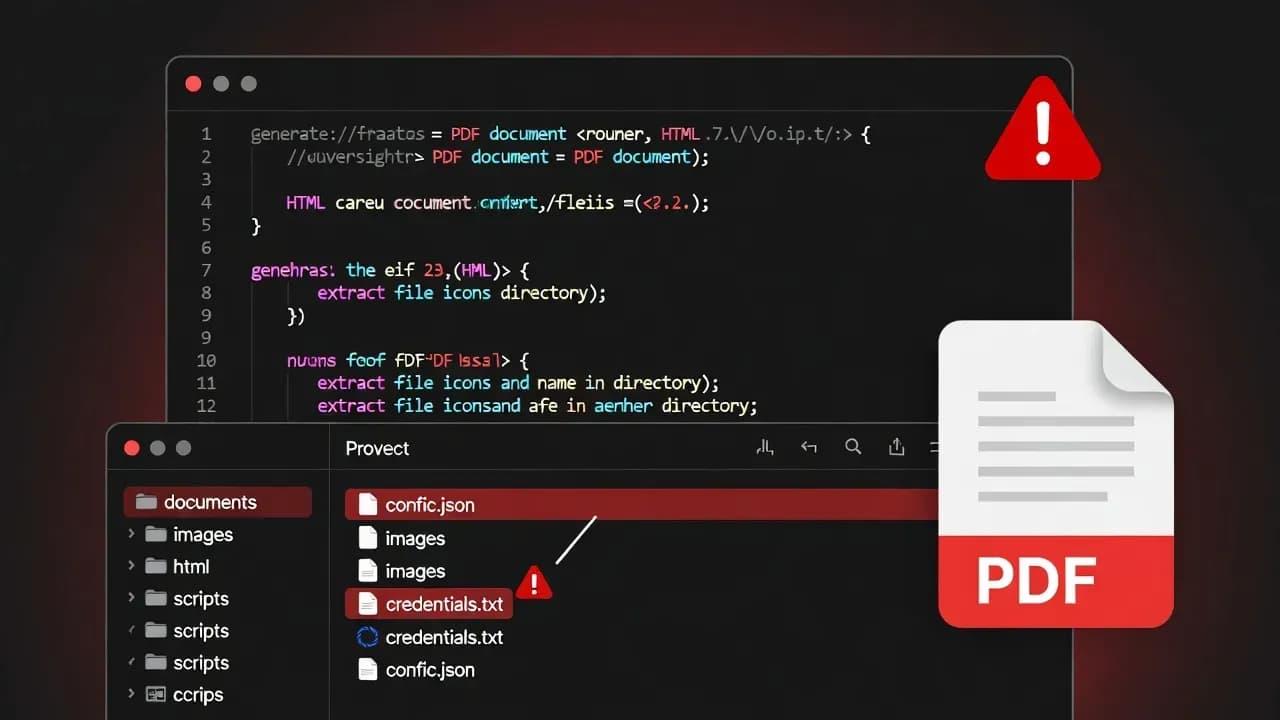
A critical path traversal flaw in the popular jsPDF library allows attackers to read arbitrary files from servers and exfiltrate sensitive data by embedding it directly into generated PDF documents. With over 3.5 million weekly downloads, the impact could be massive.

A critical security vulnerability has been discovered in jsPDF, one of the most popular JavaScript libraries for generating PDF documents. The flaw, tracked as CVE-2025-68428, allows attackers to read arbitrary files from server filesystems and exfiltrate their contents by embedding them directly into generated PDF documents.
| Vulnerability Overview | |
|---|---|
| CVE ID | CVE-2025-68428 |
| CVSS Score | 9.2 (Critical) |
| Weekly Downloads | 3.5 million+ |
| Affected Builds | Node.js only |
| Fixed Version | 4.0.0 |
With over 3.5 million weekly downloads on npm, jsPDF is widely deployed across enterprise applications, SaaS platforms, and developer projects worldwide. Organizations using the Node.js build of this library should update immediately.
How the Attack Works
The vulnerability stems from insufficient input validation in the loadFile method within jsPDF's Node.js builds. When user-controlled input is passed as a file path argument, the library reads the specified file from disk and incorporates its contents verbatim into the generated PDF output.
Security researchers at Endor Labs, who published a detailed technical analysis, explain that multiple methods are affected beyond loadFile:
| Affected Methods | Internal Behavior |
|---|---|
addImage | Calls vulnerable loadFile |
html | Calls vulnerable loadFile |
addFont | Calls vulnerable loadFile |
All of these methods internally call the vulnerable loadFile function, meaning any unsanitized path passed to them becomes an attack vector.
Proof of Concept: A simple exploitation demonstrates the severity:
import { jsPDF } from "./dist/jspdf.node.js";
const doc = new jsPDF();
doc.addImage("../../../etc/passwd", "JPEG", 0, 0, 10, 10);
doc.save("output.pdf");
// The generated PDF now contains the server's /etc/passwd file
The file type parameter (e.g., "JPEG") does not prevent non-image files from being read. The library reads whatever file path is provided and embeds the raw content. Path traversal sequences like ../ allow attackers to navigate outside the intended directory.
What's at Risk
Successful exploitation could expose any file readable by the Node.js process:
| Exposed Data Type | Impact |
|---|---|
| Configuration files | Database credentials exposed |
| Environment variables | API keys and secrets leaked |
| Application source code | Intellectual property theft |
| Private keys/certificates | Complete system compromise |
| System files | /etc/passwd, /etc/shadow access |
Stealth Exfiltration: The attack is particularly dangerous because the stolen data is exfiltrated through normal application output - the generated PDF itself. This makes detection challenging since no anomalous network connections are required.
Who Is Affected
Only the Node.js builds of jsPDF are vulnerable:
dist/jspdf.node.jsdist/jspdf.node.min.js
Browser-based implementations are not affected because browsers enforce strict sandbox policies that prevent JavaScript from directly accessing the local filesystem.
However, the vulnerability becomes exploitable in any scenario where:
- User-controlled input reaches the affected methods
- File paths are not explicitly sanitized
- No allowlist restricts which files can be loaded
Patch and Mitigation
The vulnerability has been fixed in jsPDF version 4.0.0, released on January 3, 2026. This version restricts filesystem access by default and relies on Node.js permission mode for additional protection.
Immediate Actions Required
| Priority | Action |
|---|---|
| Critical | Update to jsPDF 4.0.0 immediately |
| High | Audit all user input reaching affected methods |
| Medium | Implement input validation as defense-in-depth |
| Recommended | Enable Node.js permission mode in production |
For environments that cannot immediately upgrade, the following mitigations are recommended:
For Node.js v22.13.0+ / v23.5.0+ / v24.0.0+:
node --permission --allow-fs-read=/app/allowed-directory app.js
Warning: Endor Labs cautions that the
--permissionflag affects the entire Node.js process, not just jsPDF. Additionally, overly broad filesystem permissions in the--allow-fs-readconfiguration can negate the fix entirely.
For older Node.js versions: Rigorously sanitize all user-provided file paths before passing them to jsPDF functions. Implement strict allowlists for permitted files.
Security Recommendations
Organizations using jsPDF in Node.js environments should take immediate action:
| Step | Description | Priority |
|---|---|---|
| 1 | Audit immediately - determine if affected versions are in use | Critical |
| 2 | Update to version 4.0.0 - patch as soon as possible | Critical |
| 3 | Review code - check for user-controlled input reaching affected methods | High |
| 4 | Implement input validation - defense-in-depth regardless of version | High |
| 5 | Enable permission mode - for Node.js production deployments | Medium |
Credit
The vulnerability was discovered and responsibly disclosed by security researcher Kwangwoon Kim (kilkat). The jsPDF maintainers at Parallax delivered a prompt fix following the disclosure.
Bottom Line: Given jsPDF's widespread adoption and the CVSS 9.2 critical severity rating, CVE-2025-68428 is a strong candidate for active exploitation. Security teams should prioritize this patch immediately.



Comments
Want to join the discussion?
Create an account to unlock exclusive member content, save your favorite articles, and join our community of IT professionals.
New here? Create a free account to get started.