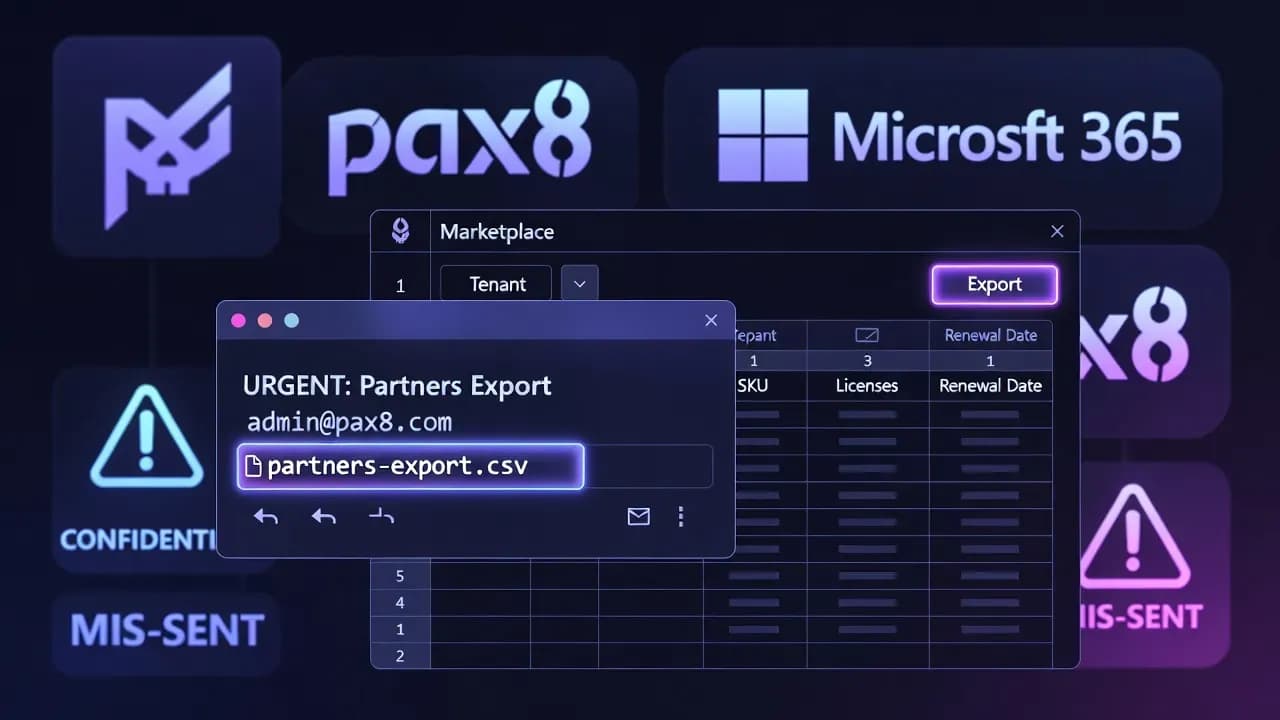
Pax8 accidentally exposed MSP customer and licensing data after spreadsheet was emailed to partners
Pax8 disclosed that an internal email mistake resulted in a spreadsheet containing MSP partner business information being sent to unintended recipients. The data included Microsoft licensing telemetry and renewal dates, creating competitive intelligence and phishing risks across the UK MSP community.

Incident date reported by Pax8 community statement
Email recipients (UK-based partners)
Approximate number of partners referenced in exposure
Opening: why licensing telemetry is breach-grade sensitive
For managed service providers, few data sets are as commercially sensitive as the one that maps customers to Microsoft SKUs, license counts, and renewal timing. It is the blueprint of an MSP's revenue stream, its customer portfolio, and its near-term renewal pipeline. This week, cloud marketplace distributor Pax8 disclosed that an internal email mistake resulted in a spreadsheet being sent to a limited number of partners, triggering concern across the UK MSP community about competitive intelligence exposure and downstream phishing risk.
This incident is not being described as a criminal intrusion. That distinction matters, because "no hackers involved" can unintentionally downplay the real impact. Data exposures caused by internal process failures are often harder to contain: the data leaves through legitimate channels, recipients may already be trusted partners, and there is no malware signature or exploited vulnerability to anchor an investigation. For security leaders in the channel ecosystem, the core lesson is straightforward: partner operations data has become breach-grade sensitive, even when it does not contain classical personally identifiable information.
What happened: confirmed facts and likely mechanics
Based on Pax8's public-facing communication shared by the MSP community, the event began on January 13, 2026, when a Pax8 employee mistakenly sent an email with an attached spreadsheet to fewer than 40 UK-based partners. In a statement posted in the MSP community, Pax8 characterized the attachment as not containing personally identifiable information, while still acknowledging it included limited internal partner business information used to support partner operations and aspects of a vendor program. The company stated it notified impacted partners and launched an internal review intended to prevent recurrence.
Those lines point to a familiar failure mode in SaaS operations: a report export or business operations file that exists for legitimate internal use, but lacks adequate controls to prevent accidental external distribution. In MSP distribution, these spreadsheets are often generated to support pricing programs, incentives, renewal optimization, or licensing portfolio management. The operational reality is that such exports are frequently handled in productivity tooling: email, spreadsheets, shared drives, and chat. That is precisely the tooling where human error can bypass the technical controls security teams expect to work.
Even when the recipient list is small, the risk surface expands quickly. A single forwarded email, a misconfigured shared link, or a mailbox compromise on the recipient side can move the file beyond the intended audience. That is why internal governance for "exportable partner telemetry" needs to be designed as if every export could become public within hours.
What data was exposed and why "non-PII" still matters
The MSP community discussion and incident summaries indicate the leaked spreadsheet contained partner-relevant operational data tied to Microsoft licensing and customer footprints, with scope impacting roughly 1,800 MSP partners. That category of information is commercially sensitive in ways that can exceed the impact of many typical PII leaks.
Three attributes make this type of dataset especially high-risk:
First, it is structured and actionable. A list of "tenant name + SKU + quantity + renewal date" can be operationalized immediately for competitive targeting or social engineering. There is no need to clean or enrich it the way criminals must with raw email dumps.
Second, it is time-bound. Renewal dates create urgency. If an attacker knows a renewal window, they can craft high-conviction messages that align perfectly with expected operational events: billing adjustments, licensing true-ups, or "service renewal confirmation." That timing alignment is what converts phishing from suspicious to plausible.
Third, it reveals relationship topology. Even without individual names, it can expose which MSP manages which customer, what the customer likely uses (for example, security add-ons versus basic subscriptions), and what their licensing posture suggests about size and maturity. For threat actors, that becomes targeting intelligence. For competitors, it becomes a client acquisition roadmap.
The "no PII" framing is therefore insufficient as a risk descriptor. Many of the most damaging incidents in B2B ecosystems involve commercially sensitive data, operational metadata, and relationship mapping rather than consumer identity data. In the channel, customer lists and renewal intelligence are business-critical assets.
Why MSPs are reacting strongly: real-world exploitation scenarios
MSPs do not need to assume malice from recipients to treat this as a serious event. The data itself creates pressure and incentives.
Competitive targeting and client poaching
If an MSP's customer portfolio and renewal schedule becomes visible to others in the same market, competitors can time outreach around renewal or commitment inflection points. The risk is not hypothetical: renewal timing is a core lever in the Microsoft licensing ecosystem, particularly under New Commerce Experience (NCE), where terms, renewal windows, and cancellation rules create predictable customer conversations. Pax8 itself provides tooling and guidance around NCE renewal tracking, which underscores how operationally valuable this data is in normal circumstances.
High-conviction phishing and invoice fraud
Threat actors do not need a password if they can convince finance teams to pay a fraudulent invoice or update bank details. Licensing and renewal metadata enables "context-rich" business email compromise tactics: messages that reference correct product names, plausible seat counts, and exact renewal windows. That dramatically increases conversion rates compared to generic phishing.
Tenant targeting and credential harvesting
License footprints can indicate what identity surface exists. For example, organizations using certain Microsoft security or identity SKUs may have different authentication controls than those that do not. Attackers can tailor lures accordingly. Even if the dataset is "only organizational," it can steer attackers to the right login portals, help them pick believable pretexts, and prioritize targets by perceived value.
What Pax8's response signals, and what remains unknown
Pax8 stated it notified impacted partners and initiated an internal review. That is a baseline requirement, but partners will reasonably seek more clarity on containment and verifiability, including whether confirmations of deletion were obtained and whether any external disclosure occurred beyond the initial recipients.
From a governance standpoint, there are several questions that typically determine whether these incidents remain reputational issues or become long-term trust failures:
- Whether the export was generated on demand or was a standing report
- Whether the export contained data-minimized fields, or included "everything because it was easier"
- Whether distribution controls were enforced at the time of sending (for example, DLP policies, external recipient warnings, or approval gates)
- Whether the incident triggered a broader review of how partner intelligence is stored, exported, and audited
Even if no additional dissemination is proven, MSPs will likely treat this as an assumption breach: information that was expected to be compartmentalized by partner is now assumed capable of cross-partner exposure.
What MSPs should do now: containment, comms, and hardening
This is a scenario where "no action required" is rarely the right operational guidance for recipients of impact. MSPs should consider at least five practical steps.
First, assume customers may be targeted. You do not need to alarm them, but you should prime your support and finance teams to watch for renewal-themed lures, suspicious license change requests, and invoice update attempts. The value of this step is speed: you want frontline staff to recognize an attack pattern before money or credentials are lost.
Second, tighten verification on licensing and billing changes. Implement a mandatory out-of-band confirmation process for bank detail changes, reseller-of-record changes, and licensing renewal approvals. If you already have controls, temporarily raise scrutiny during renewal-heavy windows.
Third, review exposure points inside your own organization. Even if the original leak was on a distributor's side, threat actors can chain events. If they know your customer list and renewal windows, they may target your service desk, your finance mailbox, or your account managers. Restrict who can export client lists from PSA, documentation platforms, and tenant management portals.
Fourth, document the incident for your risk register. This is supply chain risk in practice. MSPs selling governance and security services should treat distributor data handling as a vendor risk control objective, with measurable requirements.
Fifth, request specifics through the proper channel. MSPs affected by the dataset will want concrete confirmation: whether their customers were included, what fields were in the export, and what steps were taken to prevent redistribution. That information is necessary to calibrate customer communications and internal monitoring.
How distributors and marketplaces prevent "export-by-accident" incidents
The defensive playbook is not exotic. It is mostly about treating operational exports as regulated assets.
Data minimization and segmentation by design
If a report is meant to serve a single partner, the system should generate that view per partner, not as a multi-partner dump that later relies on correct filtering and correct distribution. Where multi-partner reports are unavoidable, implement row-level encryption or tokenization that makes the data unusable outside the intended access context.
Eliminate spreadsheet workflows for sensitive partner telemetry
Spreadsheets are convenient but they are also frictionless exfiltration. Replace email attachments with controlled portals that enforce authentication, authorization, and audit logs. If partners require exports, provide scoped exports that are generated per partner and expire quickly.
Enforce outbound controls where mistakes happen
Email DLP policies are often tuned for PII and payment card data, not for "customer list + licensing footprint." This incident is a clear example of why DLP needs business context classifiers: Microsoft SKUs, tenant identifiers, renewal date columns, pricing fields, and partner identifiers should be treated as sensitive patterns. If a file matches those patterns and recipients are external, the email should be blocked or require elevated approval.
Add friction for mass export operations
A marketplace that can export partner-impacting reports should log exports as security events and apply rate limits and human-in-the-loop gates for large exports. "Can export" is not the same as "should export." High-volume exports should be rare and should always be explainable.
Prove containment with auditability
When an incident occurs, affected partners want verifiable evidence of containment actions. That requires audit logs for report generation, download, and distribution, plus an operational process for recipient confirmations that can be evidenced later.
Key numbers
| Metric | Value | Severity |
|---|---|---|
| Incident date reported by Pax8 community statement | January 13, 2026 | normal |
| Email recipients (reported) | Fewer than 40 UK-based partners | warning |
| Approximate number of partners referenced in incident summaries | ~1,800 | high |
| Data category described by Pax8 statement | Internal partner business information; vendor program aspects | warning |
| Why renewal metadata is sensitive | Renewal timing is explicitly managed as an operational control point in NCE tooling | normal |
FAQ
Was this a cyberattack or an internal mistake?
The available statements describe it as an internal error: an email was sent with a spreadsheet attachment to unintended recipients. That does not reduce severity, but it changes the investigative focus from exploited vulnerabilities to governance, controls, and auditability.
If there was no PII, why is the impact still serious?
Because licensing footprints and renewal dates are commercially sensitive and operationally actionable. They can be used for competitive targeting, fraud, and highly convincing phishing that aligns with real renewal events.
What is the biggest immediate risk to end customers?
The most likely near-term risk is social engineering: invoice fraud, renewal-themed phishing, and support impersonation. Security teams should prioritize verification controls around billing changes and license modifications.
How can MSPs reduce exposure to renewal-themed fraud?
Implement out-of-band verification for financial changes, require explicit approvals for reseller-of-record or subscription changes, and train finance and support staff to treat renewal-timed messages as higher risk. Where possible, centralize licensing operations to reduce ad hoc handling.
What controls should distributors add to prevent repeats?
Minimize sensitive exports, generate per-partner scoped views, move away from email attachments, and enforce DLP patterns for business-sensitive channel data. Large exports should require approval and produce audit trails that can be provided to affected partners.
Affected organizations
| Organization Type | Impact | Industry | Severity |
|---|---|---|---|
| Pax8 (cloud marketplace / distributor) | Accidental disclosure of partner business information and Microsoft licensing telemetry; trust and governance impact across partner ecosystem | Cloud distribution / channel | high |
| MSP partners referenced in the spreadsheet | Potential exposure of customer portfolios, licensing footprints, and renewal intelligence; increased risk of competitive targeting and phishing | Managed services | high |
| End-customer organizations tied to the licensing data | Elevated risk of renewal-themed phishing, invoice fraud, and impersonation campaigns aligned to real subscription events | Cross-industry | medium |
Closing
This Pax8 incident should be treated as a modern channel-security case study: not an exploited zero-day, but a governance failure that exposed operational intelligence with direct business and security consequences. In ecosystems where licensing telemetry and renewal schedules drive revenue, those datasets deserve breach-grade protections even when they do not contain traditional PII. For MSPs, the practical response is to harden renewal and billing workflows against impersonation and to demand stronger auditability from suppliers. For distributors and marketplaces, the takeaway is equally clear: if a spreadsheet export can map the channel, it must be controlled like a security boundary.
Frequently Asked Questions
The accidentally shared spreadsheet contained MSP customer names, licensing information, access control configurations, and potentially sensitive business data. The exposure affected multiple MSP partners who had shared their customer data with Pax8 as part of normal business operations.
An internal spreadsheet containing aggregated MSP customer data was inadvertently attached to an email sent to Pax8 partners. This type of incident typically occurs due to human error during routine communications when employees accidentally attach the wrong file or send to an incorrect distribution list.
Affected MSPs should review the notification from Pax8 to understand exactly what data was exposed. They should assess whether customer notification is required under applicable data protection regulations, monitor for any suspicious activity related to exposed accounts, and consider whether access credentials or configurations need to be rotated as a precaution.



Comments
Want to join the discussion?
Create an account to unlock exclusive member content, save your favorite articles, and join our community of IT professionals.
New here? Create a free account to get started.