PHALT#BLYX: Fake Booking.com Emails and ClickFix BSoD Trap Deploy DCRat Malware on Hotel Systems
Threat actors are weaponizing fake Booking.com reservation cancellations and simulated Blue Screen of Death errors to trick hotel staff into executing malicious PowerShell commands. The PHALT#BLYX campaign deploys DCRat through an innovative ClickFix social engineering technique that bypasses traditional security controls.

Campaign first identified by Securonix researchers targeting hospitality industry across Europe
Security researchers at Securonix have identified a sophisticated attack campaign specifically engineered to compromise hotel computer systems across Europe. Dubbed PHALT#BLYX, the operation combines convincing Booking.com impersonation with an innovative social engineering technique that manipulates victims into infecting their own machines.
From Reservation Cancellation to System Compromise
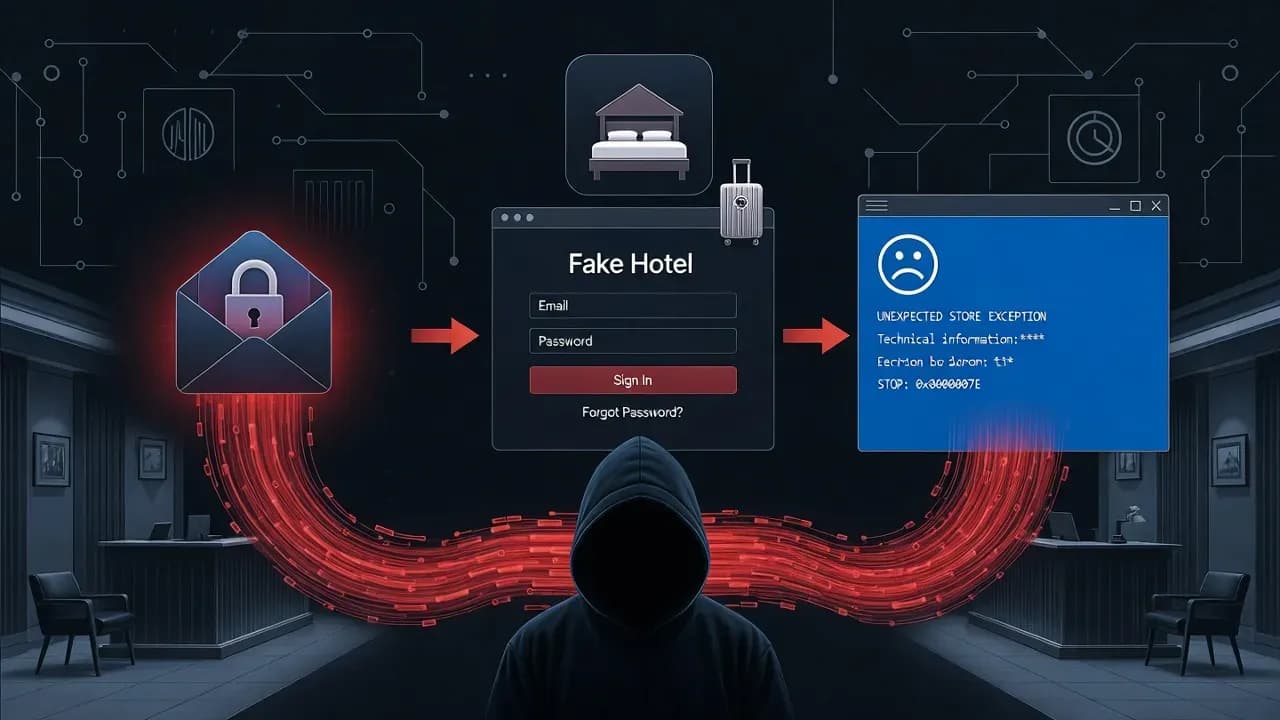
The infection sequence begins with carefully crafted phishing emails mimicking official Booking.com communications. Recipients receive urgent notifications about unexpected reservation cancellations, complete with links to "confirm" the customer's request.
Clicking the embedded link redirects victims to fraudulent domains hosting pixel-perfect replicas of Booking.com's interface. However, instead of legitimate booking management, users encounter a fake CAPTCHA verification followed by a refresh button. Selecting this button triggers the campaign's signature element: a convincing Blue Screen of Death that appears to indicate a critical system failure.
Weaponizing User Trust Through Fake Recovery Instructions
Here the attack diverges from traditional malware delivery. Rather than attempting downloads that antivirus solutions might intercept, the fake BSoD presents "recovery instructions" that victims are encouraged to follow manually.
Files downloaded through traditional means - victims execute commands manually, evading download-based security controls
Users are guided to open the Windows Run dialog, paste a specific command, and press Enter. This technique exploits the fundamental trust users place in troubleshooting procedures. The psychological manipulation proves remarkably effective - victims believe they're fixing a computer problem when they're actually executing malicious PowerShell code.
To maintain the deception, the script simultaneously opens the legitimate Booking.com administration portal in the default browser, creating a convincing distraction while background processes establish persistence.
Living Off the Land with MSBuild
Once the victim executes the initial PowerShell command, the attack leverages legitimate Windows tools to avoid detection. The dropper downloads an MSBuild project file from attacker-controlled infrastructure, then executes it through Microsoft's own build utility.
Persistence methods employed: Defender exclusions, startup folder, and UAC spam fallback when standard privileges are insufficient
When standard privileges limit the malware's options, it doesn't simply fail. Instead, it initiates a UAC spam attack, repeatedly prompting users for elevated permissions until frustration or confusion leads them to click "Yes."
A Full-Featured Remote Access Trojan
DCRat provides attackers with comprehensive control over compromised systems. Core functionality includes keystroke logging to capture credentials and sensitive data, arbitrary command execution for flexible post-compromise operations, and modular architecture supporting deployment of additional payloads.
While definitive attribution remains elusive, linguistic analysis of the campaign's MSBuild project files reveals Russian-language artifacts, suggesting potential ties to Russian-speaking threat actors with established DCRat expertise.
Protecting Hospitality Operations
Organizations in the hospitality sector should implement multi-layered defenses against this attack pattern:
Staff Training
- Awareness of ClickFix techniques
- Never execute commands from external sources
- Verify booking issues through official channels
Technical Controls
- PowerShell execution policies restricting unauthorized scripts
- Application whitelisting preventing MSBuild abuse
- Email filtering for Booking.com impersonation
Given the campaign's reliance on social engineering, security awareness programs should specifically address the psychological manipulation tactics employed - the artificial urgency, the fake system errors, and the false recovery procedures that make ClickFix attacks so effective.
Frequently Asked Questions
ClickFix is a social engineering method where attackers trick users into manually executing malicious commands by presenting fake error messages with 'recovery instructions.' This bypasses traditional security controls that block malicious downloads, since the victim initiates the attack themselves.
Hotels represent high-value targets due to their handling of sensitive guest data, payment information, and the time-sensitive nature of booking operations. Staff accustomed to handling urgent reservation requests may be more susceptible to phishing lures emphasizing cancellation urgency.
The malware creates exclusion rules in Microsoft Defender before deploying its main payload, effectively blinding the security solution to its presence. It also adds itself to the Windows startup folder and can spam UAC prompts to pressure users into granting elevated privileges.
Researchers identified Russian-language strings within the MSBuild project files used during the attack chain. Additionally, DCRat has historically been associated with Russian-speaking cybercriminal communities.

Comments
Want to join the discussion?
Create an account to unlock exclusive member content, save your favorite articles, and join our community of IT professionals.
New here? Create a free account to get started.