SHADOW#REACTOR Remcos RAT Malware Campaign Abuses Text-Only Stagers and MSBuild.exe for Stealthy Remote Access
SHADOW#REACTOR delivers Remcos RAT through a multi-stage chain using text-only stagers, PowerShell reconstruction, and MSBuild.exe LOLBin abuse. The delivery framework—not the payload—is the real risk, as it compresses detection windows and makes early triage harder.

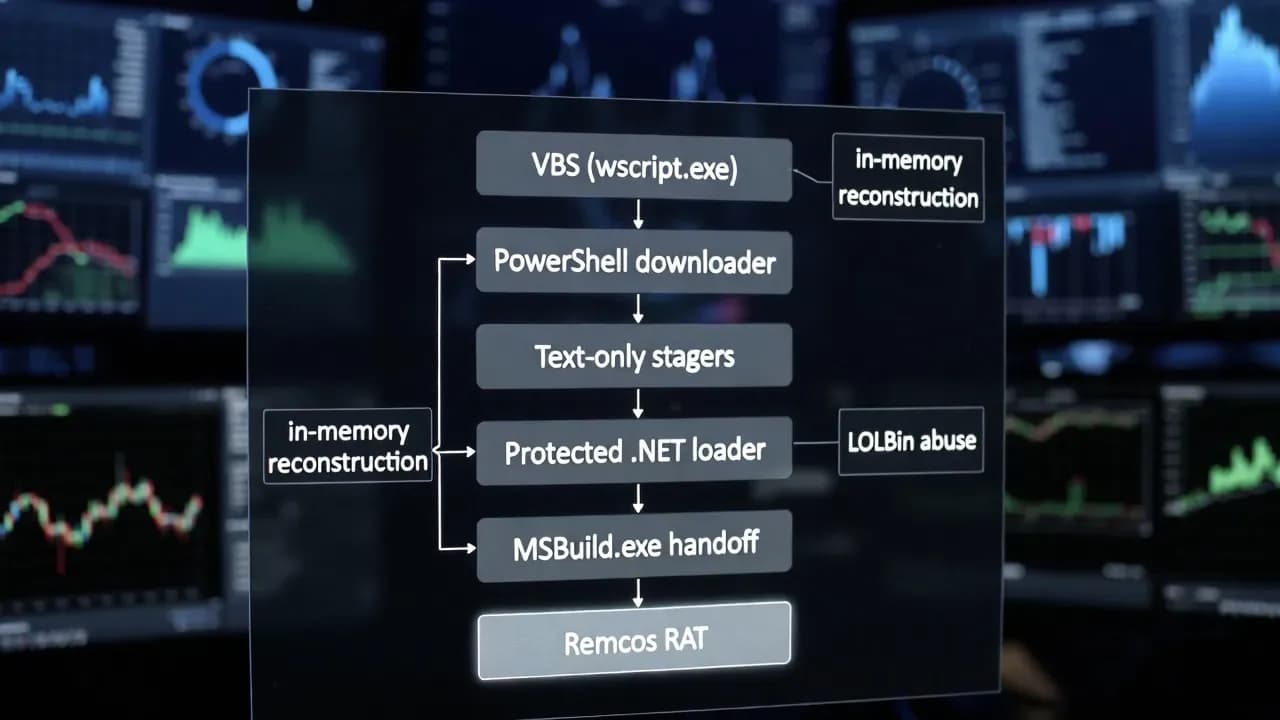
A newly documented Remcos RAT malware campaign, tracked as SHADOW#REACTOR, highlights a practical reality defenders keep relearning: you do not need a zero-day to get durable control of Windows endpoints if you can reliably execute scripts and hide your payload in plain sight. The campaign's value is not the final implant, since Remcos is a commercially available remote administration tool frequently repurposed for malicious access. The real risk is the delivery framework: text-only staging files, in-memory reconstruction, and trusted Windows binaries such as MSBuild.exe used to complete execution. For organizations, that combination compresses detection windows and makes early triage harder, especially when the first visible "malware" artifacts look like scripts, temporary text files, and legitimate processes rather than a conventional dropper.
What Happened: SHADOW#REACTOR Remcos RAT malware campaign delivery chain
SHADOW#REACTOR is a multi-stage Windows infection chain designed to deliver Remcos RAT while minimizing the static indicators that commodity security controls often rely on. The execution path begins with an obfuscated Visual Basic script that runs under wscript.exe and functions as a lightweight launcher. From there, PowerShell takes over, pulling down additional content and writing an intermediate text payload into the user's temporary directory. At face value, that can look like routine script activity or harmless staging, which is precisely the point. The campaign uses fragmentation and reconstruction to keep the next-stage loader from appearing as a clean, single-file malware specimen that can be trivially hashed, detonated, or signatured.
A notable engineering choice is resilience. The PowerShell stager includes logic that repeatedly checks whether the downloaded text payload meets a minimum size threshold and re-downloads the content if it appears incomplete. This "self-healing" loop is operationally important because it reduces the failure rate that defenders often depend on when blocking infrastructure or interrupting staging. If the download is partial or corrupted, the chain does not necessarily break, it tries again until the payload integrity conditions are met or a maximum wait behavior is reached. The practical result is that defenders may see repeated, low-volume fetches that look like benign retries rather than a single, obvious malware retrieval event.
Technical Breakdown: text-only stagers, PowerShell reconstruction, and a protected .NET loader
The campaign's most distinctive element is its use of text-only intermediates as carriers for encoded or obfuscated payload fragments. Instead of downloading a straightforward DLL or EXE, the stager retrieves text files that contain encoded content, reconstructs loaders in memory, and then hands off execution to a protected .NET component. This approach complicates several common defensive workflows at once. Static scanning of the on-disk artifacts is less effective because the files are not obviously executable. Automated sandboxing can misclassify the activity if the chain requires multiple dependent retrievals, reconstruction steps, and environment checks. Even experienced responders can lose time because the visible artifacts feel one step removed from the actual payload.
The protected loader layer is equally deliberate. The reporting describes a .NET Reactor protected assembly that performs decoding and reflective loading to progress the chain without presenting defenders with a clean loader binary. This type of packaging is a time tax on analysts and, more importantly, it is a control-evasion tactic. Many environments still treat suspicious PowerShell as the "main event" and do not systematically correlate script execution with .NET in-memory behavior, temporary file reconstitution, and build-tool execution. SHADOW#REACTOR is designed to exploit that gap: it looks like scripting until it is already too late, then it pivots into a trusted execution context to stage Remcos with a configuration retrieved from remote infrastructure.
Defense Evasion and Persistence: MSBuild.exe LOLBin abuse and repeated re-launch logic
A central late-stage technique in this Remcos RAT malware campaign is the use of MSBuild.exe as a living-off-the-land binary (LOLBin) to complete execution. From an attacker's perspective, this is a high-leverage move. MSBuild is legitimate, widely deployed, and capable of executing project logic that can be abused as an execution wrapper. When the final payload is launched through a trusted Microsoft process, some endpoint defenses and alert triage workflows treat the event as lower priority than an unknown binary running from a user-writable directory. This does not guarantee evasion, but it increases the odds that the alert is delayed, downgraded, or misrouted.
The chain also drops helper scripts intended to re-trigger execution, effectively giving the attacker a way to re-launch the initial script path and maintain continuity. This is a pragmatic form of persistence that fits the campaign's theme: do not introduce exotic mechanisms if you can rely on common scripting hosts and repeatable execution flows. For defenders, that means incident response has to go beyond "remove the final payload." If the environment still allows the same script hosts, the same staged files, and the same LOLBin execution surfaces, re-infection becomes trivial. The operational posture should treat the infection as a loader framework intrusion, not a single Remcos sample, because the loader is the durable capability the attacker can update and reuse.
Targeting and Likely Motivation: broad enterprise and SMB exposure with access-broker economics
Public reporting assesses SHADOW#REACTOR as broad and opportunistic, with a focus on enterprise and small-to-medium business environments. That targeting profile is consistent with a financially motivated ecosystem where initial access is a commodity. In that model, the actor who builds a reliable initial chain and implants remote access does not need to run the entire operation end to end. They can obtain footholds and monetize by selling access, leasing infected hosts, or enabling follow-on fraud. The design decisions in this campaign—including resilience loops, text-only stagers, and trusted-binary execution—align with the priorities of scale and repeatability rather than bespoke targeting.
Remcos itself fits that business logic. As documented in public frameworks, Remcos is marketed as a remote control and surveillance tool for Windows and has been observed in malware campaigns over time. For criminals, that means a mature feature set that supports interactive control, data theft, and operational flexibility without building a custom RAT from scratch. In real intrusions, that can translate into credential harvesting, lateral movement preparation, data staging, or simply maintaining a covert remote foothold until the access is sold onward. The core risk for defenders is that a Remcos deployment is rarely the final objective. It is often a capability layer that enables whatever comes next—from ransomware affiliate access to financial theft and business email compromise style follow-on operations.
How Organizations Should Respond: containment priorities and investigation workflow
When a multi-stage Remcos RAT malware campaign is suspected, response should prioritize breaking the chain at the earliest controllable point and validating that no re-launch mechanisms remain. Immediate containment should focus on isolating affected hosts, then preserving telemetry that captures script execution and parent-child process chains.
Critical process relationships to investigate:
wscript.exespawning PowerShell- PowerShell writing or reconstructing payload material under user temp paths
MSBuild.exeexecuting in contexts where developer build activity is not expected
Organizations that only collect high-level EDR alerts may miss the connective tissue that reveals how the infection progressed. A disciplined approach is to build a timeline from process creation events, command line logging, and script block logging, then pivot into file creation and network connection evidence that correlates to the staging server and subsequent retrievals.
Key principle: Eradication should treat the loader framework as the threat, not only Remcos. Removing the final payload without removing the staged scripts and execution wrappers leaves the environment exposed to re-deployment.
Practically, responders should search for the named staging artifacts reported publicly, examine scheduled or repeated execution triggers that re-run scripts, and verify that MSBuild is not being invoked from unusual paths or with suspicious project files. Finally, because the activity is assessed as opportunistic and unattributed, defenders should assume that any foothold could be resold or reused. That means validating privileged accounts, checking for credential exposure, and reviewing whether lateral movement preparation occurred—even if the observed payload is "only" a RAT.
Prevention and Detection Strategies: reduce scripting exposure, constrain LOLBins, and hunt the right pivots
The most defensible posture against SHADOW#REACTOR-style tradecraft is to reduce the number of allowed execution paths that turn user interaction into scripted code execution. Many environments still allow unrestricted Windows Script Host and broadly permissive PowerShell execution, especially on endpoints outside strict application control policies. That is a strategic weakness because these campaigns are built to look like scripting until the final stage.
High-impact controls to evaluate:
| Control | Impact |
|---|---|
Block wscript.exe and cscript.exe on non-admin endpoints | Eliminates VBS-based initial access |
| Enforce PowerShell Constrained Language Mode | Limits inline encoded command execution |
| Centralize script block logging | Enables detection of reconstruction behavior |
| Monitor MSBuild.exe on non-developer systems | High signal-to-noise for LOLBin abuse |
| Application allowlisting for temp directories | Blocks staged payload execution |
Key detection pivots:
- Script hosts launching PowerShell with large base64 content
- PowerShell repeatedly downloading text-based payloads into temp directories
- .NET execution patterns that imply reflective loading
MSBuild.exeusage on systems that are not developer workstations or build servers
In many organizations, MSBuild execution on ordinary user endpoints is rare enough to be a meaningful signal, especially if the parent process chain traces back to a scripting host rather than a legitimate build workflow. The strategic objective is to collapse the attacker's "looks normal" cover story by correlating the sequence: script execution → reconstruction → protected loader behavior → trusted binary handoff. SHADOW#REACTOR is effective because each component can look plausible in isolation. The defender advantage comes from joining the dots across stages.
Closing Analysis
SHADOW#REACTOR is a useful case study because it shows how commodity malware outcomes can be delivered through delivery engineering that feels uncomfortably modern. The Remcos RAT payload is familiar, but the text-only staging pipeline, protected loader behavior, and MSBuild.exe execution emphasize an attacker priority: keep defenders looking at scripts and temporary artifacts while the real capability is assembled in memory.
For security teams, the most practical takeaway is to treat scripting surfaces and LOLBins as first-class attack surfaces—not edge cases. The organizations that reduce unnecessary script host exposure, monitor high-risk parent-child chains, and constrain build tooling execution on endpoints will be better positioned to detect and disrupt the next Remcos RAT malware campaign iteration before it becomes a durable foothold.
Frequently Asked Questions
The distinguishing factor is the delivery framework, not the final payload. The chain uses text-only staging, in-memory reconstruction, and a protected .NET loader, then hands off execution to MSBuild.exe. That combination reduces static indicators and can slow down triage.
MSBuild is a legitimate Microsoft process that is present on many Windows systems. When attackers abuse it as a LOLBin, the execution context looks more "trusted" than an unknown binary, which can delay detection. It also allows attackers to blend into environments where build tooling exists.
Not reliably. The campaign is modular and relies on staging and loaders that can change frequently. Blocking a single payload artifact may not stop re-deployment if the script chain and staging infrastructure remain available.
Focus on high-leverage controls: restrict Windows Script Host where possible, enable and centralize PowerShell logging, and alert on unusual MSBuild execution on endpoints. Also enforce least privilege and ensure endpoint isolation is possible when suspicious script activity is observed.
Reporting states there is no evidence tying the activity to a known group. The tradecraft is consistent with opportunistic, financially motivated activity and could fit an access-broker style model where footholds are monetized or resold.


Comments
Want to join the discussion?
Create an account to unlock exclusive member content, save your favorite articles, and join our community of IT professionals.
New here? Create a free account to get started.