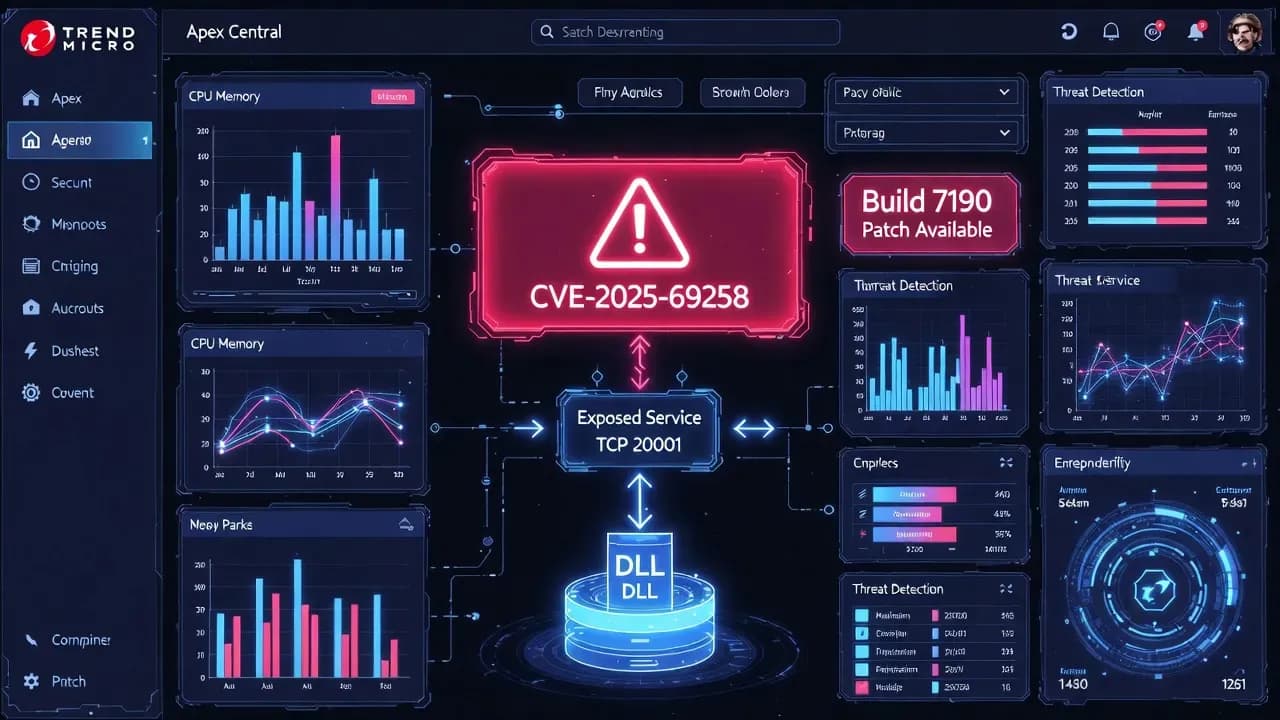
Trend Micro Apex Central critical RCE fixed in Build 7190
The Trend Micro Apex Central critical RCE is the kind of vulnerability that security teams cannot treat as routine patching, because it targets the management layer that often has elevated reach across endpoints and security controls.

Opening: The Trend Micro Apex Central Critical RCE
The Trend Micro Apex Central critical RCE is the kind of vulnerability that security teams cannot treat as routine patching, because it targets the management layer that often has elevated reach across endpoints and security controls. Trend Micro has released an update to remediate CVE-2025-69258, a critical, unauthenticated remote code execution flaw that can result in SYSTEM-level execution on affected Windows installations. The same patch release also addresses two remotely triggerable denial-of-service issues, which matters because availability attacks against a security management console can be used to disrupt response workflows during an intrusion. This is a vulnerability incident with immediate relevance for enterprises that run Apex Central on-premise, particularly where the console is reachable beyond a tightly controlled management segment. The practical message is simple: if Apex Central is deployed in your environment, you should assume it is a high-value pivot point and handle remediation with urgency.
What Happened: The Trend Micro Apex Central Critical RCE Disclosure
Trend Micro's January 2026 security bulletin describes a set of vulnerabilities affecting Apex Central (on-premise) on Windows, with the most severe issue being a pre-auth remote code execution condition. The fix is delivered through Critical Patch Build 7190, which Trend Micro positions as the minimum recommended build for remediation. From an operational perspective, the "minimum build" phrasing is important because many organizations patch opportunistically and leave older builds in place across test environments, disaster recovery instances, or isolated business units, which then become soft targets. In practice, centralized consoles are frequently deployed once and left running for long periods because they sit behind internal firewalls, which can create an illusion of safety. That is exactly why critical vulnerabilities in this tier tend to be exploited rapidly after public disclosure, even when organizations believe the system is "not internet-facing."
The disclosure context also matters. Tenable, which reported the issues, provides a coordinated timeline indicating the vulnerabilities were discovered and reported months before the public advisory window. That kind of runway usually means reliable technical details exist and, in many cases, proof-of-concept artifacts follow shortly after the patch becomes available. When defenders see a critical CVSS score paired with a mature disclosure timeline and a well-documented attack surface, it is rational to expect scanning and exploitation attempts to increase quickly across reachable deployments. For defenders, the decision point is not whether the issue is theoretically dangerous, but whether their particular Apex Central instance is reachable from anywhere an attacker can land, including compromised user endpoints or third-party access paths. In modern enterprise environments, that reachability assumption is frequently true.
How CVE-2025-69258 Works: MsgReceiver, LoadLibraryEx, and SYSTEM Execution
The core of CVE-2025-69258 is a remote, unauthenticated code execution path that leverages Windows DLL loading behavior. Technical analysis describes a service component, MsgReceiver.exe, that listens for inbound messages and processes multiple message types. In the vulnerable condition, a message can be crafted to induce the target process to call a LoadLibraryEx routine on an attacker-supplied DLL path, effectively loading arbitrary attacker-controlled code into the process. When defenders see "attacker-controlled DLL load," the risk is rarely subtle: the loaded library executes under the privileges of the hosting process, and in this case the documented impact is execution under the context of SYSTEM. That is the highest local privilege level on Windows systems and turns a network-reachable flaw into immediate full host compromise.
This implementation detail is not merely academic because it intersects with common enterprise network realities. The analysis indicates the listener runs on a default TCP port (20001), which becomes the focal point for exposure management. If that port is reachable from broader internal networks, then any attacker who compromises a low-privileged workstation can potentially pivot to compromise the security management server without needing credentials. If the port is reachable from vendor VPNs, supplier segments, or flat "server networks" shared across business units, the exploit path becomes even more plausible. The fact that the attack is unauthenticated also means traditional credential protections do not help, and the fact that the outcome is SYSTEM-level means post-exploitation tooling will have a straightforward path to persistence, credential harvesting, and lateral movement. When the target is a console used to manage security products, the attacker's reward is not just a server, but potential influence over the defensive posture of the organization.
Exposure Pathways: Why "Internal-Only" Management Consoles Still Get Compromised
Organizations routinely categorize management consoles as "internal-only" and assign them lower urgency than internet-facing applications, but that categorization often fails under real incident conditions. The modern enterprise is full of implicit paths that expand reachability, including remote support tooling, VPN access, jump hosts that are not truly isolated, and permissive east-west firewall rules that were created to "make integrations work." Once an attacker gains an initial foothold, internal network reachability frequently looks like an open landscape rather than a tightly segmented set of corridors. A listener bound to a predictable port becomes a natural target because attackers can discover it quickly through internal scanning and then test for known exposures. If an organization has not specifically designed its management plane as a separate trust zone, the "internal-only" label becomes little more than a comforting story.
Management consoles also have a second problem: they are typically treated as operational infrastructure rather than high-risk assets.
That means patching cadence can be slower, maintenance windows are harder to negotiate, and monitoring is sometimes weaker than for core business applications. In many environments, the console is deployed and then administered by a small group, and the assumption is that only those administrators can affect the system. A pre-auth vulnerability breaks that assumption completely. It does not care about who is an admin, it cares about whether a network path exists to the vulnerable service. The net result is that attackers can turn an overlooked network rule into full compromise of a system that sits at the center of a security toolchain. In mature attacks, compromise of a security control plane is often followed by attempts to suppress alerts, tamper with integrations, or use the platform's visibility to plan stealthier movement.
How Organizations Can Respond to the Trend Micro Apex Central Critical RCE
The primary remediation action is upgrading Apex Central (on-premise) to Build 7190 or later, and treating the upgrade as an urgent change for a management-plane asset. Security teams should prioritize identification first, because the fastest way to fail a critical patch cycle is to miss a forgotten instance. Apex Central frequently exists in more than one place: production and staging, regional deployments, training labs, and disaster recovery. Each of those can be exploited as an entry point into management networks, especially if credentials and trust relationships overlap. After patching, teams should validate the build level and confirm that services restarted cleanly, because incomplete upgrades can leave vulnerable components in place even when the UI reports a newer version.
A strong response also includes exposure reduction that remains valuable even after patching. The listener associated with this vulnerability is tied to a known port, so defenders should treat reachability to that port as a policy question rather than a convenience. The safest posture is to permit access only from explicitly required systems inside a dedicated management segment and deny all other sources by default. Where strict segmentation is not immediately achievable, organizations should implement pragmatic compensating controls: host-based firewall restrictions on the Apex Central server, network allow-listing at internal firewalls, and temporary blocks from user VLANs and third-party access segments. This is the kind of control that reduces both opportunistic exploitation and the blast radius of an internal compromise, because it prevents a random compromised workstation from becoming an exploit delivery platform.
Prevention and Detection Strategies for the Apex Central Management Plane
Detection strategy should start with the reality that defenders may not have a neat signature for exploitation attempts, especially when the protocol is proprietary and traffic may not be inspected deeply on internal networks. The practical first step is to treat inbound connections to the listener port on the Apex Central server as a high-signal event. In a well-designed environment, there should be a small and predictable set of sources that ever connect to that service, and anything outside that set is suspicious by default. If an environment cannot produce a small set of expected sources, that is a segmentation problem that should be treated as a remediation objective rather than accepted as normal. Even basic telemetry, such as NetFlow records or internal firewall logs, can provide meaningful detections if teams build allow-list-based alerting around management-plane ports.
Host-based monitoring is the second pillar, and it should focus on behaviors consistent with code execution and follow-on activity rather than trying to match a specific exploit payload. The vulnerability involves loading a DLL into a key executable, so defenders should watch for unusual module loads, unexpected child processes spawned by service components, and abnormal outbound connections originating from the Apex Central server. On Windows systems, service-level compromise often turns into process trees that include scripting hosts, command interpreters, or other "living off the land" tooling used to stage payloads and move laterally. Because the outcome is SYSTEM-level execution, any suspicious behavior on this host should be treated as high severity.
Lessons Learned and Industry Implications
The broader industry implication of the Trend Micro Apex Central critical RCE is that security tooling is increasingly part of the attacker's target set, not just part of the defender's kit. A management console aggregates power: it touches endpoints, pushes configuration, and often holds credentials or tokens needed to integrate with other systems. When a vulnerability grants remote code execution in that tier, the attacker's payoff can include stealth, persistence, and leverage over detection. This incident reinforces a hard but productive truth: defenders must apply the same "assume breach" discipline to security infrastructure that they apply to business applications. When security tools are treated as trusted by default, vulnerabilities in those tools can become an attacker's shortcut around more heavily protected assets.
It also illustrates why patch management cannot be limited to "internet-facing first" heuristics. While perimeter exposure is a major risk factor, internal reachability combined with common enterprise compromise paths can make an internal-only vulnerability just as exploitable. Security programs that invest in segmentation, least privilege, and explicit allow-listing of management-plane traffic are materially better positioned to absorb these events, because they reduce the number of places an attacker can stand to launch an exploit.
Closing
The Trend Micro Apex Central critical RCE is a reminder that the most dangerous vulnerabilities are often the ones that strike the systems defenders rely on to maintain control. A pre-auth, SYSTEM-level code execution path in a management console collapses multiple layers of assumed trust and can turn a routine internal foothold into a high-privilege pivot. The immediate priority is upgrading to Build 7190 or later, but the durable improvement is tightening the management plane so that critical services are reachable only from narrowly defined, monitored sources. Organizations that treat security tooling as critical infrastructure, with segmentation and observability built in, will reduce both exploitability and blast radius the next time a high-severity issue emerges.
Frequently Asked Questions
No. The critical issue is described as unauthenticated, meaning a remote attacker who can reach the vulnerable service does not need to log in first. That significantly increases exploitability in environments with flat internal networks. It also means credential protections alone cannot mitigate the vulnerability.
A management console typically sits in a privileged tier and may have broad access to endpoint fleets, telemetry, and configuration channels. Compromise can provide an attacker with leverage over defenses, including visibility into what the organization can detect. It also creates a strong pivot point for lateral movement into other administrative systems.
You should not. Many intrusions become "internal" within minutes or hours after initial access, and attackers routinely scan internal networks for high-value services. If TCP reachability exists from a compromised workstation or vendor segment to the console, the practical risk can be close to that of an internet-exposed service. Segmentation determines real exposure, not assumptions.
Restrict access to the vulnerable listener service so only explicitly required systems can reach it. That means enforcing allow-list rules at internal firewalls or on the host itself, and removing reachability from user networks and third-party access zones. This does not replace patching, but it reduces the probability of opportunistic exploitation.
Treat any suspicious inbound connections to the console's listener port as a high-confidence lead, then correlate with unusual process execution or module loads on the server. A SYSTEM-level compromise is likely to be followed by persistence actions and attempts to tamper with security tooling.



Comments
Want to join the discussion?
Create an account to unlock exclusive member content, save your favorite articles, and join our community of IT professionals.
New here? Create a free account to get started.