xRAT Malware Campaign in Korea Abuses Webhard Downloads and ETW Tampering to Hide QuasarRAT in Fake Game Installers
The xRAT malware campaign highlighted in Korea is a practical example of how "commodity" remote access trojans remain effective when delivery is engineered around user behavior and Windows telemetry gaps.

What Happened: Why Webhard Distribution Still Works
ASEC published campaign analysis
The reported activity centers on a familiar but persistent distribution channel in South Korea: webhard services, which function as widely used file-sharing and content distribution platforms. Threat actors repeatedly exploit these ecosystems because they create a high-trust, high-velocity download culture where users expect to retrieve executables, compressed archives, and "installers" directly from third-party uploaders.
That expectation is the core weakness. If users routinely treat a ZIP file as the normal delivery format for software, the attacker's challenge shifts from exploitation to packaging and persuasion. A realistic listing, an attractive title, and a plausible description can be enough to drive execution.
Technical Breakdown: Multi-Component Loader Chain
Components in the ZIP package
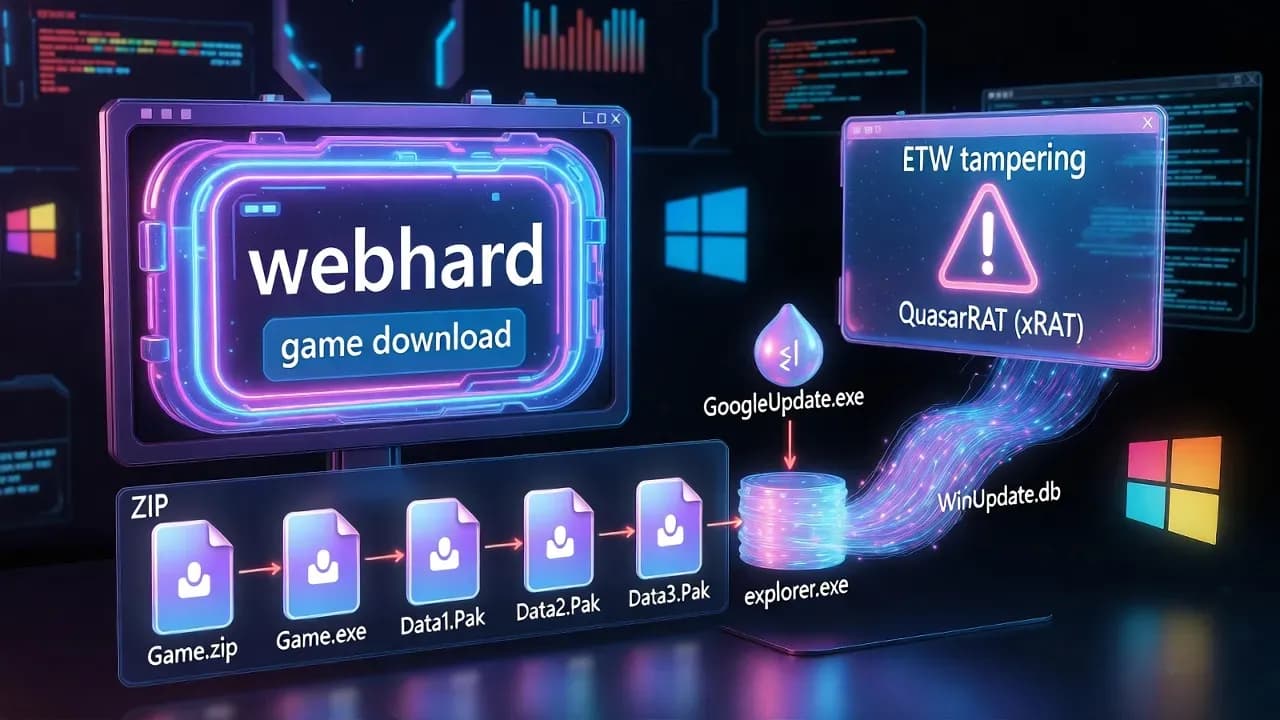
The archive reportedly contains several files that appear to be game-related assets, including a file named "Game.exe" that users would naturally run first. That naming choice is deliberate. Users are conditioned to double-click the obvious entry point, and in many cases they have been trained to ignore security warnings if the content is expected.
Package Structure:
- Game.exe - Launcher that orchestrates both legitimate and malicious execution
- Data1.Pak, Data2.Pak, Data3.Pak - Game assets and hidden malicious components
Once staged, the chain reportedly executes the real game while also launching the malicious component that decrypts a shellcode blob using AES and injects it into explorer.exe. That injection target is not accidental—explorer.exe is continuously running, trusted by the OS, and frequently allowed by enterprise policies to interact with a wide range of system resources.
ETW Tampering: A High-Signal Indicator
Function patched to disable logging
A critical detail in the reporting is that the loader does not only inject code—it also attempts to reduce visibility by patching ETW-related functionality. ETW is a key telemetry backbone in modern Windows monitoring, and many EDR products and defensive workflows rely on ETW signals directly or indirectly.
When malware actively tampers with ETW, it is effectively declaring that it expects to be monitored and is taking steps to narrow the evidence trail. This shifts the defender's mindset. You are not dealing with a casual nuisance; you are dealing with an operator who understands how Windows monitoring works in practice and is trying to degrade it.
From an operational detection perspective, ETW tampering also creates opportunities. While attackers aim to suppress events, the act of patching itself can be detected through memory integrity checks, suspicious API call patterns, anomalous module modifications, or EDR-specific tamper alerts.
xRAT and QuasarRAT: Why an Old RAT Remains a Modern Risk
Injection target for payload execution
The payload described in this campaign is xRAT, also tracked as QuasarRAT. This family is particularly relevant because it sits at the intersection of legitimate remote administration and persistent criminal abuse. As an open-source .NET project, it is easy to compile, modify, and reconfigure, which makes it attractive to a wide range of attackers.
Capabilities:
- System reconnaissance and file operations
- Command execution and remote desktop interaction
- Keylogging and credential harvesting
- Lateral movement capabilities
That accessibility is the real risk factor. Even if a specific campaign is dismantled, the tooling remains available and can be redeployed with small changes to infrastructure and configuration. QuasarRAT is often the first stable foothold that enables follow-on operations—if an attacker can run QuasarRAT reliably, they can choose when to escalate.
Detection and Response
Defending against this kind of xRAT malware chain begins by hunting the transitions that rarely occur in normal software execution:
- User-launched "game" executable that rapidly copies multiple components into system-adjacent directories
- Execution of an "update"-named binary shortly after archive unpacking
- Process injection into explorer.exe from a ZIP-delivered executable
Response discipline matters because RAT incidents often look "quiet" at first. Treat this as a potential foothold, not just a single-machine issue. Isolate the host, collect endpoint telemetry, and review credential exposure paths.
Frequently Asked Questions
In this reporting, xRAT is described as another name associated with QuasarRAT. QuasarRAT originated as an open-source .NET remote administration tool that has been repeatedly abused by attackers. The practical takeaway is that it behaves like a full remote access framework, not a one-off malware sample.
Because the chain relies on execution by the victim, not a vulnerability trigger. The package is designed to look like legitimate software and to run a real program while staging malware in parallel. This reduces suspicion and allows the attacker to focus on stealthy execution and persistence.
ETW underpins many endpoint monitoring signals, and interference can reduce the visibility your SOC expects. Attempts to disable or patch ETW-related functions indicate the operator is actively trying to evade detection. Telemetry gaps and inconsistencies can therefore become a detection signal on their own.
Treat it as a potential foothold, not just a single-machine issue. Isolate the host, collect endpoint telemetry, and review credential exposure paths such as browser sessions, saved passwords, and enterprise authentication logs. Also hunt for other endpoints that downloaded the same archive.
No. They frequently impact small businesses and corporate endpoints when software is downloaded outside managed channels. Contractors and unmanaged devices are common entry points, especially when file-sharing services are part of local user behavior.



Comments
Want to join the discussion?
Create an account to unlock exclusive member content, save your favorite articles, and join our community of IT professionals.
New here? Create a free account to get started.