APT28 Credential Harvesting Campaign Targets Energy Researchers and Policy Networks with Stealth "Redirect-to-Real" Phishing
An APT28 credential harvesting campaign has resurfaced with a familiar objective and a refined delivery: steal logins from carefully selected targets, then make the intrusion look like nothing happened. Instead of noisy malware or opportunistic mass phishing, this operation focuses on researchers, policy staff, and organizations tied to energy and government communications.

Observed campaign window
Decoy PDF display time before redirect to credential prompt
Opening: A Refined Credential Theft Operation Against Strategic Targets
An APT28 credential harvesting campaign has resurfaced with a familiar objective and a refined delivery: steal logins from carefully selected targets, then make the intrusion look like nothing happened. Instead of noisy malware or opportunistic mass phishing, this operation focuses on researchers, policy staff, and organizations tied to energy and government communications, using convincing login clones and legitimate documents as bait.
The most operationally important detail is not the lure itself, but what happens immediately after credentials are entered. Victims are seamlessly redirected to the real document or portal, reducing suspicion, lowering reporting rates, and buying the attacker time to reuse credentials before defenders can respond.
What Happened in This APT28 Credential Harvesting Campaign
This campaign fits a mature intelligence-collection playbook: credential theft as a low-cost, repeatable access method against accounts that sit near sensitive communications. Rather than targeting random inboxes, the victim set appears limited and deliberate, with lures tailored to specific regions and professional communities. That selectivity matters because it influences every layer of the tradecraft: language choices, document themes, portal branding, and even which third-party services are abused for hosting and redirection.
Major portal brands impersonated in the campaign
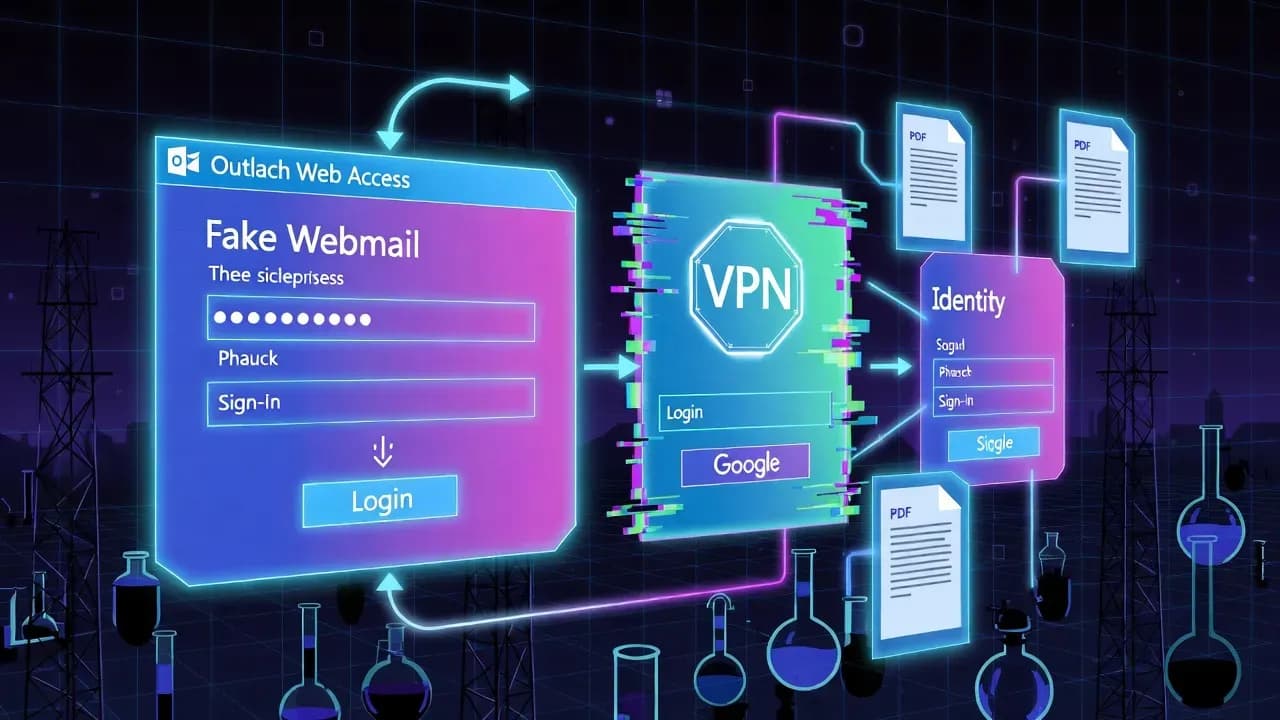
From a defender's perspective, the operational intent is clear: obtain usernames and passwords, and in some cases capture additional context that helps the operator act quickly and precisely. The phishing flow is designed to reduce friction for the attacker while minimizing the chance the victim pauses to question what they are seeing. That balance is why the campaign impersonates common enterprise authentication surfaces such as Outlook Web Access, VPN password reset portals, and consumer identity providers used in professional settings.
In environments where single sign-on is prevalent, harvested credentials can become a pivot point into email, collaboration tools, file repositories, and external partner portals, especially if MFA is weak, inconsistent, or vulnerable to real-time phishing.
How the Phishing Chain Works: PDF Lures, Staged Redirects, and "Back to Normal" Deception
The most effective part of the operation is its choreography. The victim typically clicks a shortened link delivered by email, expecting to view a document relevant to their work. A legitimate PDF is then displayed inside the browser, but only briefly, creating a split-second impression that the click was safe and that the content is authentic. Immediately after, the browser is redirected to a spoofed login page that matches the styling of a real authentication portal. This sequence is not merely cosmetic; it is engineered to defeat instinctive warning signals that users and even some security tooling rely on, because the first visible content is real.
Documented infrastructure stages in one phishing flow
Once the victim enters credentials, the operation leans into its signature deception: the user is redirected back to legitimate content. The effect is subtle but powerful. Many users will assume they mistyped a password, hit a transient login timeout, or were prompted by a normal session reauthentication step. That "nothing broke" user experience reduces helpdesk tickets and incident reports, which delays detection.
Technically, the chain also shows automation choices that reduce the attacker's operational burden. Rather than manually crafting every exfiltration endpoint per phishing page, the infrastructure includes hidden elements and scripting that can beacon when a page is opened, transmit captured fields, and then trigger the redirect back to legitimate content. For defenders, the implication is that simple user awareness is not enough; the flow is designed so that even attentive users can be nudged into treating the login prompt as routine.
Targeting Pattern: Energy Research, Think Tanks, and Government-Linked Access
The campaign's target set signals intelligence priorities more than financial motivation. Energy research organizations, nuclear-adjacent institutions, policy think tanks, and military or government-linked communications surfaces offer long-term value in the form of strategic insight, partner coordination details, and operational planning. These targets also tend to have frequent interactions with external entities, which makes inbound documents and login prompts feel normal.
Localized lure content adds another layer of credibility. When an email, document theme, or portal text matches a target's language and regional context, it reduces the mental friction that typically causes users to hesitate. In practice, this means the campaign is less reliant on generic urgency and more reliant on plausibility: documents that look like briefings, climate or regional policy material, or other content a target would reasonably open at work.
The targeting pattern also implies that the attacker is willing to invest time in reconnaissance. Once credentials are obtained, the follow-on activity may shift to quieter access methods such as mailbox rule abuse, OAuth token acquisition, or persistence in cloud environments. The initial credential theft is only the entry point; the real damage often appears later in the form of sensitive data access that looks like legitimate user behavior.
Disposable Infrastructure Abuse: Why Free Hosting and Tunneling Services Keep Winning
One reason credential harvesting remains so effective is infrastructure economics. Free hosting platforms, link shorteners, and tunneling services allow an operator to create disposable, rapidly replaceable campaign components without maintaining a traditional phishing kit on owned servers. This reduces costs, shortens setup time, and complicates takedown efforts, because the infrastructure is distributed across legitimate services used by real businesses.
Common abused services in the attack chain
The campaign's infrastructure strategy is also designed to frustrate simplistic threat hunting. Instead of a single malicious domain hosting everything, multiple stages can live on different services, and the visible content can be real for part of the chain. This undermines some scanning and sandbox approaches that rely on stable URLs or that evaluate only the first-rendered page. If an email gateway detonates a link and sees a legitimate PDF, it may not follow the timed redirect behavior that reveals the credential prompt.
For mature security programs, the key takeaway is to treat "legitimate platform" as an attribute, not an approval. Credential prompts should originate from known identity provider domains and known application entry points, not from miscellaneous hosting services. Defenders can operationalize this by building detection around authentication context, referrers, unusual redirect sequences, and the presence of URL parameters that prefill usernames, which is a common indicator of targeted credential harvesting.
How Organizations Can Respond: Contain, Harden Identity, and Hunt the Right Signals
The first response priority is identity containment. When credential harvesting is suspected, treat the affected accounts as compromised until proven otherwise, because the attacker's infrastructure is designed to minimize victim awareness. Rapid password resets alone are not sufficient if MFA is phishable or if session tokens remain valid; force sign-outs, rotate credentials, and review authentication logs for anomalous access patterns immediately after the suspected interaction window. Where possible, correlate web proxy logs and email telemetry to reconstruct the redirect chain.
Device-bound access controls and conditional access policies can turn harvested passwords into dead ends
Next, reduce the payoff of stolen credentials. Phishing-resistant MFA, device-bound access controls, and conditional access policies that require compliant devices can turn harvested passwords into dead ends. The campaign's emphasis on webmail and VPN portals is a reminder that the most targeted surfaces are often the most operationally critical. Ensure VPN portals and webmail enforce strong authentication, restrict legacy protocols, and apply risk-based controls that challenge or block logins from suspicious network paths.
Finally, adjust detection to the attacker's stealth goal:
- Look for time-based redirect patterns and unexpected use of webhook-like endpoints in browsing sessions
- Hunt for sequences where users access a PDF and then immediately authenticate to a portal from an unusual referrer
- Alert on URL parameters that include user identifiers, especially when they appear in links delivered by email
- Monitor authentication attempts that follow shortly after a user clicks an email link and opens a document
The campaign's design is optimized to evade human suspicion, so the technical response has to focus on telemetry and policy enforcement rather than user intuition alone.
Closing
Credential harvesting persists because it scales, it is cheap, and it often succeeds without triggering the alarms defenders expect. This operation demonstrates how a well-run campaign can look like normal work—a document view, a routine login, and then business as usual—even as credentials are quietly exfiltrated in the background.
For organizations in energy, policy, and government-adjacent ecosystems, the defensive center of gravity has to shift toward identity assurance, strict authentication pathways, and telemetry that captures redirect behavior and suspicious hosting dependencies. The practical goal is not to block every lure, but to make harvested credentials operationally useless and to detect the conversion step when phishing turns into account access.
Frequently Asked Questions
The flow is designed to look normal before and after the credential prompt. A legitimate PDF is briefly shown to build trust, then the victim is redirected to a familiar login page. After credentials are entered, the user is sent back to legitimate content, which reduces suspicion and delays reporting. This "redirect-to-real" behavior is a practical stealth technique, not a gimmick.
These organizations sit close to strategic decision-making and sensitive communications. Compromising a small number of relevant accounts can yield high-value intelligence over time, including partner coordination, briefings, and operational planning. That is why the campaign appears selective, localized, and tailored to professional contexts. The objective is access and insight, not immediate monetization.
MFA helps, but not all MFA is equal. Some methods can be phished in real time, especially when victims are tricked into entering codes into a fake portal. Phishing-resistant approaches, such as hardware-backed authentication or device-bound sign-in requirements, reduce the attacker's ability to reuse harvested credentials. Strong conditional access policies further limit what an attacker can do even with a password.
Focus on the sequence, not just the destination. Look for users clicking email links, opening PDFs, and then immediately hitting authentication pages from unusual referrers or via suspicious redirect chains. Review web proxy logs for traffic to webhook and free hosting endpoints near the time of the click. Then correlate that with sign-in logs that show atypical locations, network paths, or user agents shortly after.
Assume the password is already in the attacker's hands and act to prevent reuse. Force a password reset, invalidate sessions, and require reauthentication with stronger controls where possible. Review mailbox access and forwarding rules, because email is often the most valuable initial target. Then hunt for other recipients who received similar lures, since select campaigns still tend to hit clusters of related individuals.



Comments
Want to join the discussion?
Create an account to unlock exclusive member content, save your favorite articles, and join our community of IT professionals.
New here? Create a free account to get started.