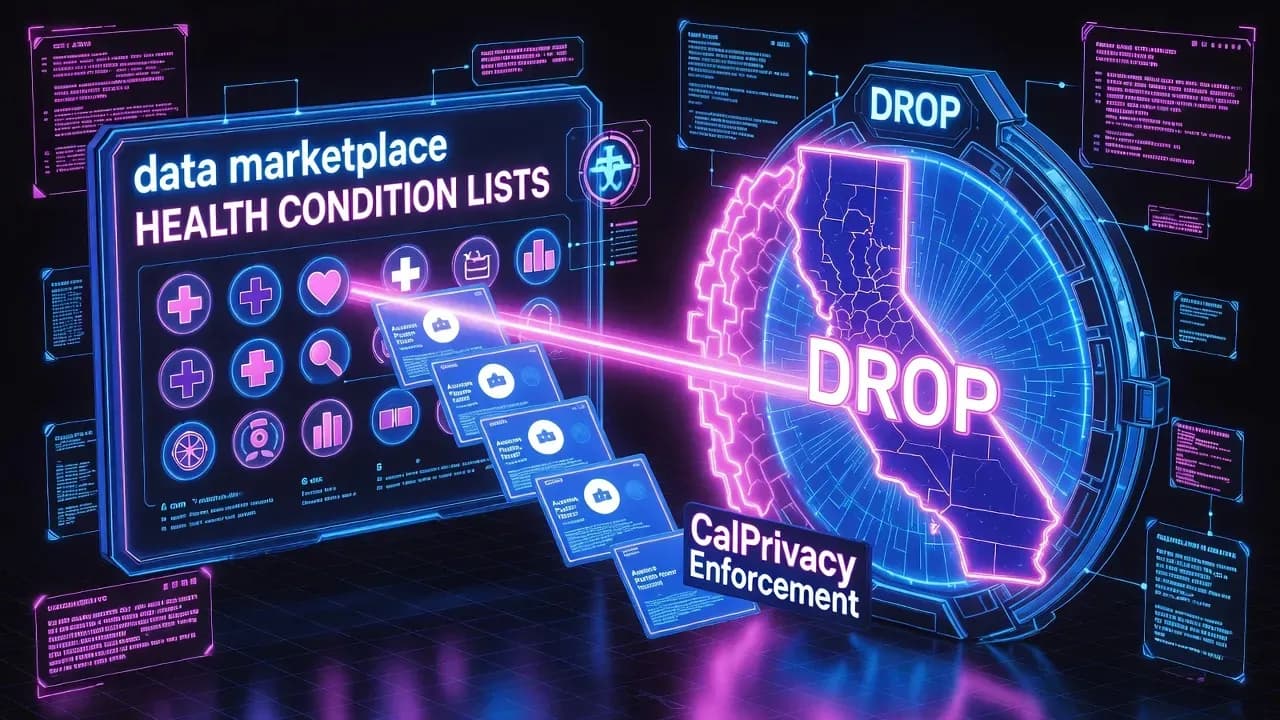
California Health Data Broker Ban: CalPrivacy Blocks Datamasters From Reselling Medical Condition Lists and Orders Rapid Deletion
The California health data broker ban is not a theoretical privacy milestone. It is an operational enforcement action with immediate consequences for how sensitive health-related profiles are bought, sold, and weaponized. California's privacy regulator says a marketing reseller built and traded lists of people tied to serious medical conditions and other sensitive attributes without registering as a data broker.

Fine issued to Datamasters for failure to register as a data broker
Maximum time to delete California data received in future datasets
Opening: An Operational Enforcement Action With Immediate Consequences
The California health data broker ban is not a theoretical privacy milestone. It is an operational enforcement action with immediate consequences for how sensitive health-related profiles are bought, sold, and weaponized. California's privacy regulator says a marketing reseller built and traded lists of people tied to serious medical conditions and other sensitive attributes without registering as a data broker, triggering a formal order to stop selling Californians' personal information and to purge previously acquired data on a strict timeline.
For security and risk leaders, the "so what" is direct: data brokers are a quiet supply chain for phishing, identity fraud, targeted scams, and discrimination at scale, because the same datasets that power advertising also power precision targeting by criminals. This case signals a more aggressive enforcement posture where non-compliant brokers can be removed from the marketplace, and where organizations need to treat data broker exposure as a real-world threat vector, not just a compliance footnote.
What Happened: CalPrivacy's Enforcement Action Against Datamasters
California's privacy regulator, the California Privacy Protection Agency (CalPrivacy), announced a new enforcement action focused on an unregistered data broker operating under the Datamasters brand. The regulator describes Datamasters as a Texas-based reseller of personal information used for targeted advertising, and it states that the company bought and resold datasets tied to highly sensitive categories. The enforcement action matters because it does not revolve around a breach notification, a hacked database, or leaked credentials. It targets the upstream market where sensitive personal information is assembled and sold in bulk, often without the data subject ever knowing the broker exists.
Time S&P Global was unregistered, resulting in a $62,600 fine
The regulator's settlement-driven decision imposes multiple consequences at once, which is a meaningful shift from warnings that simply encourage future compliance. Datamasters was fined for failing to register as required and, more importantly, was ordered to stop selling personal information about Californians entirely. The action also includes mandatory deletion requirements that force the broker to remove previously purchased California records and to rapidly delete any California data it might receive again as part of larger datasets.
In parallel, the regulator also issued a separate fine against S&P Global for failure to register by the deadline, illustrating that the enforcement posture is not limited to small firms, even when the underlying violation is framed as administrative.
Why Health-Condition Lists Are a Cybersecurity Problem, Not Only a Privacy Problem
The most alarming element in this case is the nature of the lists described by the regulator: datasets purportedly segmenting people by serious health conditions and other sensitive attributes. From a purely privacy standpoint, the harm is obvious: individuals never consented to being categorized and sold in this manner, and the downstream use is difficult to trace. From a security standpoint, however, the risk becomes more acute because health-condition lists are exceptionally exploitable.
They can support scams that mimic healthcare support programs, insurance outreach, pharmacy benefit changes, or "financial assistance" offers that appear plausible precisely because the attacker's message aligns with the victim's real-world circumstances. When the dataset includes contact details and a sensitive label, the attacker gains both reach and psychological leverage, which often translates into higher conversion rates in phishing and fraud campaigns.
Security teams should also treat sensitive-list markets as a catalyst for secondary compromise. A criminal does not need to break into a hospital to run healthcare-themed phishing if a broker can sell a list of people likely to respond to those lures. The same pattern applies to elder fraud, caregiver scams, and credential harvesting attempts that claim to protect a vulnerable person's account or benefits. Even if the broker's customers are "marketers," the existence of the dataset expands the attack surface because data resellers and aggregators are frequently chained together, and because datasets are often re-sold, repackaged, and exfiltrated over time.
For enterprises, the exposure is not limited to consumers at home. Employee personal information fuels corporate risk in predictable ways. Targeted scams become more convincing when the attacker can reference personal details, health-related purchases, or demographic segmentation that makes the victim feel "seen" and pressured to act quickly. That increases the probability of credential theft, financial fraud, and social engineering that can lead to business email compromise and account takeover. Organizations often invest heavily in endpoint security while overlooking the data exhaust that makes their people easier to manipulate. This enforcement action should be read as a reminder that cybersecurity is partly about reducing attacker intelligence inputs, and data broker markets are a major intelligence input.
The Regulatory Mechanics: The Delete Act, Data Broker Registration, and DROP
This case sits inside a broader regulatory framework that California has been tightening over multiple years. The state requires data brokers, broadly understood as businesses that buy and sell consumers' personal information, to register on a regular cadence and to fund the operation of the state's oversight and consumer tools through fees. The Delete Act is central here because it extends and operationalizes oversight beyond a simple registry. It creates a mechanism for the state to identify brokers, enforce registration, and impose penalties when companies fail to comply.
Delete Request and Opt-out Platform: California's single-point deletion mechanism for consumers
The consumer-facing component that changes the practical impact is DROP, the Delete Request and Opt-out Platform. California's model is designed to reduce the friction of deletion requests by providing a single place where consumers can submit deletion requests that are distributed to registered brokers. This is important from a security perspective because deletion is not only a privacy right, it is a risk reduction measure. Fewer broker-held records means fewer opportunities for downstream misuse, fewer potential exposures when brokers are breached, and less targeting fuel for criminals.
Security and compliance teams should interpret this regulatory architecture as an operational reality that will affect vendors, partners, and internal risk posture. If your organization buys marketing data, uses third-party enrichment, or relies on lead-gen services, you are adjacent to the broker ecosystem and may be exposed to both legal and reputational risk.
The enforcement case against Datamasters highlights a key point: regulators are not only asking brokers to register, they are prepared to force market exit for certain datasets and to mandate deletion and future screening obligations. That changes the cost model for non-compliance and signals that organizations should increase due diligence on data sources, provenance, and broker compliance status.
Practical Impact: What This Means for CISOs, Privacy Teams, and Vendor Risk Programs
For security leaders, the immediate takeaway is that data broker risk is now converging with identity risk. Many identity-driven attacks rely on enrichment: attackers combine a name with a phone number, then add an address, employer signals, or behavioral profiles to craft credible lures. Data brokers accelerate that enrichment. If regulators are identifying and removing non-compliant brokers, the ecosystem may fragment, but the underlying demand for sensitive segmentation will not disappear overnight.
Privacy teams should treat this as a moment to operationalize a "broker exposure" playbook that is linked to security outcomes. In many organizations, privacy and security operate in parallel, but broker-driven targeting attacks exploit the gap between them. A pragmatic approach is to map which datasets are most harmful if weaponized against employees and customers, then reduce that exposure using a combination of employee education, identity hardening, and deletion or opt-out strategies where legally available. This includes updating internal fraud awareness materials to account for precision targeting. Generic training that warns about "random emails" is less effective when attackers can tailor messages with plausible personal context.
Vendor risk programs should also adapt. Many marketing, analytics, and enrichment vendors sit downstream of data brokers. Even if your company does not buy broker data directly, you may be using a service that does. This case provides a concrete due diligence prompt: ask vendors whether they qualify as data brokers under California definitions, whether they are registered when required, whether they process deletion requests properly, and whether they can demonstrate controls to avoid collecting or retaining restricted data categories. Organizations that ignore these questions risk being surprised by enforcement action, contract disruption, or reputational fallout when a partner is exposed as trading sensitive lists that customers or employees would find unacceptable.
How Organizations Can Respond: Tactical Steps That Reduce Exposure and Abuse
Organizations should start with defensive fundamentals that reduce the harm if sensitive lists circulate. Strengthen account recovery and authentication flows for employees, especially for roles that can be targeted for financial fraud. Health-related targeting often drives urgency and emotional manipulation, which can lead to credential disclosure or MFA approval mistakes. Phishing-resistant MFA, rigorous conditional access, and clear escalation paths for suspicious outreach are practical countermeasures that reduce conversion.
The frontline defense when data broker intelligence is used for targeted phishing campaigns
At the same time, improve monitoring for social engineering-driven incidents by focusing on identity telemetry and anomalous sign-in behavior rather than waiting for malware alerts. When data broker intelligence is used for phishing, the first indicators are frequently inbox activity, login attempts, and unusual account recovery patterns.
Privacy and HR functions can partner with security teams on exposure reduction initiatives. Where permitted, encourage or assist employees in using California's deletion mechanisms if they are eligible, particularly for employees who are frequently targeted such as executives, finance staff, and customer support leads. While deletion will not erase every dataset everywhere, it reduces accessible supply and can raise attacker costs. In parallel, reinforce internal policy that bans the use of questionable data sources and requires documented provenance for any third-party personal data used in marketing or customer profiling.
Finally, incident response teams should treat broker-driven fraud as a repeatable scenario. Build playbooks for spear-phishing campaigns that reference personal attributes and appear "context-aware." Include a communications plan that explains how attackers likely obtained targeting details without implying an internal breach prematurely, because the distinction matters for credibility and legal exposure. This is also a moment to review whether your organization's customer support channels can be abused by impersonators using broker-enriched personal data. Tighten verification steps, protect helpdesk workflows from social engineering, and ensure that support staff are trained to recognize highly tailored scams that mimic legitimate personal circumstances.
Closing
The California health data broker ban illustrates a reality that security teams have known for years but rarely operationalize: attacker success often depends on data access, not technical exploitation. When sensitive health-related profiles and contact details circulate in broker markets, the result is a scalable targeting engine for fraud and social engineering, with consequences that land inside corporate risk boundaries even if no internal system is breached.
CalPrivacy's enforcement approach, combining market exclusion, deletion requirements, and penalties, signals that data brokerage is becoming a regulated threat surface rather than a lightly governed industry. Organizations that want to reduce exposure should treat broker data as a measurable cyber risk driver, tighten identity defenses against tailored scams, and build privacy-led controls that reduce the supply of sensitive data available for abuse.
Frequently Asked Questions
It reflects a regulator-issued order that blocks a specific data reseller from selling Californians' personal information and requires deletion of California data on strict timelines. The enforcement posture targets the data broker marketplace, not just individual breaches. It also signals that non-compliant brokers can be pressured out of the California data market.
Because health-condition labels can be used to craft highly convincing scams, from fake insurance outreach to "medical support" phishing. These campaigns often exploit urgency and vulnerability, increasing the likelihood of credential theft and fraud. The same datasets that enable targeted advertising can enable targeted victimization.
No. The issue here is commercial data brokerage and resale, not a healthcare provider breach notification under HIPAA rules. The risk comes from sensitive segmentation and contact data circulating in marketing ecosystems. That data can still be abused in cybercrime even if it did not originate from a hospital system compromise.
DROP is a California platform that enables consumers to request deletion from registered data brokers via a single workflow. Reducing broker-held records lowers the supply of targeting data used in phishing, fraud, and identity scams. It is a privacy tool with measurable security benefits when adoption is meaningful.
Treat it as an identity threat scenario. Harden authentication, improve monitoring for suspicious sign-ins and recovery attempts, and issue targeted guidance explaining how attackers can appear unusually "informed" without a breach of corporate systems. Also evaluate marketing and enrichment vendors to ensure your organization is not indirectly funding sensitive-list markets.


Comments
Want to join the discussion?
Create an account to unlock exclusive member content, save your favorite articles, and join our community of IT professionals.
New here? Create a free account to get started.