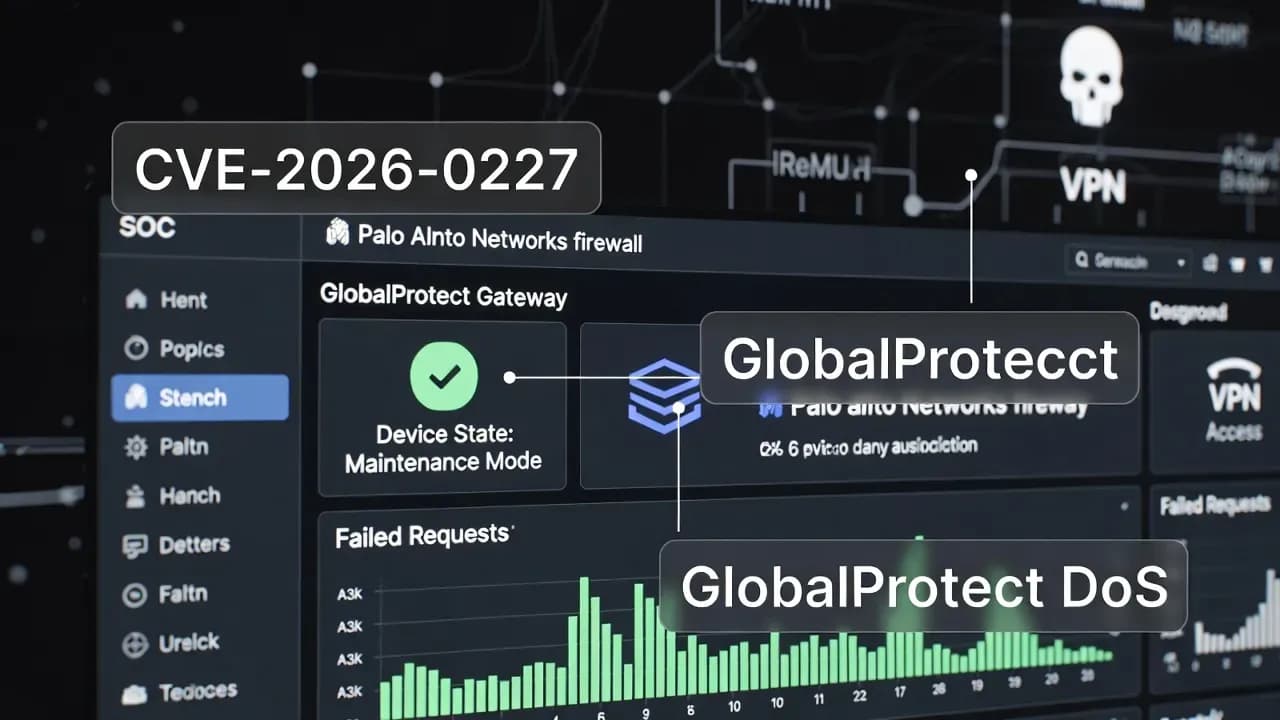
Palo Alto Networks patches CVE-2026-0227 GlobalProtect DoS flaw that can force firewalls into maintenance mode
Palo Alto Networks has released fixes for CVE-2026-0227, a high-severity denial-of-service flaw affecting PAN-OS and Prisma Access when GlobalProtect gateway or portal is enabled. An unauthenticated attacker can repeatedly trigger the issue over the network until the firewall enters maintenance mode, effectively taking it offline.

CVE-2026-0227 is the type of perimeter vulnerability that turns "availability" into a security problem, fast. Palo Alto Networks has patched a high-severity denial-of-service issue affecting PAN-OS and Prisma Access deployments where GlobalProtect gateway or portal is enabled. The uncomfortable detail is not the crash itself, but the outcome: repeated unauthenticated triggers can push a firewall into maintenance mode, effectively removing a key control plane from the network at the worst possible time.
For organizations that expose GlobalProtect to the internet, the risk is operational and defensive at once. A forced maintenance mode event is not just an outage. It can create monitoring blind spots, break remote access, and trigger emergency change windows that attackers often exploit with follow-on phishing and credential abuse.
What happened: the technical breakdown of CVE-2026-0227 in GlobalProtect
CVE-2026-0227 impacts Palo Alto Networks firewalls and Prisma Access configurations running PAN-OS when the GlobalProtect gateway or portal feature is enabled. At a high level, the bug allows an unauthenticated attacker to reach the vulnerable code path over the network and induce a denial-of-service condition. The key operational twist is that the device does not merely restart a process and continue. With repeated triggering, the firewall can enter maintenance mode, which many administrators treat as a recovery posture rather than an attacker-reachable state.
From a defender's perspective, this behavior changes how you think about exposure. Traditional DoS vulnerabilities are often triaged as "noise" if they require high bandwidth or are hard to reproduce. CVE-2026-0227 is different because the vendor classifies it as network-reachable with low attack complexity and no user interaction.
Another critical point is the absence of a workaround. When a perimeter product has no mitigation short of upgrading to a fixed build, patching becomes the only durable control.
Exposure conditions: why "GlobalProtect enabled" is the real trigger
The most important scoping question for IT teams is not "Do we have Palo Alto firewalls?" It is "Do we have GlobalProtect gateway or portal enabled on an affected PAN-OS or Prisma Access version?" That is where exposure concentrates.
Many organizations run Palo Alto firewalls internally with minimal external services and assume they are insulated. But GlobalProtect is designed to be reachable by remote endpoints, which means it is commonly:
- Published through public DNS
- Fronted by a VIP
- Exposed directly to the internet
A DoS that hits a centralized GlobalProtect gateway can collapse remote access for a large portion of the organization, including incident responders who now cannot reach internal tools.
Prisma Access customers face a slightly different operational reality. Cloud-delivered services often get patched centrally, but not uniformly, and not on every tenant's preferred schedule.
Impact analysis: what "maintenance mode" means in real networks
In the abstract, "maintenance mode" sounds like a safety feature. In practice, it is a high-friction state that can translate into real downtime, especially if you rely on the device as a chokepoint for remote access, segmentation, or upstream inspection.
When a firewall enters maintenance mode:
- It can stop enforcing policy in the usual way
- It may require admin intervention to return to normal operation
- The organization loses confidence in the integrity of the control plane
That loss of confidence is the real cost. Security teams will often treat a forced maintenance event as a possible compromise until proven otherwise, because it occurred through an attacker-reachable path. That triggers containment-style workflows: collecting logs, checking for suspicious config changes, validating admin accounts, and reviewing authentication telemetry.
There is also a business continuity angle. If remote users lose access repeatedly, they will search for workarounds—and the most common workarounds are not secure.
Key numbers at a glance
High severity - vendor rating
Proof-of-concept exists
Patching is the only fix
| Field | Value |
|---|---|
| CVSS Score | 7.7 (High) |
| Exploit maturity | Proof-of-concept |
| Exposure condition | GlobalProtect gateway/portal enabled |
| Workarounds available | None known |
| Advisory published | January 14, 2026 |
Source verification map
- CVSS score, exploit maturity, and workaround status: source [1].
- Affected PAN-OS versions and Prisma Access impact: source [2], source [3].
How organizations can respond: patch strategy, validation, and safe rollout
The response to CVE-2026-0227 should be structured like any perimeter patch emergency, but with an emphasis on verification and rollback planning.
Step 1: Inventory Start by inventorying all PAN-OS and Prisma Access GlobalProtect entry points, including any that exist for legacy, testing, or acquisitions. Shadow VPN gateways are common.
Step 2: Version mapping Map each gateway or portal to its current PAN-OS version and compare against the fixed versions. The vendor's advisory provides explicit version thresholds across PAN-OS 10.1, 10.2, 11.1, 11.2, and 12.1.
Step 3: Continuity planning Plan for remote access continuity during the maintenance window. If you have multiple gateways, stagger upgrades and validate failover. If you have a single gateway, schedule a window with a tested break-glass access path.
Step 4: Detection Instrument detection for abnormal GlobalProtect request patterns. Watch for bursts of malformed or repetitive requests to the gateway or portal endpoints.
Lessons learned: perimeter availability is now part of incident response readiness
CVE-2026-0227 fits a broader trend: attackers do not need a full compromise to create leverage. If they can selectively remove your edge controls, they can reshape how your organization operates under stress. In 2026, remote access is not optional infrastructure. It is the backbone of many organizations' operations.
There is also a governance takeaway: security appliances must be managed like software, not hardware. PAN-OS trains, hotfix builds, and feature enablement like GlobalProtect create a software lifecycle that requires discipline. Organizations that treat firewall upgrades as rare events tend to accumulate "version debt," which becomes painful when urgent patches land.
Closing
CVE-2026-0227 GlobalProtect is a reminder that firewall vulnerabilities are not only about intrusion. Availability flaws on exposed gateways can still create a security event by breaking remote access, reducing visibility, and forcing rushed operational decisions.
With no workaround and proof-of-concept maturity, the safest posture is simple: identify exposed GlobalProtect gateways and portals, upgrade to the fixed builds, and verify the running versions. If your organization depends on GlobalProtect for business continuity, treat this patch cycle as a readiness drill for the next, more complex edge incident.



Comments
Want to join the discussion?
Create an account to unlock exclusive member content, save your favorite articles, and join our community of IT professionals.
New here? Create a free account to get started.