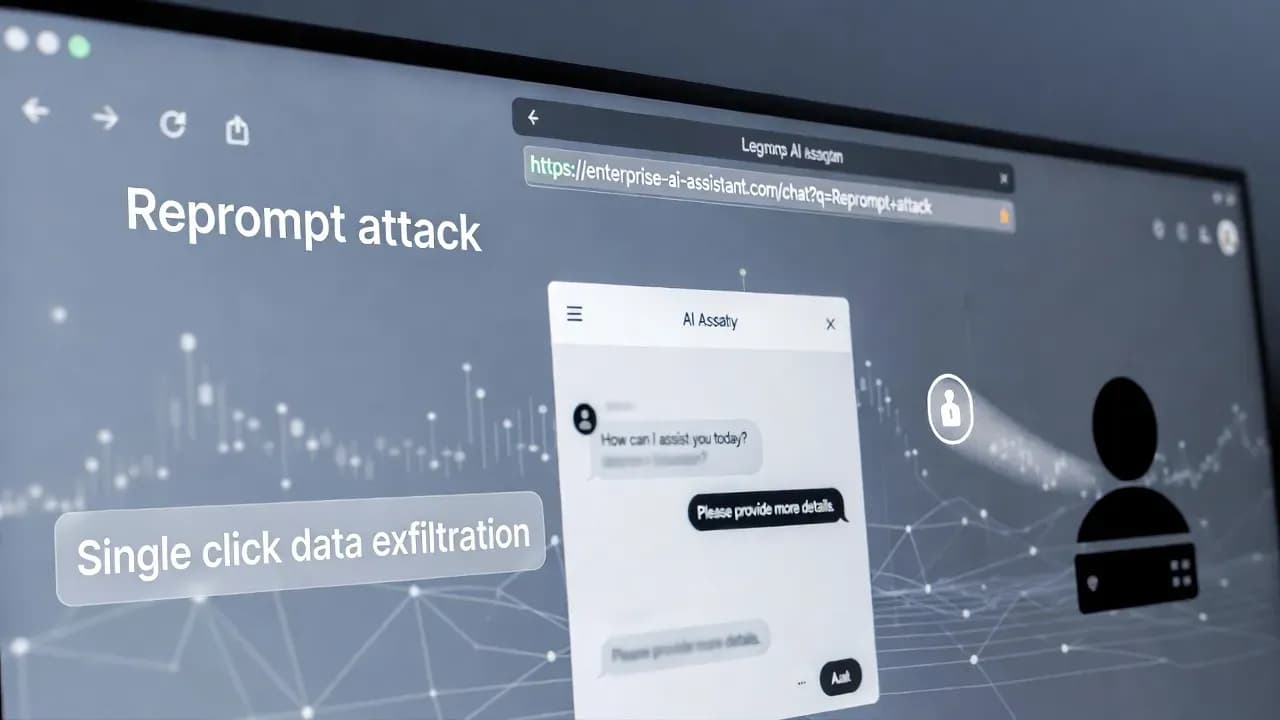
Reprompt attack showed how a single click could silently siphon data from Microsoft Copilot Personal sessions
Security researchers disclosed "Reprompt," a single click prompt injection chain that could quietly exfiltrate data from Microsoft Copilot Personal, even after the chat window was closed. The technique abused URL prefilled prompts, a safeguard gap on follow up requests, and a server driven instruction chain to keep the victim session "steerable" without further interaction. Microsoft says the issue has been patched, and enterprise Microsoft 365 Copilot users were not affected.

The Reprompt attack matters because it turns a familiar phishing primitive into something many security teams are not yet instrumented to detect: a legitimate looking link that quietly "programs" an AI assistant session to leak data. Researchers demonstrated that a victim did not need to type anything into Copilot, install a plugin, or approve a connector. The only requirement was a single click on a Microsoft Copilot link that arrived through a normal channel such as email or chat. From there, the session could be steered into a stealthy data exfiltration chain that continued even after the user closed the chat window, which is exactly the kind of persistence defenders rarely associate with browser based assistants.
This is a vulnerability story, not just an awareness story. The key lesson is architectural: once an assistant becomes a privileged interface to personal context, chat history, and user identity, seemingly harmless UX features like prefilled prompts become security relevant surfaces. Microsoft says the issue has been patched, and the researchers report that Microsoft 365 Copilot enterprise users were not affected. Even so, Reprompt is a useful blueprint for how attackers will keep testing AI assistants: not by breaking the model, but by chaining product behaviors until guardrails only apply on paper.
What Happened: The Technical Breakdown Behind the Reprompt Attack
Reprompt combined three techniques into a single flow that is easy to operationalize for attackers because it starts with standard social engineering. The first technique was a URL based prompt injection that uses a query parameter to pre populate the assistant's input. The researchers call this "parameter to prompt" injection, and the core idea is simple: the URL itself becomes the prompt. When the user clicks the link, Copilot loads with attacker supplied instructions already present, and the victim does not need to interact with the UI for the instruction to execute. In practice, this is a dangerous convergence of convenience and trust, because users tend to treat "it is a Microsoft link" as the end of their suspicion, especially when the destination looks like a first party service.
What makes Reprompt more than a one off trick is what happened after the first instruction ran. The researchers observed that Copilot's leakage protections were more aggressive on the initial request than on follow up requests, which created a gap attackers could exploit. Their bypass was not a technical evasion of filters in the classic sense. It relied on persuading the assistant to perform the same operation twice and return only the second result, effectively turning a "sanitized first pass" into a "clean second pass." From there, the flow became a chain: the attacker's server could provide follow up instructions based on previous outputs, allowing incremental, low signal exfiltration that is harder to spot than a single large dump. That chain property is what makes Reprompt feel persistent from the victim's point of view, because the attacker can keep adjusting prompts after the click without the user doing anything else.
Why It Was Stealthy: Session Persistence and Guardrails That Did Not Persist
Reprompt's stealth is important because it changes how incident responders should reason about AI assistant misuse. Traditional phishing detection expects either credential harvesting, attachment malware, or a redirect into an obvious exploit kit. Reprompt did not need those. Once the victim clicked, the attacker could run a "server driven" sequence of prompts that made the assistant fetch external content and embed sensitive values into subsequent requests. The researchers emphasized that this reduced what defenders could learn from the initial link alone, because the first prompt can look innocuous while the real intent lives in follow up instructions delivered later. From an investigation perspective, that means looking only at the entry URL is often insufficient. You need telemetry about what the assistant did after the click, which many environments do not currently log with enough granularity.
The second stealth factor is behavioral. Many users treat closing a tab as the end of a risk event, and many SOC playbooks implicitly do the same. Reprompt challenged that intuition by showing how an assistant session can remain "steerable" even when the chat surface is not visible. That does not necessarily mean the product is running in the background in a malware like way. It means the attacker can continue a chain of assistant driven actions as long as the session context remains valid and the product continues processing follow ups. This is precisely why AI security has to be treated as session security: tokens, context lifetime, chat history, and allowed actions all become part of the attack surface. It also explains why endpoint tools might miss the activity, because nothing looks like a suspicious binary execution. The "payload" is the assistant's own behavior, and the data movement can happen through normal web requests.
Who Was Affected and What Could Be Exposed
The researchers report that Reprompt was demonstrated against Microsoft Copilot Personal, and that enterprise Microsoft 365 Copilot customers were not affected. That scope distinction matters operationally, because many organizations are still deciding whether to allow personal assistants in corporate browsers and what guardrails to enforce. Even if a company does not formally deploy Copilot, users can still access consumer assistants from managed devices, which means the risk can show up as shadow AI. When that happens, the organization loses the governance layer that would normally constrain what data is shared with the assistant and what logs exist for investigations.
The more uncomfortable question is what "data theft" means in this context. Reprompt does not magically grant access to data the user cannot access. It exploits the fact that the user's assistant session may already have sensitive context, including conversation history and personal details the user previously shared. In enterprise adjacent scenarios, users frequently paste internal snippets into assistants, even when policy forbids it, because it feels like a productivity shortcut. Over time, that creates an informal data store inside chat history and "memory" features. Reprompt's significance is that it turns that accumulated context into an exfiltration target that can be triggered by a single click. It is also a reminder that AI assistants are increasingly wired into permissioned data sources. Microsoft's enterprise model is built around Microsoft Graph and user permissions, which is a strong boundary, but it also means that if an assistant interaction path is abused, the assistant can become a high bandwidth interface to everything the user is allowed to see.
How Organizations Can Respond: Governance, Detection, and Practical Controls
For defenders, the immediate response is to treat AI assistant links as a phishing class of their own. Most secure email gateways and awareness programs focus on credential entry pages and executable attachments, but Reprompt shows how a link to a legitimate first party domain can still be malicious because the prompt content is attacker controlled. This is where URL inspection has to evolve. Query parameters that prefill input fields should be treated as untrusted input, especially when the target is an assistant. In high risk environments, consider rewriting or stripping assistant related query parameters at the gateway, or adding warning banners when links contain known prefill parameters. This is not a permanent fix for every assistant, but it is a pragmatic mitigation against the low effort version of the technique.
On the detection side, focus on the behaviors that are hard for attackers to avoid. Reprompt relies on an assistant fetching external URLs or producing outputs that drive subsequent requests. That means your web proxy, DNS, and CASB telemetry can still be useful, even if you cannot directly inspect the assistant's reasoning. Watch for unusual outbound requests that originate immediately after a user clicks an assistant link, especially to newly registered domains, low reputation hosts, or endpoints that look like tracking pixels. Also treat "double execution" patterns as suspicious when they appear in assistant logs or browser side telemetry. Even without perfect visibility into prompts, you can often detect the side effects. In enterprise deployments, align this with DLP and audit strategy. Microsoft documents that Microsoft 365 Copilot includes multiple protections and that prompts and responses operate within Microsoft 365 boundaries under enterprise terms, but governance still matters: you need policies that limit what users can feed into assistants, plus monitoring that tells you when assistants are being used in sensitive contexts.
Finally, reduce the value of chat history as an exfil target. Encourage users to avoid storing secrets in assistant conversations, disable or restrict memory features where feasible, and build a habit of treating AI chat like a semi persistent record rather than a disposable scratchpad. The hard truth is that many "AI leaks" are not a single catastrophic breach. They are the accumulation of thousands of small, convenience driven disclosures. Reprompt only becomes high impact when there is something worth stealing in the session context. Lower that value and you lower the blast radius.
Lessons Learned: Why AI Assistant Security Is Becoming Browser Session Security
Reprompt is a preview of how attackers will adapt to AI assistants as they become standard UI layers across consumer and enterprise workflows. The most reliable exploitation strategies will not look like model jailbreaks or adversarial ML research. They will look like product abuse: prompt injection through features meant to improve UX, guardrails that apply only on first pass for performance reasons, and chaining that hides the true objective until after the victim has clicked. This is also why the usual boundary between "security vulnerability" and "user behavior" keeps blurring. A single click is user behavior, but the product's decision to treat URL parameters as executable prompts is an engineering decision that creates a vulnerability shaped surface.
The forward looking takeaway is that AI assistants need security controls that persist across the entire chain, not just at the entry point. If a product sanitizes the first request but not the second, attackers will always ask for the second. If a product checks output filtering only at the prompt level but not at action level, attackers will push the assistant into actions like URL fetching and data transformation that bypass naive filters. And if defenders do not instrument assistant activity as a first class signal, attackers will treat assistants as their stealth layer. The most mature posture in 2026 is to manage assistants the way you manage browsers: harden the session, constrain what it can reach, log the actions that matter, and assume adversaries will test every convenience feature until it becomes an exploit path.
Closing Perspective
The Reprompt attack is a reminder that AI assistants are not just another SaaS app, they are a privileged session layer that blends identity, memory, and action. Microsoft's patch closes this specific path, but the broader pattern will persist: attackers will keep targeting UX shortcuts like URL prefilled prompts and will keep probing for guardrails that do not persist across request chains. The practical defense is equal parts product hygiene and security operations: govern assistant usage, reduce sensitive data in chat history, and instrument AI driven web actions as something your SOC should be able to see and investigate.
Frequently Asked Questions
No public CVE was referenced in the research write ups that described Reprompt. The disclosure is framed as an AI product security issue involving prompt injection and request chaining behavior rather than a classic memory corruption bug.
Reprompt does not grant new permissions. It abuses the fact that Copilot operates inside the user's session context and can surface or summarize data that is already within the assistant's reachable scope, including conversation history and content the user previously shared.
The researchers stated enterprise Microsoft 365 Copilot users were not affected by this specific issue. Even so, the technique highlights why assistant governance and auditing remain necessary in enterprise deployments.
Phishing remains the simplest. The attacker only needs to convince a user to click a link that looks legitimate because it points to a real Copilot domain and does not require any additional interaction after opening.
Focus on post click behavior: unusual outbound requests from browsers to low reputation domains, bursts of assistant driven URL fetch activity, and users suddenly interacting with assistant sessions that produce sensitive summaries immediately after a link click.
Tell users to treat prefilled prompts like a file download. If a chat opens with text already filled in, read it before running it, and close it if it asks to fetch URLs, reveal personal data, or summarize sensitive work content.



Comments
Want to join the discussion?
Create an account to unlock exclusive member content, save your favorite articles, and join our community of IT professionals.
New here? Create a free account to get started.