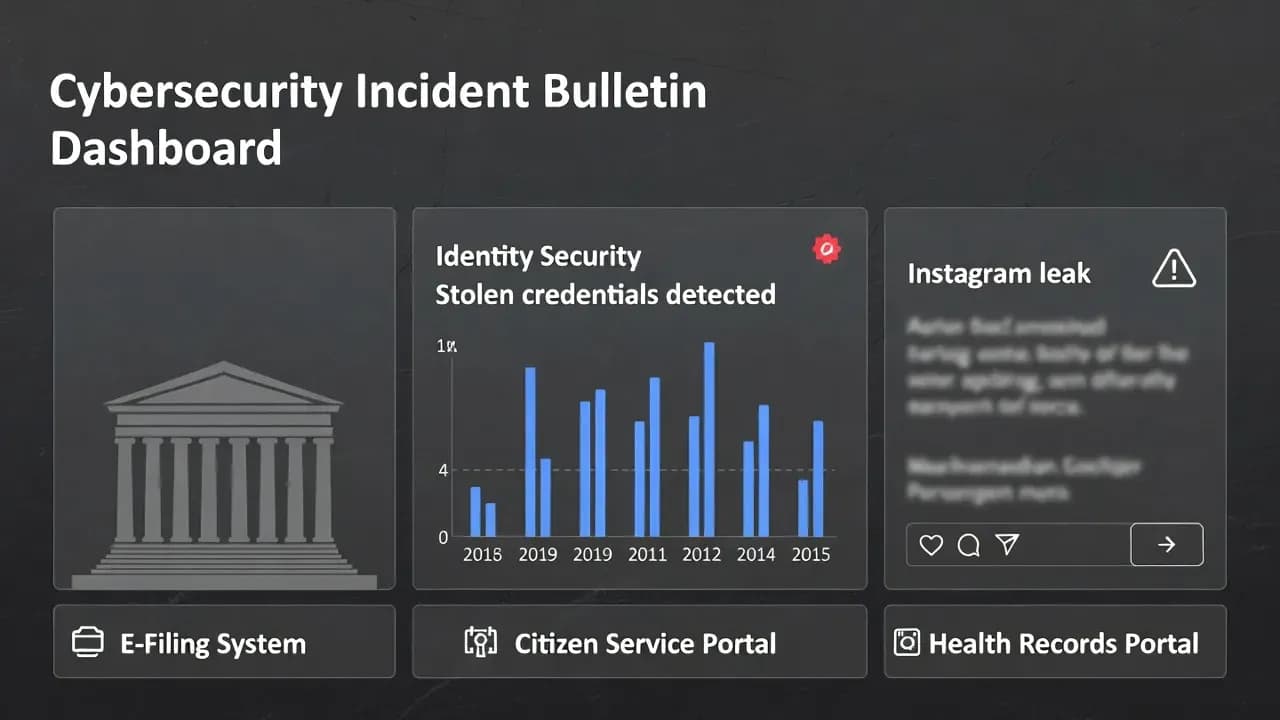
Supreme Court Filing System Hack: Tennessee Man Admits Stolen Data Was Posted on Instagram
A Supreme Court filing system hack used stolen credentials and leaked victim data on Instagram. What happened, what failed, and hardening steps.

The Supreme Court filing system hack story is not a tale of exotic malware or a zero-day chain. It is a reminder that the most damaging breaches often start with something painfully ordinary: stolen credentials, repeated unauthorized access, and a public leak designed to embarrass the victim rather than monetize the data. U.S. prosecutors say a 24-year-old Tennessee man accessed the U.S. Supreme Court's restricted electronic filing system dozens of times, then posted screenshots and personal details to Instagram. In parallel, he admitted to breaching accounts tied to AmeriCorps and the Department of Veterans Affairs' My HealtheVet platform, exposing sensitive personal and health information. For defenders, the "why care" is immediate: credential-based attacks increasingly look like legitimate use, and public-sector systems are often constrained by legacy processes, complex access models, and uneven monitoring coverage.
What Happened: The Technical Breakdown of the Supreme Court Filing System Hack
According to the U.S. Department of Justice, Nicholas Moore pleaded guilty in U.S. District Court in Washington, D.C., to a one-count information charging fraud activity in connection with computers, classified as a Class A misdemeanor. Prosecutors say Moore accessed the U.S. Supreme Court's electronic filing system without authorization at least 25 times, using a stolen credential belonging to an authorized user. The access window is unusually specific: the DOJ cites activity between August 29, 2023, and October 22, 2023, with Moore sometimes returning multiple times on the same day. That kind of persistence matters because it suggests the activity was not a single opportunistic login. It was repeated re-entry, which typically leaves a trail across authentication logs, session histories, and application-level telemetry if those layers are configured and retained.
The operational takeaway is that credential abuse in restricted systems is rarely "one and done." Attackers test the boundary: what can they see, what triggers alerts, and how long can they remain unnoticed. In this case, the alleged behavior involved viewing sensitive filing system details tied to an authorized user's account and then externalizing the exposure via social media. Reports indicate that Moore posted screenshots containing victims' names and Supreme Court filing system details to an Instagram account named @ihackedthegovernment. From a defensive standpoint, the exact handle spelling is less important than the tactic: public posting raises the blast radius by making sensitive information non-retractable, creating reputational harm and secondary risks such as harassment, doxxing, or targeted social engineering against individuals.
The same "valid credential" pattern appears across the other admitted intrusions. DOJ says Moore used stolen MyAmeriCorps credentials to access a second victim's AmeriCorps account over multiple dates and then posted the victim's personal information to Instagram. For the Department of Veterans Affairs, DOJ says Moore used stolen credentials to access the My HealtheVet platform on five days, exposing private health information including prescribed medications and other sensitive data, then posted it and claimed access to VA servers. The immediate lesson is that once an attacker has a legitimate login, many conventional perimeter defenses become irrelevant. The fight shifts to identity controls, anomaly detection, least privilege, and post-authentication monitoring.
Affected Organizations and Industries: Why This Was More Than a Single System Intrusion
At first glance, this incident may look narrow: one defendant, a small number of accounts, and a misdemeanor plea. But the target set spans multiple federal environments, each with different mission profiles and risk tolerances. The Supreme Court's electronic filing system is restricted for authorized users, and any unauthorized access raises integrity and privacy questions, even if the attacker primarily viewed account-level records rather than altering filings. In government contexts, the most sensitive element is often not a single record, but the implied "path": if one credential can be stolen and reused repeatedly without being locked out quickly, similar identities may also be at risk across adjacent systems.
The AmeriCorps compromise highlights a second theme: citizen-facing or service-member-facing portals can contain rich identity data that is valuable for downstream fraud. DOJ says the AmeriCorps victim data included name, date of birth, email, home address, phone number, citizenship status, veteran status, service history, and the last four digits of a Social Security number. Even partial identifiers like last-four SSN and service history can materially strengthen synthetic identity attempts, targeted phishing, or account recovery abuse. In practical terms, this is the kind of dataset that enables "precision" social engineering, where the attacker knows enough to sound legitimate to a helpdesk or to pass weak identity verification flows.
The VA My HealtheVet angle is particularly sensitive because health information introduces additional harms and regulatory complexity. DOJ says the defendant accessed private health information and posted screenshots showing medications prescribed to a victim. That escalates the impact beyond standard PII exposure into the realm of potential discrimination risks, personal safety concerns, and long-term reputational damage to individuals. It also creates a different incident response burden for defenders: health-related exposures typically involve stricter notification workflows, more careful public communications, and a broader scope of remediation guidance for affected users.
Finally, the cross-agency nature of the activity matters because it reflects how attackers behave in the real world. They reuse what works. Once a method for acquiring or abusing credentials is proven, they often apply it across multiple services until the underlying access channel is closed. Even if the technical steps were not sophisticated, the operational pattern aligns with a broader trend: "valid login" intrusions that blend into normal usage unless monitoring is tuned for behavior, not just signatures.
Threat Actor Profile and Motivation: Credential Abuse and Social-Platform Amplification
This is not a typical ransomware or financially motivated breach. The behavior described by prosecutors suggests the motive leaned toward notoriety and humiliation: access the systems, capture screenshots, publish the victim's information, and boast publicly. Reports indicate the defendant "bragged" about the breaches on Instagram and posted screenshots containing victims' names and system details. The public-facing nature of the leak changes the defender's job. With extortion, there is sometimes leverage for controlled disclosure timing. With social posting, there is no negotiation, and the data is instantly replicated, screenshotted, reposted, and archived.
From a security operations perspective, this pattern sits at the intersection of cybercrime and influence dynamics. Attackers increasingly use mainstream platforms to amplify impact because it guarantees attention and creates uncertainty for victims who cannot easily confirm what else was accessed. In this case, the Instagram posts function like a "proof of access," and they also weaponize the victim's identity by placing it in an adversarial public context. The attacker does not need to exfiltrate a database dump to create real-world harm; a small number of screenshots can trigger organizational incident response, damage trust, and endanger individuals.
The underlying enabler remains simple: stolen credentials. Court reporting states the defendant used stolen credentials to access the Supreme Court system on 25 different days and posted information on Instagram. Federal court records systems have faced repeated cyber issues over recent years, with broader efforts underway to strengthen protections around sensitive filings. While this incident does not prove systemic compromise across the judiciary, it does reinforce an uncomfortable truth: identity is often the softest point in complex government ecosystems, especially where user populations include external filers, partners, contractors, or intermittent authorized users who may not follow rigorous security hygiene.
Motivation also matters for prevention planning. Notoriety-driven intruders are often less predictable than profit-driven ones. They may return repeatedly, they may take risks, and they may publicize partial data purely for attention. That combination means defenders should prioritize rapid credential revocation, strong anomaly detection for repeated access patterns, and pre-planned communications playbooks for social-media-driven leaks.
How Organizations Can Respond: Practical Controls for Credential-Based Intrusions
If you treat this incident as a one-off embarrassment, you miss the operational lesson. This is a blueprint for how low-complexity attacks create high-complexity response costs. The priority is to reduce the odds that stolen credentials can be reused repeatedly, and to ensure that if reuse happens, it is detected quickly and contained decisively.
Start with identity hardening that specifically targets "valid login" abuse. Enforce phishing-resistant MFA where feasible, especially for users with privileged access or access to restricted filing systems and high-sensitivity portals. In many environments, MFA exists but is not uniformly enforced, or it allows weaker factors that can be bypassed via session theft. Pair MFA with conditional access signals: device trust, geolocation risk, impossible travel, and high-risk sign-in detection. These controls are most effective when combined with short session lifetimes and re-authentication requirements for sensitive actions such as viewing protected documents, exporting records, or changing account details.
Second, operationalize anomaly detection. In this case, prosecutors say Moore accessed the Supreme Court filing system over 25 days and sometimes multiple times per day. That pattern should be modelable. Build detections for unusual access cadence, repeated logins from new IP ranges, sudden spikes in document views, and "thin" sessions where a user only views sensitive records without normal workflow behavior. Tie these detections to automatic response where appropriate: step-up authentication, temporary lockouts, and rapid verification workflows.
Third, assume public leak amplification and plan for it. The Instagram posting element means your incident response plan must include rapid social monitoring, evidence preservation, and user protection steps. Create a process to capture and preserve leaked posts for investigative and legal needs, while also coordinating takedown requests through platform channels. Focus on downstream risk: warn potentially affected users about targeted phishing, account recovery fraud, and impersonation attempts.
Lessons Learned and Industry Implications
The most important insight from the Supreme Court filing system hack is not the attacker's tooling. It is the mismatch between how defenders often categorize attacks and how attackers exploit operational reality. Many organizations still treat credential theft as an end-user problem and focus investments on perimeter controls, malware prevention, or "advanced" threat hunting. But credential abuse is a system problem: it exploits authentication design, session handling, logging gaps, and slow revocation workflows.
This case also illustrates why "misdemeanor" does not mean "minor impact." The maximum exposure includes up to one year in prison and a fine of up to $100,000. That classification reflects charging decisions and legal frameworks, not the sensitivity of the accessed information. The posting of personal and health information, even in limited quantities, can produce long-term harm that far outlasts the court process.
Looking forward, expect two trends to accelerate. First, more attackers will use mainstream social platforms as a disclosure channel because it is fast, attention-grabbing, and difficult to fully contain. Second, defenders will increasingly need to measure success in "time to detect credential misuse," not just "time to patch vulnerabilities." In a world where attackers can log in legitimately, your security posture is only as strong as your identity telemetry and your ability to shut sessions down quickly and safely.
Frequently Asked Questions
It appears driven by credential abuse and public exposure rather than monetization. Prosecutors describe repeated unauthorized access using stolen credentials and the posting of victim data on Instagram.
Public reporting and DOJ statements focus on stolen credentials and unauthorized access, not a disclosed software exploit or CVE.
Because the traffic often looks legitimate. Detection relies on behavior, unusual access patterns, and correlated identity telemetry rather than simple signature-based alerts.
Phishing-resistant MFA for sensitive roles, tighter session controls, rapid credential revocation, and detections for repeated access patterns across days or weeks.
Yes. Health information exposure raises additional privacy risks and typically demands more careful user notification and support guidance, especially for targeted phishing and impersonation scenarios.
Comments
Want to join the discussion?
Create an account to unlock exclusive member content, save your favorite articles, and join our community of IT professionals.
New here? Create a free account to get started.