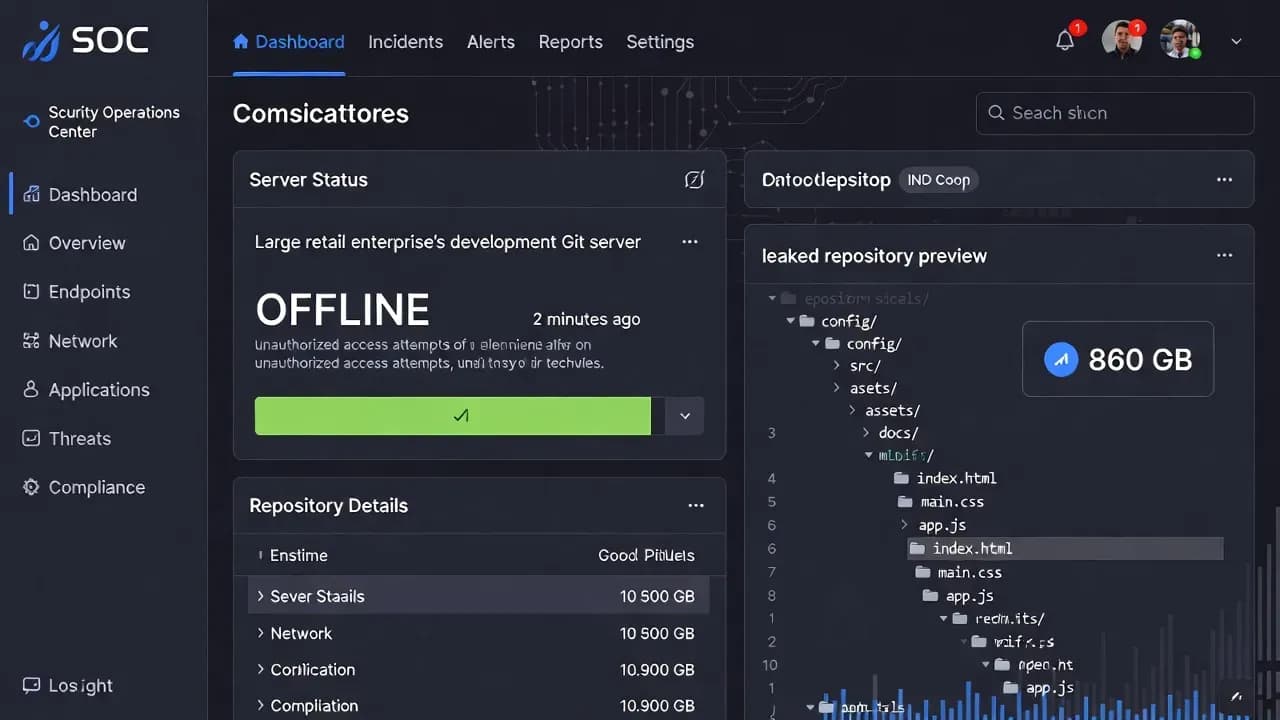
Target Dev Git Server Goes Dark After Hackers Claim 860 GB Source Code Theft
Target's developer Git server became unreachable from the public internet shortly after hackers claimed they had stolen internal source code and published sample repositories as proof.

Alleged size of the full source code archive advertised for sale
Directory index in the SALE.MD file listing files and folders
Developer Infrastructure Under Fire
Target's developer Git server became unreachable from the public internet shortly after hackers claimed they had stolen internal source code and published sample repositories as proof. The alleged leak is not a typical "customer data breach" story. It is a software supply chain and internal security story, where stolen code, documentation, and commit metadata can become a blueprint for future exploitation, targeted phishing, and long-tail security debt. Even if no customer data is involved, source code exposure can materially raise risk because modern enterprise repos frequently contain internal endpoints, architecture clues, and occasionally secrets that were never meant to leave a trusted engineering boundary.
What Happened: Alleged Target Source Code Posted as "Preview" Ahead of a Sale
According to reporting, an unknown threat actor posted screenshots in a private hacking community claiming access to Target's internal development environment. Around the same time, the actor created multiple repositories on Gitea that appeared to contain portions of Target's internal code and developer documentation. These repositories were framed as a preview of a larger dataset allegedly being offered for sale to buyers through underground channels.
Each sample repository included a file named SALE.MD that listed tens of thousands of files and directories purportedly included in the full dataset. The index was described as more than 57,000 lines long, with the overall archive advertised at approximately 860 GB. If accurate, that scale would be consistent with a broad internal dump rather than a single application repo.
The repository names highlighted in reporting also suggest a wide scope, spanning identity and provisioning themes, gift card related components, and documentation that could include sensitive operational context. Importantly, the sample content was described as referencing internal Target systems and people, including internal server naming and references to current engineers in commit metadata and documentation. That kind of internal "texture" is often what investigators look for when assessing whether a leak plausibly originated from a private enterprise environment rather than a staged fabrication.
The Immediate Response Signal: The Sample Disappears and git.target.com Becomes Inaccessible
After questions were sent to Target about the alleged incident, the public samples reportedly began returning 404 errors, consistent with a takedown. Around the same time, Target's developer Git server at git.target.com became inaccessible from the internet.
Before it went dark, the Git subdomain reportedly redirected to a login page and prompted employees to connect via Target's secure network or VPN. The shift from "reachable with login prompt" to "not loading externally" is not proof of a breach by itself, but it is a notable operational change. It suggests Target either tightened exposure proactively, reacted to the public attention, or took the service offline as part of an internal incident response workflow.
Another subtle but important point: search engines had indexed and cached a small number of resources from git.target.com, implying that some content may have been publicly accessible at some point. That does not automatically validate the hacker's claim, because indexed resources could reflect historical configuration, public assets, or unrelated exposure. But it does reinforce a central lesson for enterprise development infrastructure: internet adjacency is risk, even when authentication exists.
What Can Be Confirmed vs What Remains Unverified
At the time of reporting, the most defensible framing is "breach claim with supporting artifacts," not "confirmed compromise." The full 860 GB dataset was not independently verified in public reporting, and Target did not publicly confirm a breach.
However, several details make this event operationally meaningful even without confirmation:
- The sample repos were described as consistent with an enterprise Git environment in naming conventions and directory structure.
- Commit metadata and documentation were described as referencing internal servers and current personnel.
- The sample was described as not matching Target's open-source projects, which suggests the material would originate from private development infrastructure if authentic.
This is the point where security teams should shift mindset. Confirmation is important for public statements, but containment and scoping do not wait for external validation. If there is a plausible chance that internal repos were accessed or exfiltrated, the correct response is to assume compromise of developer trust boundaries until proven otherwise.
Why Source Code Theft Is Not "Just Embarrassing": The Long Tail of Exploitation
Source code alone rarely gives an attacker instant access. The real risk comes from what code and documentation reveal over time:
Internal architecture and trust relationships: repo structure can expose service boundaries, naming conventions, identity flows, and dependency chains.
Internal endpoints and admin surfaces: docs and config often reference non-public URLs, internal dashboards, and operational tooling.
Credential and secret leakage: even mature teams sometimes commit API keys, tokens, certificates, or temporary secrets, especially in private repos where developers feel "safe."
Supply chain and CI/CD abuse: code repositories are not only storage. They are execution triggers. If attackers obtain credentials, tokens, or CI runner access, they can pivot from read-only theft to code changes, build manipulation, or lateral movement.
Modern incidents increasingly treat "code to cloud" as an attack path: compromise developer credentials, locate secrets and workflow patterns, then pivot into cloud control planes or production environments. That is why repos demand security controls that look more like identity and infrastructure security than "developer tooling."
Likely Intrusion Paths (and Why Dev Git Servers Are Attractive Targets)
Without confirmed root cause, any specific intrusion narrative would be speculation. But defenders can still model realistic paths based on how these environments are typically breached:
Credential compromise: stolen passwords, reused credentials, or leaked tokens for Git access are common entry points.
Weak access governance: stale accounts, over-broad permissions, or lack of strong MFA on developer identity can turn a single phished credential into broad repo access.
Internet exposure and misconfiguration: a Git service can be "authenticated" yet still leak metadata, assets, or endpoints; reverse proxy mistakes can also expose services unintentionally.
Secrets in repos or tooling: credentials stored in code or build pipelines can enable escalation into CI/CD systems, artifact registries, and cloud services.
The presence of a repo named "Secrets-docs" in the published sample list is particularly notable as a risk signal. The name alone does not confirm sensitive content, but it underlines the operational reality: internal documentation frequently includes the very details defenders work to keep out of attacker hands.
Practical Incident Response: What Target (and Any Enterprise) Should Do First
If you are defending a large engineering organization and you face a similar breach claim, the playbook is straightforward and time-critical:
Contain access to source control and developer SSO: restrict public reachability, validate firewall and reverse proxy posture, and require secure network access where feasible.
Rotate credentials aggressively: rotate access tokens, deploy key material, CI secrets, service credentials referenced by repos, and any secrets that could plausibly be embedded in code or documentation.
Inventory and invalidate personal access tokens: many breaches persist because tokens outlive password resets.
Audit repo access patterns: look for anomalous cloning, bulk fetch, unusual times, new SSH keys, and uncommon user agents.
Hunt for CI/CD execution abuse: identify unexpected workflow runs, new pipelines, modified build scripts, and suspicious runner registrations.
Assume targeted phishing against engineers: leaked names and internal system references can immediately fuel highly convincing pretexting.
If the threat actor's goal is resale, you should also assume the dataset may change hands quickly. That increases the importance of rotating secrets and hardening identity before secondary buyers begin exploitation.
Defensive Engineering: Controls That Reduce Blast Radius When Repos Leak
This incident highlights the difference between "repo security" and "software engineering discipline." A mature program reduces the value of stolen code:
Secrets never live in repos: enforce pre-commit scanning, server-side scanning, and automated secret revocation workflows.
Least privilege by default: developers should not have broad access to unrelated repos; service accounts should be tightly scoped.
Strong MFA and device-bound authentication: require phishing-resistant methods for privileged engineering accounts.
Branch protections and signed changes: protect critical repos so that even with access, attackers cannot silently inject changes into production paths.
Segment CI/CD from core identity: limit what build systems can access and monitor for unusual workflow creation and deletion behavior.
Logging that supports investigations: retain source control audit logs, including token creation, repo exports, and admin-level changes.
The objective is not to prevent every compromise. It is to make compromise noisy, containable, and expensive for the attacker.
What Readers Should Watch Next
Two developments will determine the real severity:
Independent validation: credible samples, hashes, or third-party confirmation that the dataset is authentic and current.
Target's disclosures or customer impact statements: whether Target confirms internal compromise, and whether any downstream systems were affected beyond source control.
Until then, the most responsible stance is to treat this as a serious breach claim with meaningful indicators, while being precise about what is verified and what is not.
Conclusion
The most important detail in the Target story is not the underground sales pitch. It is the response signal and the security lesson: developer infrastructure is now a frontline target, and repo exposure is often a precursor to deeper incidents. Whether this turns out to be a confirmed compromise or a well-constructed breach claim, the defensive takeaway is the same. Treat source control as critical infrastructure, design repos so that stolen code has limited value, and assume that attackers will use engineering context to drive targeted phishing and long-tail exploitation.
Frequently Asked Questions
Public reporting described a breach claim supported by sample repositories and internal-looking metadata, but the full dataset was not independently verified and Target did not confirm the breach publicly at the time.
Because source code and internal documentation can reveal architecture, internal endpoints, dependency chains, and sometimes secrets. That information can enable targeted phishing and future exploitation, even if there is no immediate customer impact.
No. It is a response signal, not proof. Organizations often restrict exposure or take services offline during incident response even when investigating a claim. It does, however, indicate the claim was treated seriously enough to trigger operational changes.
Rotate secrets and tokens broadly, especially CI/CD secrets and access tokens that can persist beyond password resets. Then audit repo access and workflow execution logs to scope whether data theft or build abuse occurred.
Common outcomes include selling archives, using internal knowledge to find vulnerabilities, targeting engineers with believable pretexts, and attempting CI/CD or cloud pivots using leaked credentials and workflow patterns.
Related Incidents
View All High
HighTelegram Proxy Links IP Address Leak: One Click Can Bypass Your Privacy Proxy and Expose Your Real IP
The Telegram proxy links IP address leak is a privacy failure that looks deceptively ordinary: a user taps what appears...
 Medium
Discord "Breach" Claim Looks Like Mass Scraping: HawkSec Auctions 78,541,207-File Dataset From Public Servers
A new "Discord breach" claim circulates as HawkSec promotes an auction of 78,541,207 files. Early indicators suggest lar...
 High
HighIndia Becomes the Primary Mobile Malware Target: Why Attackers Concentrate on Phones, Payments, and "Trusted" App Stores
India's position as the most targeted region for mobile malware is not an abstract statistic. It is an operational reali...
Comments
Want to join the discussion?
Create an account to unlock exclusive member content, save your favorite articles, and join our community of IT professionals.
New here? Create a free account to get started.