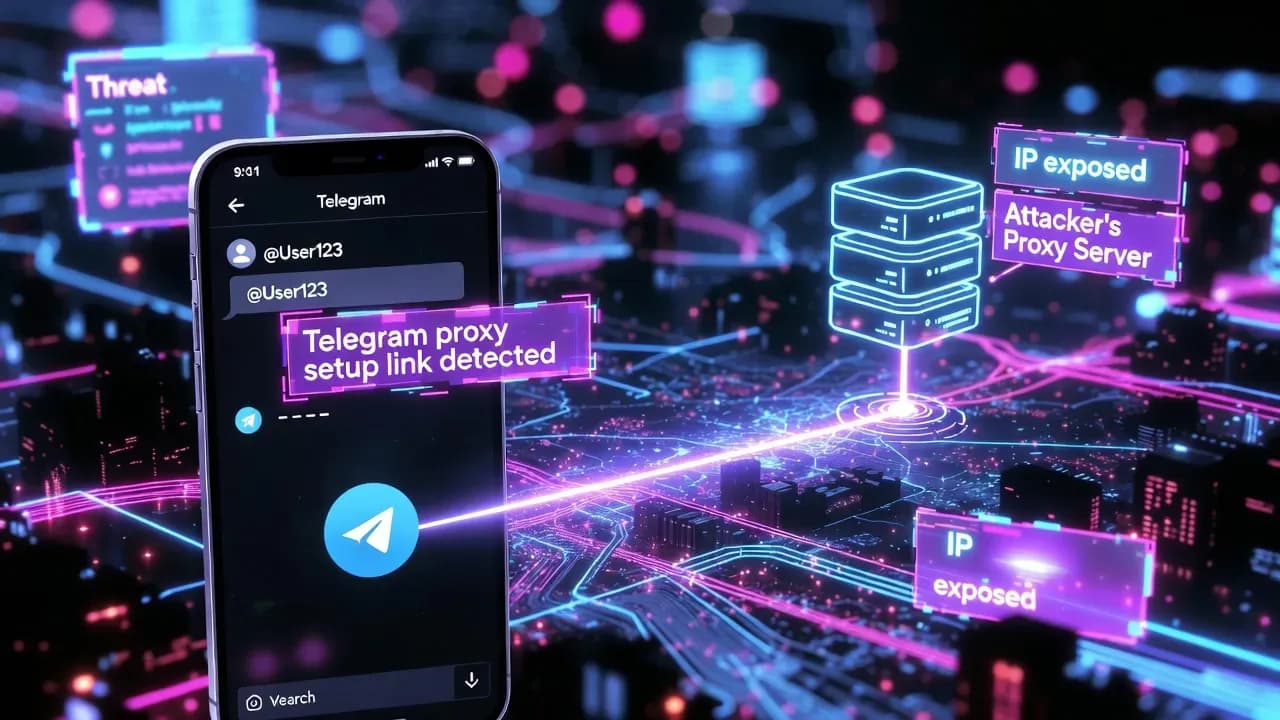
Telegram Proxy Links IP Address Leak: One Click Can Bypass Your Privacy Proxy and Expose Your Real IP
The Telegram proxy links IP address leak is a privacy failure that looks deceptively ordinary: a user taps what appears to be a harmless Telegram username, and their real IP address can be exposed immediately.

User interaction required for complete IP exposure via a disguised proxy link
Additional steps needed before the proxy connectivity test begins
The Privacy Failure Hidden in Plain Sight
The Telegram proxy links IP address leak is a privacy failure that looks deceptively ordinary: a user taps what appears to be a harmless Telegram username, and their real IP address can be exposed immediately. The problem is not that proxy operators can see traffic, that is expected. The problem is that Telegram's mobile clients can initiate a direct connection test to a proxy server before the user meaningfully confirms the action, and that test can occur outside the privacy assumptions that led the user to enable a proxy in the first place. For activists, journalists, and anyone using Telegram to reduce location exposure, this is the worst kind of risk: low effort for attackers, easy to disguise, and difficult for victims to notice until the damage is done.
What Happened: The One-Click Flow That Turns a Proxy Feature Into a Deanonymization Trap
Telegram supports proxy links so users can configure MTProto proxies quickly without typing server details manually. In practice, that convenience creates a sharp edge: on Telegram's Android and iOS clients, a proxy link can trigger an automatic connectivity test to the proxy endpoint as soon as the user clicks it. That test is the key event, because it originates from the user's device and can reveal the user's public IP address to whoever controls the proxy server. In a targeted scenario, the attacker does not need to compromise Telegram, break encryption, or steal an account. They only need the victim to click once.
The threat becomes more credible because proxy links can be disguised. The user might believe they are clicking a normal username mention, a channel reference, or a benign link. Instead, the click resolves to a proxy configuration deep link, and the client begins the test connection. Even if the user backs out or refuses to add the proxy, the sensitive part may already have occurred because the attacker's server has logged the inbound request. That makes the exposure both fast and asymmetric: defenders need detection, education, and policy controls to reduce clicks, while attackers need only a well placed lure.
Telegram has acknowledged the behavior to media outlets and stated it will add warnings when users click proxy links, aiming to make disguised links easier to spot. The company did not publicly commit to a rollout date at the time of reporting, which means the window of exposure depends on when specific client updates ship and how quickly users update their apps. Until warnings are deployed broadly, the safest assumption is that the current click behavior remains exploitable for targeted IP discovery, especially in communities where proxy links are common and clicks are routine.
Why This Happens: Deep Links, MTProto Proxy Setup, and "Test Before Trust" Behavior
To understand the Telegram proxy links IP address leak, it helps to view proxy links as part of Telegram's deep link ecosystem. Telegram clients are built to handle special t.me and tg:// links that execute actions inside the app, not just open webpages. Proxy setup links are a legitimate example of that design: they encode proxy parameters like server and port so Telegram can present a configuration prompt and enable the proxy quickly. This is why proxy links are frequently shared in channels that help users bypass network blocks.
The technical issue is not the existence of proxy links, it is the sequence of events on mobile clients. When a client attempts to "test" a proxy before the user clearly commits to using it, the test becomes an information leak channel. It effectively says: "I will reach out to this server right now from your real network interface to check if the proxy is reachable." From a user experience perspective, that seems helpful. From a privacy and threat modeling perspective, it breaks a core assumption: the user expects the app's proxy setting to protect them from direct exposure, yet a crafted link can cause a direct outbound connection anyway.
This also highlights a broader industry pitfall: privacy features that are primarily designed for availability, such as bypassing ISP blocks, are often misused as anonymity tools. MTProto proxies can help access Telegram in restrictive environments, but that does not automatically mean they provide strong identity or location protection in all click paths. The distinction matters because many users treat "proxy enabled" as a universal shield, and attackers build lures around that confidence. The result is a design mismatch between why the feature exists and how users operationally rely on it.
Who Is at Risk: High Sensitivity Communities, Operational Security Failures, and Targeted Lure Placement
Not every Telegram user faces the same risk. The most exposed group is anyone who uses Telegram proxies as part of a privacy routine, especially if their threat model includes state level surveillance, coercion, stalking, or doxxing. Journalists communicating with sources, activists coordinating under censorship, and individuals in conflict zones often rely on Telegram's proxy ecosystem because it is widely available, culturally normalized, and easy to share. Those same properties make it attractive for adversaries who want deanonymization without malware.
The risk is also elevated for users who participate in large public groups where links and username mentions are frequent. In those environments, clicking becomes reflexive. A disguised proxy link inserted into a conversation can look like a normal mention, and social context can suppress suspicion. If the attacker controls the proxy endpoint, they can log IP addresses at scale, but the more realistic threat is targeted. A single click from a single high value person can be enough to narrow location, map travel patterns, or confirm whether a user is connecting from a specific country or network.
Enterprises are not immune either. Telegram is often used as an informal coordination channel in IT and security communities, incident response circles, and regional business networks. When employees use Telegram on personal devices with mixed personal and professional identities, an IP leak can become a bridge into additional targeting. Once an attacker has a rough location, ISP, and time pattern, they can tailor follow on phishing, harassment, or even denial of service attempts. In threat intel terms, this is a low cost enrichment step that helps the attacker pivot from broad speculation to confirmed identity context.
How Attacks Would Use This in the Real World: Social Engineering Beats Exploitation
The most practical abuse case is simple: a malicious actor wants to confirm where a person is connecting from, or to identify whether a target is using a VPN or a specific network. Instead of burning expensive exploits, the attacker leverages a proxy link lure. They share it in a group where the target is active, embed it in a message that looks like a username mention, or wrap it in a context that prompts curiosity. The victim clicks. The attacker logs the IP. The attacker now has a concrete technical artifact tied to a social identity.
A second abuse case is intimidation and disruption. If the attacker learns the target's approximate location, they can escalate harassment, attempt account recovery scams tailored to the region, or launch nuisance traffic toward the user's network. The IP itself does not automatically equal compromise, but it can be enough to raise the personal risk level for individuals who depend on ambiguity for safety. In some threat models, losing location ambiguity is the incident.
A third abuse case is correlation. Many targets maintain multiple online identities, but they reuse devices and networks. IP logging from a Telegram click can be correlated with activity elsewhere, especially if the attacker has visibility into other datasets or can induce similar "one click" beacons on other platforms. This is why defenders should treat IP leakage as an enabling signal. The attack chain does not end at "we learned the IP." It begins there, because the IP becomes the anchor that makes other correlation attacks more accurate.
How Organizations and Individuals Can Respond: Prevention, Safe Defaults, and Compensating Controls
Telegram's promise to add warnings is helpful, but it should not be treated as a complete mitigation. Warnings reduce accidental clicks, but they do not remove the underlying reality that a proxy link points to an attacker controlled server. Users should assume that clicking any proxy link is equivalent to contacting that server directly, and therefore should be treated like clicking an unknown website. If you would not click a random shortened URL in a high risk chat, you should not click a random proxy link either.
For high risk users, the most robust compensating control is system wide tunneling. A device level VPN that forces all traffic through an encrypted tunnel reduces the chance that an application can make a direct connection that exposes a real IP. This does not fix every problem, but it aligns the control with the user's goal: routing all apps through a protective path. If your threat model is serious, rely on controls that apply beneath the app layer, not inside it. The most important mindset shift is to treat app built in proxy settings as a connectivity tool, not a guaranteed anonymity layer.
For organizations, the response is partly policy and partly hygiene. If Telegram is used in any professional context, define acceptable use guidance that includes link handling and threat awareness. Encourage staff to avoid clicking links that resolve to t.me actions unless they are expected and verified, and treat proxy links as high risk. If your environment supports mobile device management, consider enforcing a trusted VPN configuration on devices that handle sensitive communications, and provide a secure alternative channel for high sensitivity coordination so staff are not forced into ad hoc practices.
Finally, detection and incident response should be realistic. IP leakage is often not visible in enterprise logs if it happens on a personal device. The best defensive posture is prevention, education, and minimizing the number of people who must rely on Telegram proxy features for safety. When an exposure is suspected, focus on operational security: assume the attacker may have location context, adjust comms patterns, rotate identities where possible, and reduce predictable online routines. In privacy incidents, remediation is often about changing behavior faster than the attacker can exploit it.
Conclusion
The Telegram proxy links IP address leak is a reminder that privacy failures often emerge from convenience features, not sophisticated exploitation. When a deep link can trigger an automatic outbound connection to an attacker controlled endpoint, a single click becomes a deanonymization event. Telegram's plan to add warnings is a sensible short term mitigation, but high risk users should not wait for UI changes to protect them. Treat proxy links as untrusted, prefer device level tunneling for strong IP protection, and assume that in adversarial environments, anything clickable can become a sensor that reports back to someone else.
Frequently Asked Questions
No evidence suggests Telegram's backend was compromised. The issue is a client side behavior where clicking a proxy setup link can trigger a direct connection test to a server controlled by an attacker, which can reveal the user's IP address. The exposure happens even if the user does not intend to add the proxy.
The problem is the surprise and the disguise. Users may click something that looks like a username or harmless link and unintentionally contact an attacker's proxy server. In high risk scenarios, even a single unexpected IP disclosure can enable location inference and targeted follow on actions.
MTProto proxies are primarily designed to help users reach Telegram when access is restricted, not to provide strong anonymity guarantees in every interaction path. If you need consistent protection against IP exposure, a device level VPN that routes all traffic is a stronger baseline control. High risk users should not rely on app only proxy settings as the sole safety measure.
Treat proxy links as potentially dangerous content. Educate members that proxy links can disclose IP addresses and that they should be clicked only when the proxy source is trusted and expected. Consider adding moderation rules that restrict proxy link posting or require clear labeling and verification in sensitive communities.
For most enterprises, the risk is targeted reconnaissance and identity enrichment. If employees use Telegram for professional discussion, an attacker can use IP logging to build a more precise targeting profile. The safest approach is to avoid sensitive operational discussions on public platforms and ensure staff use protected network paths on mobile devices.
Related Incidents
View All High
HighTarget Dev Git Server Goes Dark After Hackers Claim 860 GB Source Code Theft
Target's developer Git server became unreachable from the public internet shortly after hackers claimed they had stolen...
 Medium
Discord "Breach" Claim Looks Like Mass Scraping: HawkSec Auctions 78,541,207-File Dataset From Public Servers
A new "Discord breach" claim circulates as HawkSec promotes an auction of 78,541,207 files. Early indicators suggest lar...
 High
HighIndia Becomes the Primary Mobile Malware Target: Why Attackers Concentrate on Phones, Payments, and "Trusted" App Stores
India's position as the most targeted region for mobile malware is not an abstract statistic. It is an operational reali...
Comments
Want to join the discussion?
Create an account to unlock exclusive member content, save your favorite articles, and join our community of IT professionals.
New here? Create a free account to get started.