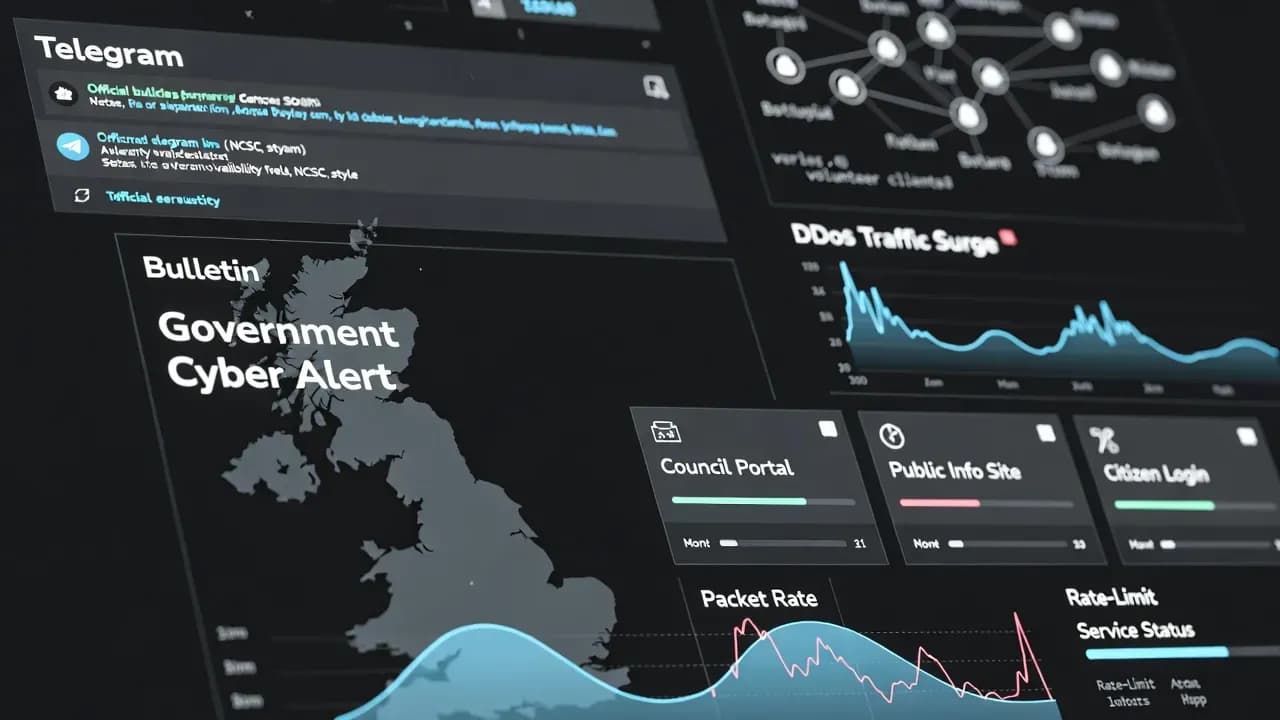
UK Warns of Ongoing Pro-Russian Hacktivist DDoS Attacks: Why "Simple" Disruption Is Becoming a Strategic Risk
UK warns pro-Russian hacktivists keep hitting councils and critical services with DDoS. What's driving it, what breaks first, and how to harden fast.

Estimated users mobilised by NoName057(16)
Of hacktivist incidents were DDoS attacks (ENISA)
The UK government has issued a fresh warning that pro-Russian hacktivist groups are continuing to target UK organisations with denial-of-service attacks, with local authorities and critical national infrastructure among the most exposed. What makes this wave worth treating as more than "noise" is not technical novelty, but operational reality: availability attacks are cheap to launch, easy to repeat, and disproportionately expensive to absorb when they hit the wrong dependency at the wrong time. In 2026, pro-Russian hacktivist DDoS attacks in the UK are less about a single website going offline and more about testing how quickly public services, suppliers, and incident teams can recover under pressure.
What Happened: The Technical Breakdown Behind the UK Warning
The public-facing story is straightforward: UK authorities say Russian-aligned hacktivist activity is ongoing, and organisations should expect disruption. The more important detail is why that warning is being repeated now and what it signals about the current operating tempo.
According to reporting based on the National Cyber Security Centre's alert, the attacks are designed to take websites offline and disable services, and the NCSC stresses that even technically basic denial-of-service activity can impose meaningful cost and operational drag on defenders. The Register's coverage includes a succinct framing from NCSC leadership: denial-of-service can be "technically simple" while still producing significant impact by blocking access to everyday services. That statement matters because it reflects a mature view of security outcomes: availability is a business function, not a vanity metric.
From an operational perspective, DDoS campaigns typically succeed not because defenders lack a firewall, but because organisations underestimate their own bottlenecks. That includes rate limits on authentication endpoints, fragile DNS dependencies, single-region hosting, insufficient upstream coordination with ISPs, and brittle third-party integrations. In public sector environments, another classic weakness is governance: "Who calls the ISP?", "Who approves emergency changes?", and "What do we take offline first to preserve essential services?" Those questions become the real kill chain during sustained disruption.
Threat Actor Profile: NoName057(16), DDoSia, and the Pro-Russia "Crowd" Model
The UK warning highlights NoName057(16) as a notable actor, widely linked to ideologically motivated DDoS campaigns since 2022. The model is important: these groups can look like "hacktivists," but their operations often resemble an organised online mobilisation effort.
BleepingComputer notes that NoName057(16) operates DDoSia, a platform that allows volunteers to contribute computing resources and receive rewards or recognition. This crowdsourced approach changes the economics. You are not defending against one attacker; you are defending against a distributed pool of participants whose only constraint is coordination and tooling.
Eurojust's 2025 takedown narrative helps explain the scale and persistence of this ecosystem. In its Operation Eastwood press release, Eurojust states it was estimated the hackers could mobilise around 4,000 users, and that the group built a botnet using hundreds of servers to increase attack load. That is not a "few teenagers on Telegram." It is a repeatable capability with a recruitment pipeline.
Persistence is a feature, not a bug. Even after major disruption operations, these groups can reconstitute because the crowd model is resilient. You can take down infrastructure, but re-recruitment and retooling are comparatively fast when the narrative is political and the barrier to participation is low.
Claims are part of the operation. The joint advisory community has repeatedly noted that hacktivist groups can exaggerate or misrepresent outcomes to amplify psychological effect. That does not make the threat harmless. It means defenders must separate "service impact" from "propaganda impact" and respond calmly, with measured communications.
Why the UK, Why Now: Strategic Messaging and Event-Driven Targeting
Hacktivist DDoS activity is often event-driven: elections, summits, speeches, sanctions announcements, and military aid packages create narrative hooks that make disruption feel "justified" to participants. Eurojust describes NoName057(16) conducting attacks during high-level political events and notes targeting patterns across Europe, including activity during European elections and around major international moments.
This matters because it changes how UK organisations should interpret risk. The question is not "Will someone DDoS us randomly?" The better question is: "What events in the next quarter create a predictable spike in interest, and are our availability controls tested for that window?"
ENISA's Threat Landscape reinforces how dominant DDoS is within hacktivism campaigns, noting that DDoS attacks constituted 91.5% of incidents in its EU member state reporting period, with hacktivist groups remaining a highly active threat category.
What "DDoS Impact" Actually Looks Like in 2026
Many organisations still evaluate DDoS readiness using a simplistic question: "Can our website handle a flood?" In practice, the first failure is often not bandwidth. It is a dependency chain failure.
Common patterns seen in real-world disruption incidents include:
- DNS or authoritative provider saturation: the site is "up," but name resolution becomes unreliable.
- Upstream provider throttling: an ISP or hosting provider applies protective rate limiting that inadvertently blocks legitimate users.
- Authentication endpoint collapse: login services fail, which cascades into "everything is down."
- Third-party integrations: payment portals, identity services, form submissions become the choke point.
- Human bottlenecks: the technical mitigations exist, but access to administer them is not available out of hours.
The multi-agency advisory published in 2025 highlights that pro-Russia hacktivists have also been observed exploiting insecure, internet-facing VNC connections to reach operational technology environments.
How Organisations Can Respond: A Practical Playbook
1) Map your "availability surface"
Identify what must stay up for your organisation to function: citizen portal, call-center workflows, emergency updates, authentication, DNS, email, status page. Then identify what can degrade gracefully.
2) Put upstream mitigation in writing
If you do not have a signed agreement or documented process with your ISP, CDN, or DDoS provider, you do not have mitigation. You have hope.
3) Pre-authorise emergency actions
The organisations that recover fast are the ones that do not need a committee meeting to switch DNS, increase capacity, or activate a "static mode" for citizen updates.
4) Monitor for "smokescreen" behaviour
While many attacks are pure disruption, defenders should be alert to the classic smokescreen pattern: DDoS to distract while credential stuffing, phishing, or opportunistic exploitation occurs elsewhere.
5) Communicate like an operator
Public sector incidents degrade trust faster when communications are slow. Pre-draft external statements that explain what is affected, what is not affected, what users should do, and where to get updates.
Closing
The UK's renewed alert is a reminder that pro-Russian hacktivist DDoS attacks in the UK are now part of the operational baseline for public services and critical operators. The uncomfortable truth is that "simple" attacks win when organisations treat availability as an afterthought. The fastest path to resilience is not chasing the latest threat actor brand, but hardening fundamentals: upstream mitigation, rapid scaling, rehearsed response, and calm communications.
Frequently Asked Questions
Most reported activity is disruptive denial-of-service designed to take services offline. However, defenders should still watch for parallel malicious activity. [4]
Because impact is measured in service availability, recovery cost, and public trust. Even technically basic attacks can force incident response and trigger expensive mitigation actions. [1][2]
Local authorities and critical national infrastructure operators are repeatedly highlighted as exposed categories. [1][2]
DDoSia is a crowdsourced platform used to coordinate volunteers contributing resources toward attacks. This model makes campaigns easier to scale and sustain. [1][3]
Establish upstream mitigation agreements and run a live rehearsal: confirm who can trigger ISP or CDN protections, and test a degraded-mode plan for critical pages. [1]
The broader ecosystem has been associated with opportunistic access attempts in critical infrastructure contexts, including insecure VNC exposures. [4]

Comments
Want to join the discussion?
Create an account to unlock exclusive member content, save your favorite articles, and join our community of IT professionals.
New here? Create a free account to get started.