

BlueMoon exploit kit chains Chrome and Windows zero-days in espionage campaigns
Proofpoint and Volexity tie multiple espionage clusters to one shared chain of two Chrome bugs and a Windows kernel flaw, all now patched.

On this page
Key takeaways
- BlueMoon chains CVE-2026-85046 and CVE-2026-87491 in Chrome's V8 engine with CVE-2026-85880, a heap overflow in Windows ALPC.
- Google fixed CVE-2026-85046 in Chrome 152.0.7977.82/.83 on 3 September 2026 and CVE-2026-87491 in Chrome 153.0.8010.36/.37 on 8 September 2026.
- Microsoft patched CVE-2026-85880 in its September 2026 Patch Tuesday release, crediting Volexity and Proofpoint researchers.
- Proofpoint identified four clusters using the kit from 28 August 2026; Volexity separately documented UTA0560 against NGOs.
- The Windows privilege escalation only runs on builds 17763, 19041 to 19045, 20348 and 22000, which narrows the viable target pool.
What to do now
High urgency- Update Chrome to 153.0.8010.36/.37 or later and verify the deployed build across the fleet.
- Apply the September 2026 Windows security updates that address CVE-2026-85880.
- Inventory endpoints on builds 17763, 19041 to 19045, 20348 and 22000, and prioritise those for upgrade or isolation.
- Hunt for the chrome.exe to cmd.exe to curl.exe process tree and for msgbox.exe or ChromeUpdate.exe in %TEMP%.
- Audit installed Chromium extensions and enforce an install allowlist through browser policy.
- Load the indicators published by Proofpoint and Volexity into email, proxy and endpoint tooling.
The BlueMoon exploit kit chains two Google Chrome vulnerabilities with a Windows kernel privilege escalation flaw, letting a single phishing link run attacker-chosen malware outside the browser sandbox. Proofpoint named the kit and published its analysis on 9 September 2026, alongside a parallel report from Volexity. Both firms saw espionage-motivated groups using the same chain against NGOs, aerospace suppliers and government targets from late August 2026.
The kit was built on a Chromium patch gap, the period when a fix is public in open source code but has not yet reached Chrome's stable channel. Google and Microsoft have since shipped fixes for all three flaws, so the defensive work is now patch verification and threat hunting.
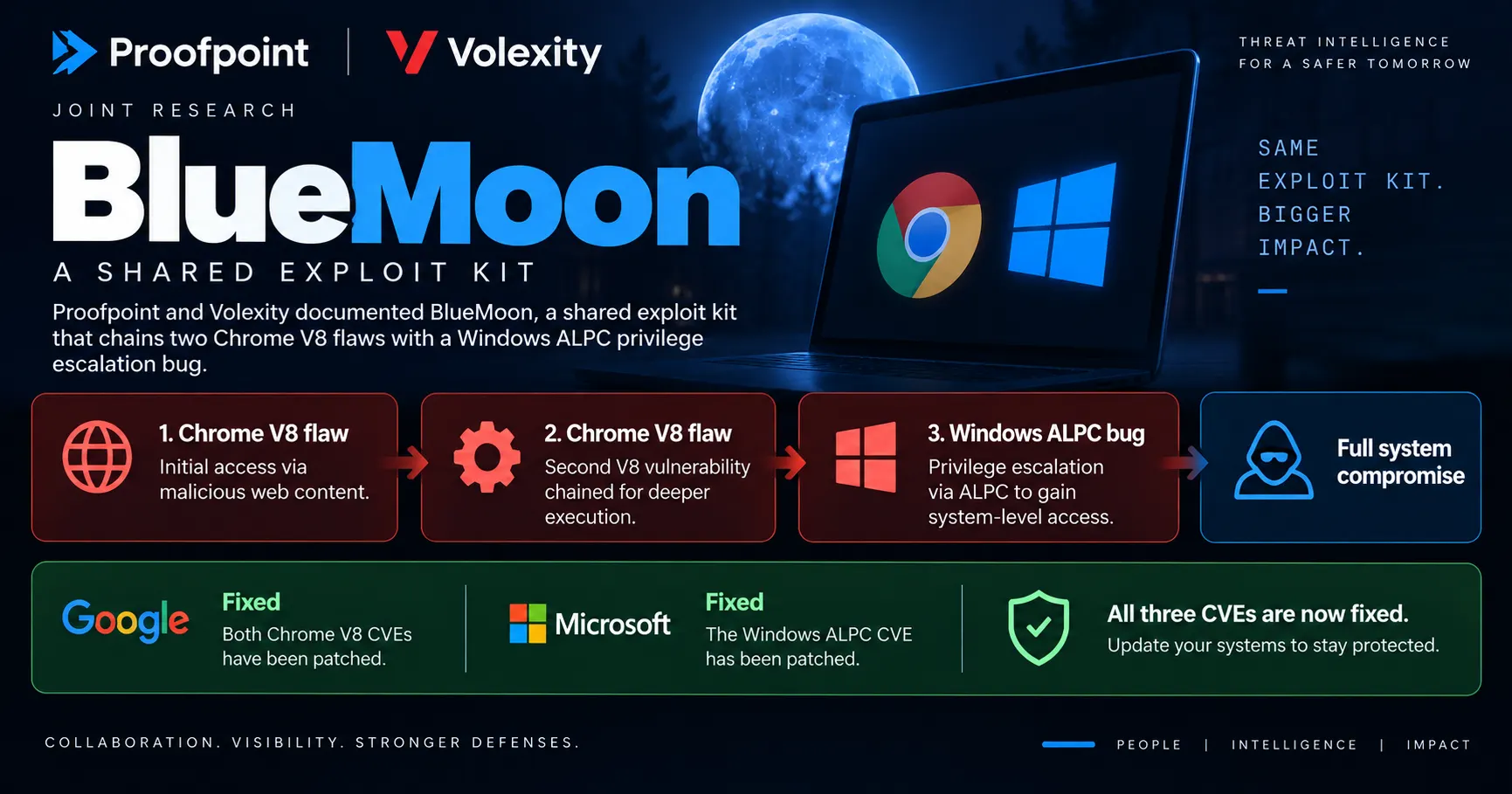
Several espionage groups adopted a shared exploit kit called BlueMoon that chained two Chrome V8 zero-days with a Windows ALPC privilege escalation flaw, all three of which are now patched.
BlueMoon turned a public Chromium bug fix into a working Chrome exploit before the patch reached users, then used a Windows ALPC flaw to break out of the renderer. Update Chrome to 153.0.8010.36 or later, apply the September 2026 Windows updates, and hunt for the chrome.exe to cmd.exe to curl.exe process tree.
Affected & context
Proofpoint and Volexity published parallel reports on 9 September 2026 describing BlueMoon, an exploit kit that chains CVE-2026-85046 and CVE-2026-87491 in Chrome's V8 engine with CVE-2026-85880 in the Windows ALPC subsystem to run attacker-selected payloads outside the browser sandbox.
Both Chrome flaws were patch-gap zero-days, fixed in public Chromium source before Chrome's stable channel shipped the fix, and several espionage clusters adopted the same kit within days.
Organisations running Chrome or Chromium-based browsers on older Windows builds, with observed targeting of NGOs, mining and commodity trading firms, US aerospace and defence suppliers, Vietnamese manufacturing, and government, consulting and financial organisations in Indonesia and Singapore.
- Vendors
- GoogleMicrosoft
- Products
- Google ChromeChromium-based browsersMicrosoft Windows
- Threat actors
- TA412 (JungleBamboo, APT31, Violet Typhoon, TIDE CASTLE)UTA0560UNK_LateNightUNK_DoubleCheckUNK_QuietRacket
- Malware
- GemStoneLONGTALESUPERSTOMPGRIMWEDGEShadowPad
- Geography
- United StatesVietnamIndonesiaSingaporeGlobal
- Industry
- Non-governmental organisationsAerospace and defenceManufacturingGovernmentFinancial services
- CVEs
- CVE-2026-85046CVE-2026-87491CVE-2026-85880
What is the BlueMoon exploit kit?
The BlueMoon exploit kit is a packaged browser exploit chain that turns one click on a phishing link into code execution outside Chrome's sandbox. Proofpoint named the kit and published its analysis on 9 September 2026, the same day Volexity documented parallel campaigns from its own telemetry.
The chain has three stages. CVE-2026-85046, a type confusion bug in Chrome's V8 JavaScript engine, gives an attacker arbitrary read and write access inside the V8 sandbox. CVE-2026-87491, a second V8 defect, corrupts WebAssembly module metadata to escape that sandbox. CVE-2026-85880, a heap-based buffer overflow in the Windows Advanced Local Procedure Call subsystem, then elevates the renderer process so the kit can inject into the parent Chrome process.
Per Proofpoint, the default final action is blunt. A curl command downloads an executable into %TEMP% and runs it. Operators change payloads by editing a single URL parameter.
Why the Chromium patch gap made this possible
A patch gap is the period when a security fix is visible in public open source code but has not yet reached the packaged product users run. Chromium is open source, Chrome is not shipped instantly, and that difference gave BlueMoon's developer a working head start.
Proofpoint reports that the change fixing CVE-2026-85046 was committed on 7 August 2026 but only reached the general stable Chromium build on 3 September 2026. That left close to four weeks in which the diff was public and no released patch existed. Volexity describes the same effect, noting the flaw was an N-day in Chromium source and a true zero-day for Chrome users.
Volexity assesses with medium confidence that the developer reverse engineered those upstream fixes. Proofpoint found no artifact that proves AI-assisted development, but flagged verbose debugging comments, heavy logging and a referenced markdown handover file as consistent with it.
How the chain runs on the victim host
Execution happens inside a dedicated Web Worker rather than the visible tab, so a failed attempt crashes a background thread instead of alerting the user. Volexity found a retry mechanism that stores an attempt counter in sessionStorage and relaunches the exploit up to five times.
Three binary components ride along, embedded as Base64 in the JavaScript. The first, p1, reflectively loads a DLL that profiles the host: Windows version and build, process token integrity level, CPU features and hypervisor indicators. The JavaScript reads that profile and decides whether to continue.
The second component, p2, runs the ALPC kernel exploit, but only when the process is not already elevated and the Windows build sits in a fixed target set. The third, pp, opens the Chrome browser process, writes a stub and calls CreateProcessA. From there the downloaded payload runs outside the renderer sandbox and looks like ordinary Chrome child activity.
Which groups used BlueMoon, and against whom
Proofpoint identified four clusters, most with a suspected China nexus. TA412, also tracked as JungleBamboo, Violet Typhoon and APT31, was first, starting on 28 August 2026 against US NGOs, mining companies and physical commodity trading firms. Its payload was GemStone, a browser extension posing as an AI companion from Google Gemini that logs keystrokes and steals cookies.
UNK_LateNight followed on 2 September, targeting US aerospace companies with request-for-quotation lures and delivering the ShadowPad backdoor. UNK_DoubleCheck hit a Vietnamese manufacturer the same day using a compromised Southeast Asian government mailbox and a Rust loader chain. UNK_QuietRacket started on 3 September against government, consulting and financial organisations in Indonesia and Singapore.
Volexity separately tracked UTA0560, which phished NGO staff with donation lures and deployed the GRIMWEDGE JScript backdoor. The two vendors use different naming, so cluster counts do not map one to one.
What administrators should check today
All three flaws are patched, so the work is verification and hunting. Update Chrome to 153.0.8010.36/.37 or later, which carries both V8 fixes, and confirm the version actually deployed rather than the version offered. Other Chromium-based browsers pick up the same fixes on their own release schedules.
Apply Microsoft's September 2026 security updates for CVE-2026-85880. The privilege escalation stage only ran on builds 17763, 19041 to 19045, 20348 and 22000, which covers Windows 10 1809 through 22H2, Server 2019, Server 2022 and the initial Windows 11 release. Proofpoint notes most of those builds are unsupported, so an inventory pass is worth the time.
For hunting, Proofpoint highlights a distinctive process tree of chrome.exe launching cmd.exe, then curl.exe, then msgbox.exe. Also look for the sessionStorage key v8ctf_exp_attempt and unexpected scheduled tasks.
Check the build, not the policy
Verify the deployed Chrome build rather than the update policy. The chain worked against stable Chrome releases that admins would have called current.
What comes next
Proofpoint expects BlueMoon to spread further, including to financially motivated actors, as patched builds roll out across Chromium browsers. A kit that needs no exploit development skill to operate is attractive to anyone who can host a landing page.
The browser extension angle deserves attention too. Both vendors describe installers that forge Chromium's Secure Preferences integrity values to plant an extension without a Web Store prompt. Volexity notes that Chrome still permits a legacy hash fallback by default, and that disabling it means compiling Chromium from source. Organisations that do not manage extensions through policy have limited visibility into what is installed.
The broader pattern is the one worth tracking. Public upstream fixes plus fast reverse engineering equals a repeatable window, and that window is not specific to this kit or this quarter.
Timeline
CVE-2026-85046 reported to Chromium
Google's release notes credit the V8 type confusion report to researcher Salvatore Gulizia, working under the nickname Serotav.
Source: https://chromereleases.googleblog.com/2026/09/stable-channel-update-for-desktop_01882797386.html
Confidence: High
Fix lands in public Chromium source
Per Proofpoint, the change containing the CVE-2026-85046 fix was committed upstream, starting the patch gap window.
Confidence: High
First observed BlueMoon campaign
Proofpoint saw TA412 targeting US NGOs, mining companies and physical commodity trading firms with the kit.
Confidence: High
Volexity detects spearphishing against NGOs
Volexity's network monitoring service flagged UTA0560 emails abusing a reflected XSS flaw on a university website to redirect targets into the exploit chain.
Confidence: High
Two more clusters adopt the kit
Proofpoint recorded UNK_LateNight targeting US aerospace firms with ShadowPad, and UNK_DoubleCheck hitting a Vietnamese manufacturer with a Rust loader chain.
Confidence: High
Chrome 152 stable fixes the first V8 flaw
Google shipped Chrome 152.0.7977.82/.83 with the CVE-2026-85046 fix and confirmed an exploit existed in the wild. UNK_QuietRacket activity against Indonesia and Singapore began the same day.
Source: https://chromereleases.googleblog.com/2026/09/stable-channel-update-for-desktop_01882797386.html
Confidence: High
Chrome 153 and Windows updates close the chain
Chrome 153.0.8010.36/.37 fixed the sandbox escape CVE-2026-87491, and Microsoft's September 2026 Patch Tuesday addressed the ALPC flaw CVE-2026-85880.
Source: https://chromereleases.googleblog.com/2026/09/stable-channel-update-for-desktop_0808145027.html
Confidence: High
Proofpoint and Volexity publish
Both vendors released technical analyses and indicators of compromise for the shared exploit chain and the distinct post-exploitation payloads.
Confidence: High
Impact
A single phishing link could execute attacker-chosen code outside the Chrome sandbox on affected Windows builds, leading to credential theft, session hijacking or backdoor installation.
Business impact
Espionage-motivated access to mailboxes, documents and authenticated sessions at targeted organisations, with follow-on risk from stolen credentials.
Technical impact
Code execution in the Chrome browser process outside the renderer sandbox, with SeDebugPrivilege obtained in the renderer token before injection.
Security impact
Post-exploitation payloads included a credential-stealing browser extension, the ShadowPad backdoor, an in-memory JScript backdoor and a Rust loader chain.
Privacy impact
The observed browser extensions recorded keystrokes, captured form input and exfiltrated cookies and storage tokens.
Affected audience: IT administrators managing Chromium browser fleets, MSPs supporting Windows endpoints on older builds, Security operations and threat hunting teams, NGOs, aerospace suppliers and government contractors
Action required.
Technical details
- CVEs
- CVE-2026-85046, CVE-2026-87491, CVE-2026-85880
- Exploitation
- Exploited in the wild
- Attack vector
- Spearphishing link leading to an attacker-controlled landing page that runs the exploit chain in the browser, in some cases via a reflected XSS redirect on a legitimate site.
- Affected versions
- Google Chrome stable before 152.0.7977.82 (CVE-2026-85046), Google Chrome stable before 153.0.8010.36 (CVE-2026-87491), Windows builds 17763, 19041 to 19045, 20348 and 22000 (CVE-2026-85880 exploitation)
- Patched versions
- Google Chrome 152.0.7977.82/.83, Google Chrome 153.0.8010.36/.37, Windows September 2026 security updates
Indicators of compromise
- Domain
cloud.shinewrist[.]netUTA0560 exploit hosting and C2
Source: Volexity
Confidence: High
- Domain
ocr[.]opusaccel[.]topGRIMWEDGE backdoor C2
Source: Volexity
Confidence: High
- Domain
gitprogram[.]comJungleBamboo phishing and C2 infrastructure
Source: Volexity
Confidence: High
- Ip
206[.]166[.]251[.]164Hosts cloud.shinewrist[.]net
Source: Volexity
Confidence: High
- Domain
secboxes[.]comTA412 delivery and download domain
Source: Proofpoint
Confidence: High
- Domain
ms.checrity[.]comShadowPad C2 used by UNK_LateNight
Source: Proofpoint
Confidence: High
- Domain
brianwilli[.]comUNK_DoubleCheck payload download domain
Source: Proofpoint
Confidence: High
- Mutex
DataupcheckinfoMutex observed in UNK_DoubleCheck activity
Source: Proofpoint
Confidence: Medium
- Other
v8ctf_exp_attemptsessionStorage retry counter key written by the exploit
Source: Proofpoint and Volexity
Confidence: High
- File
%TEMP%\msgbox.exeDefault downloaded payload path and filename
Source: Proofpoint
Confidence: High
Detection methods
- Process tree of chrome.exe launching cmd.exe, then curl.exe, then msgbox.exe (Proofpoint)
- sessionStorage key v8ctf_exp_attempt present in Chrome profiles (Proofpoint)
- Scheduled tasks named EdgeCore_AutoUpdate, MicrosoftEdgeUpdatesTaskMachine or Avpcheckup (Proofpoint)
- Scheduled task named Windows Scheduled System re-running a sideloading chain every five minutes (Volexity)
- Emerging Threats signatures 2071919 to 2071924 for the BlueMoon loader and C2 beacons (Proofpoint)
- YARA rule MAL_BlueMoon_ExploitKit published by Proofpoint
- Unexpected Chromium extension with ID ckiknalbeplpcpofpnabcnhjcegckfei posing as Google Gemini (Volexity)
Mitigations
- Deploy Chrome 153.0.8010.36/.37 or later, which contains fixes for both V8 flaws.
- Install the September 2026 Windows security updates addressing CVE-2026-85880.
- Upgrade or isolate endpoints on the Windows builds the privilege escalation stage targets.
- Block the published domains and URLs at mail, proxy and DNS layers.
- Manage Chromium extension installation through enterprise policy and review installed extensions.
Technical references
Response
Vendor statement
Google confirmed in both release notes that exploits exist in the wild for CVE-2026-85046 and CVE-2026-87491. Microsoft credited Volexity and Proofpoint researchers for CVE-2026-85880 and shipped the fix in its September 2026 release, without describing how the flaw was exploited.
Customer guidance
Google delivered both V8 fixes through the Chrome stable channel, so the guidance is to take the current stable build. Microsoft delivered the ALPC fix through its September 2026 security updates. Proofpoint and Volexity both published indicators for defenders to block and hunt on.
Response status: Patched
Patch available: Yes
Workaround available: No
FAQ
Which vulnerabilities does the BlueMoon exploit kit chain?
Three. CVE-2026-85046 is a type confusion flaw in Chrome's V8 engine that gives arbitrary read and write inside the V8 sandbox. CVE-2026-87491 is a second V8 flaw used to escape the sandbox. CVE-2026-85880 is a heap-based buffer overflow in the Windows ALPC subsystem used for local privilege escalation.
Are all three flaws patched?
Yes. Google fixed CVE-2026-85046 in Chrome 152.0.7977.82/.83 on 3 September 2026 and CVE-2026-87491 in Chrome 153.0.8010.36/.37 on 8 September 2026. Microsoft addressed CVE-2026-85880 in its September 2026 Patch Tuesday release.
Is Microsoft Edge affected?
Proofpoint states the browser flaws were present in the latest stable versions of Chrome and Chromium-based browsers, naming Microsoft Edge as an example. Chromium-based browsers pick up the upstream V8 fixes on their own release schedules, so check the build your fleet is running.
What is a patch-gap zero-day?
It is a flaw already fixed in public open source code but not yet fixed in the released product built from that code. The fix is visible to anyone reading the commit, while users remain exposed until the vendor ships a build. Both Chrome flaws in this chain were in that state when the attacks ran.
How can defenders detect BlueMoon activity?
Proofpoint published Emerging Threats rules and a YARA rule, and highlights a distinctive process tree where chrome.exe spawns cmd.exe, then curl.exe, then msgbox.exe. Also check for the sessionStorage key v8ctf_exp_attempt, dropped executables in %TEMP%, and the scheduled tasks named in both reports.
The bottom line
BlueMoon chained two Chrome V8 flaws with a Windows ALPC privilege escalation bug, and several espionage clusters adopted it within days of the first observed campaign on 28 August 2026. Google and Microsoft have since fixed all three CVEs.
Being on the current stable browser build was not protection here, which makes patch verification and endpoint hunting the practical response rather than reassurance from update policy.
What happens next
Watch for wider adoption of the kit, including by financially motivated operators, and for further exploitation built on the gap between public Chromium fixes and shipped browser builds.
What to do
Confirm Chrome 153.0.8010.36/.37 or later is deployed, apply the September 2026 Windows updates, then hunt using the indicators from both reports.
Sources
Proofpoint · Sep 9, 2026 · Primary source
Claims supported
- Proofpoint named the kit BlueMoon and identified four clusters using it.
- The CVE-2026-85046 fix was committed on 7 August 2026 and reached stable Chromium on 3 September 2026.
- Targeted Windows builds for the privilege escalation stage are 17763, 19041 to 19045, 20348 and 22000.
Volexity · Sep 9, 2026 · Primary source
Claims supported
- UTA0560 phishing against NGOs began on 1 September 2026 and delivered GRIMWEDGE.
- The exploit runs in a Web Worker with up to five retries.
- SUPERSTOMP forges Secure Preferences values to install the LONGTALE extension.
Google · Sep 3, 2026 · Primary source
Claims supported
- Chrome 152.0.7977.82/.83 fixes CVE-2026-85046.
- Google confirmed an exploit for CVE-2026-85046 exists in the wild.
- CVE-2026-85046 was reported on 4 August 2026 by Salvatore Gulizia.
Google · Sep 8, 2026 · Primary source
Claims supported
- Chrome 153.0.8010.36/.37 fixes CVE-2026-87491.
- Google confirmed an exploit for CVE-2026-87491 exists in the wild.
BleepingComputer · Sep 8, 2026
Claims supported
- Microsoft patched CVE-2026-85880 as an actively exploited zero-day in its September 2026 release.
- Microsoft describes the flaw as a heap-based buffer overflow in Windows ALPC allowing local privilege escalation.
BleepingComputer · Sep 10, 2026
Claims supported
- General framing of the joint Proofpoint and Volexity disclosure.