

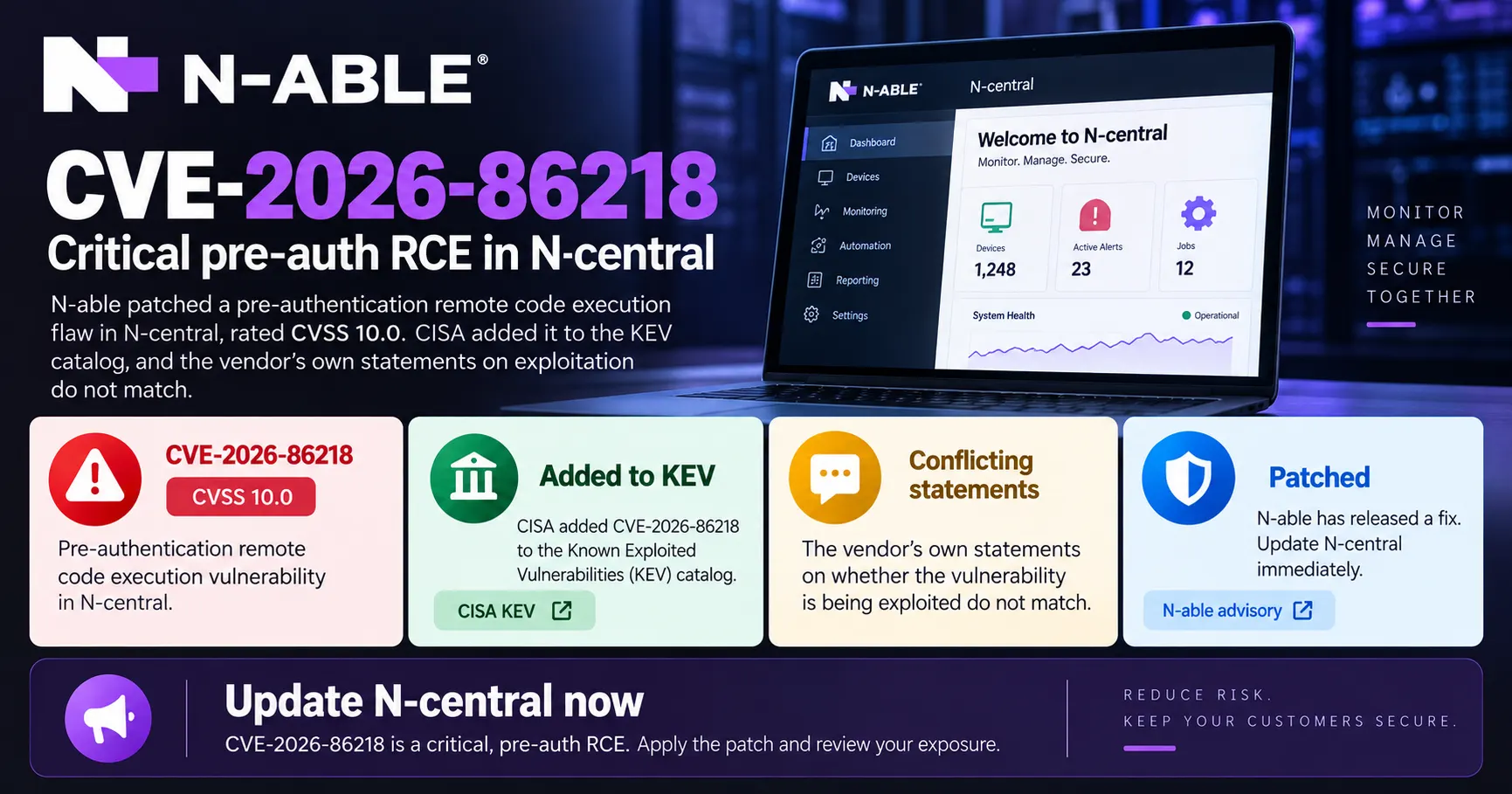
N-able ships emergency N-central hotfix for CVSS 10 flaw CVE-2026-86218
Hotfix 4 supersedes a hotfix released the day before, and every self-hosted N-central build below 2026.3.1.14 is affected.

On this page
Key takeaways
- CVE-2026-86218 allows pre-authentication remote code execution on N-central and is rated CVSS 10.0, assigned by N-able as CVE Numbering Authority.
- Every build before 2026.3.1.14 is affected, including systems that applied Hotfix 3 on 5 September.
- CISA added the flaw to the KEV catalog in its 8 September alert, requiring federal civilian agencies to patch by 11 September.
- N-able's release notes say exploitation is unconfirmed, while its urgent customer notice says the flaw was observed exploited in the wild.
- Shadowserver counts close to 1,500 internet-facing N-central servers, most of them in the United States and Europe.
What to do now
Immediate urgency- Install N-central 2026.3 Hotfix 4 (build 2026.3.1.14) on every self-hosted instance, including those on Hotfix 3.
- Audit N-central user accounts for unrecognised additions and role changes, including addresses ending in .invalid.
- Review envoy_proxy_HTTPS.log and syslog ncentraldms for successful requests to internal API routes with URL-encoded characters.
- Restrict inbound access to the console with IP allowlisting or a VPN, and enforce MFA on all accounts.
- Review recent remote control sessions for connections into domain controllers and other high-value hosts.
- Treat the KEV deadline as the internal deadline rather than waiting for a maintenance window.
N-able has patched N-central CVE-2026-86218, a pre-authentication remote code execution flaw in its RMM platform that carries a CVSS v4.0 score of 10.0. The fix is N-central 2026.3 Hotfix 4, build 2026.3.1.14, published on 6 September 2026. It supersedes Hotfix 3 from the day before, so administrators who patched on 5 September are still exposed until they install it.
N-central is the console MSPs use to push scripts, run remote sessions and manage patching across client fleets. Code execution on that server is code execution everywhere it reaches, which is why CISA added the flaw to its Known Exploited Vulnerabilities catalog with a short federal deadline.
N-able patched a CVSS 10.0 pre-authentication remote code execution flaw in N-central that CISA has since added to its Known Exploited Vulnerabilities catalog.
Apply N-central 2026.3 Hotfix 4, build 2026.3.1.14, on every self-hosted instance, including those already on Hotfix 3. Then audit user accounts for unauthorised additions, review the appliance API logs, and take the console off the public internet.
Affected & context
N-able released N-central 2026.3 Hotfix 4, build 2026.3.1.14, to fix CVE-2026-86218, a pre-authentication remote code execution flaw rated CVSS 10.0 that affects every earlier build of the RMM platform. CISA added the flaw to its Known Exploited Vulnerabilities catalog days later.
N-central is the console MSPs use to manage client fleets, so code execution on the server reaches downstream endpoints, and roughly 1,500 instances are internet-facing.
MSPs, MSSPs and internal IT teams running self-hosted N-able N-central on any build before 2026.3.1.14, plus the client environments those consoles manage. Hosted NCOD instances were patched by the vendor.
- Vendors
- N-able
- Products
- N-able N-central
- Geography
- United StatesEuropeGlobal
- Industry
- Managed service providersIT services
- CVEs
- CVE-2026-86218CVE-2026-86206CVE-2026-86207
What N-able fixed in N-central Hotfix 4
N-able has patched a pre-authentication remote code execution flaw in N-central, the remote monitoring and management platform MSPs and IT departments use to run client fleets from one console. The fix is N-central 2026.3 Hotfix 4, build 2026.3.1.14, posted to the vendor status page on 6 September 2026.
The flaw is tracked as CVE-2026-86218 and carries a CVSS v4.0 base score of 10.0, assigned by N-able as the CVE Numbering Authority for its own products. CISA and the vendor both describe it as a static code injection issue leading to pre-authentication remote code execution on the N-central server.
Every build below 2026.3.1.14 is affected. Hosted instances, which N-able runs as NCOD, were patched by the vendor before disclosure. Self-hosted deployments must install the hotfix themselves, and that includes anyone who applied Hotfix 3 the previous day.
How much is public, and what is missing
N-able has published no root-cause detail for CVE-2026-86218 beyond the static code injection label, so there is no public mechanism analysis. watchTowr told The Hacker News it reproduced the flaw and that changes made on a compromised N-central instance propagate to connected systems.
The two flaws fixed a day earlier are documented in full. Rapid7's Stephen Fewer found that a semicolon in the request path slips past the Envoy proxy's block on internal API routes, because Jetty later strips it and resolves the path to the protected SOAP servlet. A malformed Forwarded header does the rest, since Jetty reads it as a loopback address while N-central's own parser fails open on the invalid value.
From there, a legacy two-factor method binds a requested user ID to the session before authentication runs. Built-in accounts throw an exception, the binding survives, and the session becomes privileged. Rapid7 rates that pair at 6.9 and 7.7 on CVSS v4.0.
Why an RMM console is the worst place for a pre-auth flaw
An RMM server is a management plane with standing authority over other people's networks. Once code runs on it, an attacker inherits the platform's normal powers: push scripts to managed endpoints, deploy tooling through the agent, open remote sessions into servers, and change roles and policies to keep access.
The exposure is measurable. Shadowserver tracks close to 1,500 internet-facing N-central servers, most of them in the United States and Europe. Each one sits in front of an unknown number of client environments.
watchTowr's Yordan Ganchev told The Hacker News that this profile is exactly what makes N-central valuable to ransomware crews, since compromising it grants access to connected computers and downstream systems. Huntress made the same point in operational terms during the August wave, noting that the appliance runs a custom AlmaLinux build and rarely carries EDR.
N-able's two versions of the exploitation story
The vendor has said two different things. The Hotfix 4 release notes state that exploitation in production environments is not confirmed. The urgent notice sent to customers, and a message from N-able's Jason Murphy in the MSPGeek community, describe a zero-day already exploited in the wild.
Huntress flagged the contradiction directly in its rapid response post, having received the second version first. Its own investigation began on 4 September after a customer's fully patched N-central production environment was compromised. Because appliance logs had already rotated, Huntress could not confirm which flaw the intruder used, and could not rule out others.
CISA settled the practical question on 8 September by adding CVE-2026-86218 to its Known Exploited Vulnerabilities catalog, with an 11 September deadline for federal civilian agencies.
Act on the KEV listing
A vendor release note saying exploitation is unconfirmed is not a reason to schedule this for the next maintenance window.
What N-central operators should do now
Install build 2026.3.1.14 on every self-hosted instance, including any that received Hotfix 3 on 5 September. N-able lists direct upgrade paths from 2025.4 through Hotfix 2, and older builds need an intermediate hop first. Hosted NCOD customers have nothing to install.
Patching is the floor, not the response. Huntress recommends auditing user lists for accounts created without authorisation, particularly email addresses with an appended .invalid string or subtle domain swaps meant to survive a quick glance. It also points defenders at the appliance logs below, filtering for successful requests to internal API routes containing URL-encoded values such as %2F.
envoy_proxy_HTTPS.log
syslog ncentraldms
Finally, take the console off the public internet. Huntress advises IP allowlisting or a mandatory VPN even after patching, and says taking N-central offline is a reasonable option for exposed, unpatched deployments.
Four hotfixes in five weeks
This is the third distinct N-central security event since the start of August. Hotfixes 1 and 2 answered CVE-2026-18556 and CVE-2026-18577 in early August, Hotfix 3 answered the Rapid7 chain, and Hotfix 4 answered a flaw reported independently by a third party.
A cadence like that usually means researchers are actively digging through the same product, and that more findings are queued behind the ones already public. For anyone running N-central, the operational conclusion is to treat vendor advisories for this platform as an out-of-band process rather than a monthly cycle.
The other thing worth watching is whether root-cause detail for CVE-2026-86218 ever appears. Without it, defenders are hunting on tradecraft rather than on the mechanism, and detection stays reactive.
Timeline
August wave ends with a second hotfix
N-able shipped build 2026.3.1.10 after attacks exploiting CVE-2026-18556 and CVE-2026-18577, which Huntress tracked across multiple organisations.
Source: https://www.huntress.com/blog/n-able-vulnerability-exploitation
Confidence: High
Rapid7 reports two new flaws to N-able
Rapid7 Labs contacted the vendor about the access control bypass and authentication bypass later tracked as CVE-2026-86206 and CVE-2026-86207.
Confidence: High
Huntress investigates a compromised patched server
The investigation started after a customer's fully patched N-central production environment was compromised. Rotated appliance logs left the exploited flaw unconfirmed.
Source: https://www.huntress.com/blog/n-able-vulnerability-exploitation
Confidence: High
Hotfix 3 fixes the Rapid7 chain
N-central 2026.3.1.13 addressed CVE-2026-86206 and CVE-2026-86207, which chain into unauthenticated creation of a system administrator account.
Confidence: High
Hotfix 4 lands for CVE-2026-86218
N-able published build 2026.3.1.14 on its status page and told customers through a separate notice that the flaw is a zero-day seen in attacks.
Source: https://status.n-able.com/2026/09/06/n-central-2026-3-hotfix-4-cve-2026-86218/
Confidence: High
CISA adds the flaw to KEV
The agency's alert set an 11 September remediation deadline for federal civilian agencies. Rapid7 published its technical analysis of the two Hotfix 3 flaws the same day.
Source: https://thehackernews.com/2026/09/n-able-n-central-pre-auth-rce-flaw.html
Confidence: Medium
watchTowr reproduces the exploit
The exposure management firm said it recreated the pre-authentication flaw and warned that changes made through N-central propagate to connected systems.
Source: https://thehackernews.com/2026/09/n-able-n-central-pre-auth-rce-flaw.html
Confidence: Medium
Impact
Unauthenticated attackers could execute code on an N-central server, gaining the platform's own authority over scripts, remote sessions and managed endpoints across every client environment attached to that console.
Business impact
A single compromised console can expose every managed client at once, which turns a platform patch into a contractual and reputational matter for service providers.
Technical impact
Remote code execution on the N-central server without credentials, with access to software deployment, automation policies and remote control functions.
Security impact
Prior N-central incidents involved abuse of the built-in remote control feature, unauthorised administrator accounts and Cloudflare tunnels for persistence.
Privacy impact
Access to managed endpoints creates exposure of client data held on those systems, though no data theft has been publicly tied to this flaw.
Affected audience: MSPs and MSSPs running self-hosted N-central, Internal IT teams using N-central for fleet management, Client organisations managed through an N-central console, Security operations and incident response teams
Action required.
Technical details
- CVEs
- CVE-2026-86218, CVE-2026-86206, CVE-2026-86207
- CVSS
- 10
- Exploitation
- Exploited in the wild
- Attack vector
- Network access to the N-central management interface, with no authentication and no user interaction required.
- Affected versions
- N-able N-central, all builds before 2026.3.1.14 (CVE-2026-86218), N-able N-central, all builds before 2026.3.1.13 (CVE-2026-86206 and CVE-2026-86207)
- Patched versions
- N-central 2026.3 Hotfix 4, build 2026.3.1.14, N-central 2026.3 Hotfix 3, build 2026.3.1.13 (earlier pair only)
Indicators of compromise
- Ip
23.234.100[.]105Intruder IPv4 seen in the September activity
Source: Huntress
Confidence: High
- Ip
23.234.97[.]68Intruder IPv4 seen in the September activity
Source: Huntress
Confidence: High
- Other
5568cd69c754b392121f1dbb8f900fdaMalicious Cloudflare tunnel account tag
Source: Huntress
Confidence: High
- Url
/remoteControlAction.do?method=getPierDetailsReconnaissance endpoint probed with appliance IDs before exploitation
Source: Huntress
Confidence: High
- Other
.invalidString appended to known N-able email addresses during unauthorised account creation
Source: Huntress
Confidence: High
- File
svchost.exe in a user Documents folderArtefact flagged by N-able during the August wave
Source: N-able via Huntress
Confidence: Medium
- Other
CloudflaredRegistered service name flagged by N-able during the August wave
Source: N-able via Huntress
Confidence: Medium
Detection methods
- Filter envoy_proxy_HTTPS.log and syslog ncentraldms for successful internal API requests using URL-encoded values such as %2F (Huntress)
- Audit newly created N-central users for .invalid addresses, spoofed domains or character swaps (Huntress)
- Look for probes of /remoteControlAction.do?method=getPierDetails with specific appliance IDs (Huntress)
- Review Take Control session logs under C:\ProgramData\GetSupportService_N-Central\Logs on managed Windows hosts (Huntress)
- Check managed hosts for svchost.exe in user Documents folders and services registered as Cloudflared (N-able)
Mitigations
- Upgrade self-hosted N-central to build 2026.3.1.14; Hotfix 3 does not address CVE-2026-86218.
- Keep the N-central console off the public internet using IP allowlisting or a mandatory VPN.
- Enforce MFA on all N-central accounts and review role assignments.
- Consider taking an exposed, unpatched N-central server offline until the hotfix is applied (Huntress).
Technical references
Response
Vendor statement
N-able released Hotfix 4 and told customers to upgrade immediately. Its release notes say exploitation in production environments is not confirmed, while its urgent customer notice says the flaw has been observed exploited in the wild and that the company is investigating and has taken further steps to protect customer environments.
Authorities
CISA added CVE-2026-86218 to its Known Exploited Vulnerabilities catalog in an 8 September alert, describing it as a static code injection flaw allowing pre-authentication remote code execution, and set an 11 September remediation deadline for federal civilian agencies.
Customer guidance
N-able tells self-hosted customers to move to build 2026.3.1.14 immediately and says hosted NCOD instances need no action. Huntress adds account auditing, appliance log review and strict perimeter controls on the console.
Response status: Patched
Patch available: Yes
Workaround available: No
FAQ
What is CVE-2026-86218?
It is a pre-authentication remote code execution flaw in N-able N-central, the RMM platform used by MSPs and IT teams. N-able and CISA describe it as static code injection. It is rated CVSS v4.0 10.0 and affects every build before 2026.3.1.14.
Is Hotfix 3 enough?
No. Hotfix 3, build 2026.3.1.13, fixed CVE-2026-86206 and CVE-2026-86207 only. Hotfix 4, build 2026.3.1.14, supersedes it and is the build that addresses CVE-2026-86218. Systems left on Hotfix 3 remain vulnerable to the newer flaw.
Do hosted N-central customers need to act?
No. N-able says instances it hosts, known as NCOD, were patched on its own infrastructure before public disclosure. The upgrade requirement applies to self-hosted, on-premises deployments.
Has the flaw actually been exploited?
The evidence points that way, though N-able's own statements differ. Its release notes say exploitation in production is unconfirmed, while its urgent customer notice describes exploitation in the wild. CISA added the flaw to its Known Exploited Vulnerabilities catalog on 8 September, which is the practical answer for prioritisation.
What should defenders hunt for after patching?
Huntress recommends auditing user accounts for unauthorised creations, including addresses ending in .invalid, and reviewing envoy_proxy_HTTPS.log and syslog ncentraldms for successful internal API requests containing URL-encoded characters. Also review recent remote control sessions into critical hosts.
The bottom line
N-able fixed CVE-2026-86218, a CVSS 10.0 pre-authentication remote code execution flaw in N-central, with build 2026.3.1.14 on 6 September 2026. CISA added the flaw to its KEV catalog two days later, and Hotfix 3 does not protect against it.
When the vendor's own statements about exploitation disagree, the KEV listing and the pre-authentication attack path are the signals worth acting on.
What happens next
Watch for root-cause detail from N-able, for confirmed intrusions tied specifically to this CVE rather than the earlier chain, and for further findings in a product that has taken four hotfixes in five weeks.
What to do
Verify every self-hosted N-central instance is on build 2026.3.1.14, then audit accounts and appliance logs for signs of earlier access.
Sources
N-able · Sep 6, 2026 · Primary source
Claims supported
- Hotfix 4 is build 2026.3.1.14 and supersedes Hotfix 3 (2026.3.1.13).
- The release notes state that exploitation in production environments is not confirmed.
- Hosted NCOD instances were already patched; supported upgrade paths start at 2025.4.
Huntress · Sep 6, 2026 · Primary source
Claims supported
- Huntress began investigating on 4 September after a fully patched N-central environment was compromised.
- Rotated appliance logs prevented confirmation of which flaw was exploited.
- Detection guidance covering .invalid account names, the getPierDetails probe and the appliance log files.
- N-able described the flaw as a zero-day exploited in the wild in its customer communications.
Rapid7 · Sep 8, 2026 · Primary source
Claims supported
- CVE-2026-86206 scores 6.9 and CVE-2026-86207 scores 7.7 on CVSS v4.0.
- The chain combines an Envoy and Jetty path parsing discrepancy with a Forwarded header parsing failure.
- The legacy two-factor method binds a user ID to the session before authentication, allowing a privileged session.
The Hacker News · Sep 9, 2026
Claims supported
- CISA added CVE-2026-86218 to the KEV catalog with an 11 September deadline for federal civilian agencies.
- N-able's urgent customer notice says the flaw has been observed exploited in the wild.
- watchTowr reproduced the vulnerability and commented on ransomware interest in RMM platforms.
BleepingComputer · Sep 7, 2026
Claims supported
- Shadowserver tracks nearly 1,500 internet-exposed N-central servers, mostly in the United States and Europe.
SecurityWeek · Sep 8, 2026
Claims supported
- CVE-2026-86218 carries a CVSS score of 10.0.
- Administrators are advised to check deployments for unrecognised user accounts.