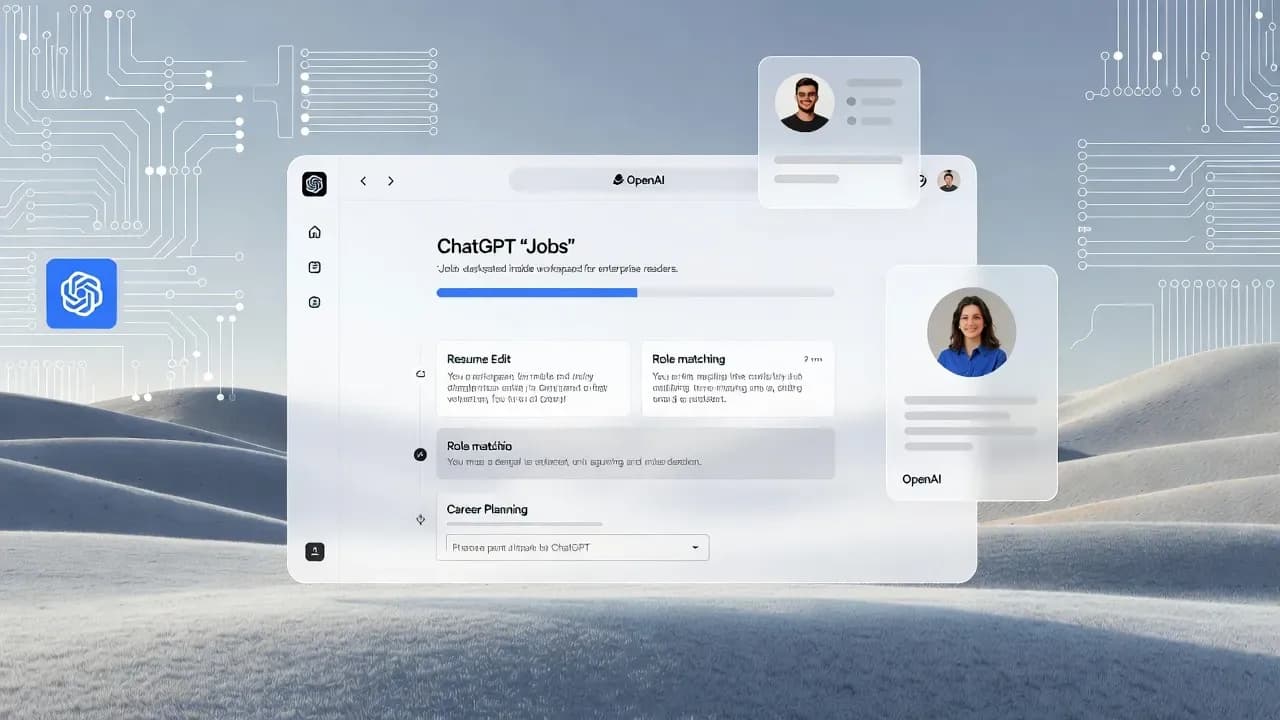
ChatGPT quietly tests a new "Jobs" experience for job search and resume coaching
ChatGPT is experimenting with a dedicated "Jobs" experience that guides career planning, job discovery, and resume improvements through an interactive interface. The test follows the launch of ChatGPT Health, signaling OpenAI's shift toward task-specific spaces inside the chatbot.

OpenAI appears to be testing a new "Jobs" experience inside ChatGPT that goes beyond generic prompt-and-response career advice and moves toward a guided, productized workflow. Instead of treating resumes and job hunting as just another conversation topic, the test points to a dedicated space with its own interface, designed to help users explore roles, refine their positioning, and map next steps.
The timing matters because it arrives right after OpenAI introduced ChatGPT Health, another purpose-built area that sits alongside normal chats rather than blending into them. Taken together, these moves suggest a broader product direction: turning ChatGPT into a suite of specialized experiences that feel closer to apps than a single chatbot. For job seekers, this could shift the starting point from "ask for tips" to "follow a structured flow," which typically produces more consistent outcomes.
Technical and Business Breakdown
The "Jobs" test was surfaced as an in-product feature under active experimentation rather than a formally announced launch with a public rollout schedule. In the reporting around the discovery, the Jobs experience is described as a dedicated feature that can help users explore job opportunities, improve resumes, and support career planning tasks that typically require repeated iteration.
The key product detail is that Jobs is positioned as an interactive interface, which implies a more guided pathway than simply returning a text answer to a question about interview prep or resume wording. The placement also matters: the feature is expected to live in the left sidebar, aligning with how OpenAI is organizing newer capabilities into distinct spaces. That "space" concept has precedent in Health, which appears as a separate area in the interface and is designed to handle sensitive conversations with additional protections.
From a systems perspective, the test indicates OpenAI is investing in orchestration as much as model quality. A resume improvement flow usually involves repeated steps:
- Capturing background context
- Normalizing existing resume content
- Aligning it to specific roles
- Producing outputs that match conventions in different industries and geographies
A job discovery flow adds another layer: users often want filters, comparisons, and a way to track what they have reviewed, which is harder to do reliably when everything is just plain chat messages. The Jobs experience, if it follows the Health model, may also rely on automated detection where ChatGPT recognizes career-related questions and suggests moving into the dedicated space. That kind of routing makes the product feel less like a blank canvas and more like a system that steers users into purpose-fit tooling.
Industry Implications
The most important implication is not that ChatGPT can help with resumes, since it has been used that way for years, but that OpenAI is formalizing the behavior into a first-party workflow. In practice, productization tends to standardize outcomes and reduce the "prompt skill" gap between users who know how to ask and users who do not.
If Jobs is implemented as a guided interface, it could normalize career coaching patterns such as:
- Translating experience into role-relevant impact statements
- Adjusting tone for seniority levels
- Generating consistent variants for different job postings
That would put OpenAI in a more direct relationship with job-seeking workflows that are currently spread across templates, resume builders, and recruiting platforms. It also increases the strategic value of data boundaries, because career history and job search behavior are among the most sensitive categories of personal information outside of health and finance.
Jobs also lands in a competitive environment where hiring and professional identity platforms are already adding AI features, and where AI is reshaping both candidate behavior and recruiter screening. OpenAI has separately discussed a broader "Jobs Platform" initiative aimed at matching employers and candidates, which would put it on a collision course with incumbent ecosystems if it scales.
The presence of a Jobs experience inside ChatGPT can be read as a bridge between "assist me with career materials" and "connect me to opportunities," even if the current test stops well short of a full recruiting marketplace. The question the market will watch is whether Jobs remains a productivity assistant that helps users craft better applications, or whether it becomes an on-ramp to a deeper platform strategy.
Expert Analysis
The unique signal here is interface architecture. Over the past year, OpenAI has been rolling out interactive experiences that sit beside normal chat, including features that centralize automation and introduce dedicated spaces for specific categories of work. Health is a concrete example, built as a separate area with distinct privacy and memory behavior, and it sets a template for how OpenAI might handle other high-sensitivity domains.
Jobs fits naturally into that same pattern because it involves identity, income, and personal history, all of which demand clearer user controls if the product is to earn trust at scale. Even without an explicit Jobs privacy statement yet, the direction suggests OpenAI recognizes that "one universal chat history" is not sufficient for domains where compartmentalization is a feature, not a preference.
A second differentiator is that OpenAI has already been investing in employment-adjacent initiatives outside the ChatGPT UI, including partnerships and training resources aimed at helping people use AI for job seeking. That matters because a Jobs experience becomes more credible when it is backed by institutional learning about what job seekers actually need, where errors are common, and what guardrails prevent harmful outcomes.
The hard part is less about generating text and more about avoiding failure modes, such as:
- Overstating skills
- Fabricating experience
- Pushing users into overly generic resumes that fail screening
If Jobs becomes a structured workflow, OpenAI can embed constraints that nudge toward truthfulness, clarity, and role specificity, while also signaling that the user remains responsible for verification. This is where product design and safety engineering converge: the system can encourage best practices without turning into an applicant fabrication machine.
Practical Implications
For End Users
The near-term takeaway is that ChatGPT may soon offer a more guided career toolkit than the current "paste a job description and ask for edits" pattern. If the feature rolls out broadly, it could:
- Reduce the time spent iterating on resume versions
- Make role alignment more systematic, especially for people applying across adjacent roles where small framing changes matter
The most useful deployments will likely be those that keep the user in control of factual accuracy, while making it easier to translate raw experience into clear outcomes and measurable impact. Users should still expect to review outputs carefully, since small errors or exaggerations can be costly in hiring contexts. They should also treat any request to upload documents or store profiles as a moment to review account settings, retention controls, and data usage disclosures.
For Enterprises and Recruiters
A Jobs experience inside a mainstream assistant may increase the volume and polish of applications, which can raise the bar for screening and amplify the need for authentic skill signals. If OpenAI pairs the Jobs workflow with its broader certification and economic opportunity initiatives, the industry could see more standardized ways to describe AI fluency and operational competence.
At the same time, the move increases pressure on transparency: candidates will want to know how their data is handled, while employers will watch for shifts in application quality and authenticity. The timeline is still uncertain because this is a test, but the direction is clear enough that hiring teams should anticipate more AI-assisted application materials becoming the default rather than the exception.
Closing
The Jobs experiment is best understood as part of a larger product story: ChatGPT is evolving from a single conversational surface into a set of domain-specific spaces with guided interfaces and clearer boundaries. Health established the concept for sensitive use cases, and Jobs extends it into another high-stakes area where trust, privacy, and accuracy matter as much as helpful wording.
Whether this remains a resume and career coaching workflow or expands toward a broader marketplace, it signals that OpenAI is building for repeatable outcomes rather than one-off answers. The next concrete indicators to watch are:
- Rollout scope
- Explicit privacy controls for career data
- Whether Jobs integrates with external systems or remains an internal coaching experience



Comments
Want to join the discussion?
Create an account to unlock exclusive member content, save your favorite articles, and join our community of IT professionals.
New here? Create a free account to get started.