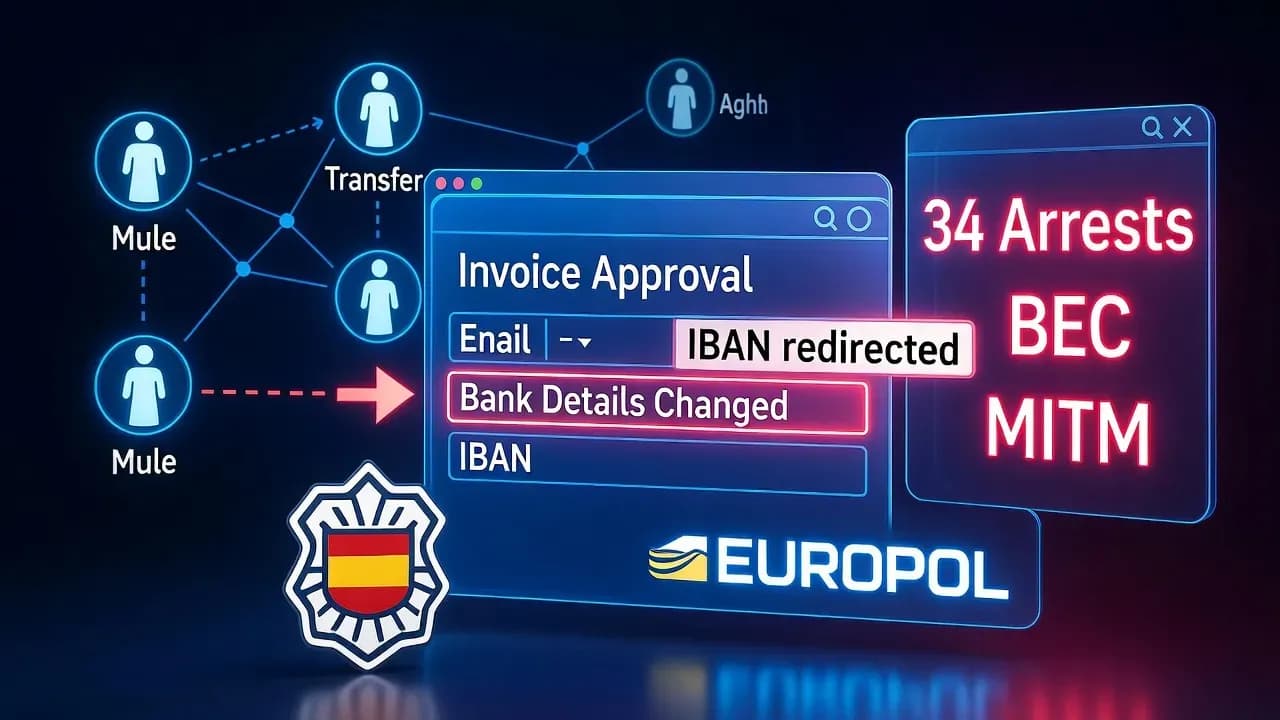
Black Axe Arrests in Spain: 34 Suspects Tied to Long-Running BEC and Man-in-the-Middle Fraud Network
Black Axe arrests in Spain are a timely reminder that the most expensive cyber incidents do not always begin with ransomware or a zero-day. They often begin with a finance workflow that trusts email too much and verifies bank detail changes too little.

Suspects arrested across Spain linked to the Black Axe fraud network
Total fraud attributed to the criminal network
Opening: Black Axe Arrests in Spain
Black Axe arrests in Spain are a timely reminder that the most expensive cyber incidents do not always begin with ransomware or a zero-day. They often begin with a finance workflow that trusts email too much and verifies bank detail changes too little. Spanish investigators say 34 suspects tied to a network linked to Black Axe were arrested for large-scale fraud that relied heavily on man-in-the-middle techniques and business email compromise, the kind of threat that slips past endpoint defenses because the attacker's real target is business process integrity. The significance for IT and security leaders is immediate: when criminals can intercept legitimate vendor conversations, alter payment instructions, and cash out through distributed mule networks, your "security posture" is only as strong as your payment verification controls, identity telemetry, and incident escalation speed.
What Happened: Spain's Operation Against a Black Axe-Linked Fraud Network
Spanish authorities describe a coordinated action that resulted in 34 arrests across Seville, Madrid, Málaga, and Barcelona, tied to a criminal structure allegedly linked to the transnational organization commonly referred to as Black Axe. The operational details matter more than the headline count. Investigators characterize the group as hierarchical, with differentiated roles spanning mule recruitment, collection, laundering, and the creation of shell companies. That structure is consistent with "industrialized" fraud operations, where success is measured not by a single big hit, but by repeated diversion of legitimate payments across multiple victims, countries, and banking rails.
Geographic distribution of arrests across Spain
The police actions included searches that produced cash seizures, device and documentation collection, and the blocking of funds held in bank accounts. More importantly, investigators emphasize that the organization's core business model was not random phishing. It was the deliberate insertion into legitimate commercial communications to intercept and redirect payments without the victim noticing in real time. That is why these Black Axe arrests in Spain should be read as an enterprise risk story rather than an "underground crime" story. The fraud technique thrives precisely in environments that rely on email threads, rushed approvals, and informal vendor changes.
Several principal suspects were placed in provisional imprisonment, and authorities signaled the investigation remains open, which typically implies additional beneficiary accounts, mule handlers, and cross-border facilitators may still be under active identification. For enterprises, this is a meaningful operational point: fraud investigations often trigger late-stage notifications, bank queries, or legal requests months after the event. If your organization has ever dealt with invoice redirection, you should assume evidence collection and follow-up can be long-lived, and you should preserve relevant logs accordingly (identity logs, mailbox audit logs, ERP audit trails, and bank transfer records).
How the Fraud Worked: Man-in-the-Middle in Business Communications, Not Just Networks
The phrase "man-in-the-middle" is often misunderstood by non-specialists as purely a network attack. In this case, the focus is operational: attackers insert themselves into legitimate communications between organizations, then quietly shape outcomes by modifying payment details at the moment money is about to move. That framing is essential because it explains why the technique remains successful even when organizations invest heavily in classic cybersecurity controls. You can patch servers and harden endpoints, but if a finance team accepts an emailed change of IBAN details without out-of-band verification, the attacker does not need to deploy malware at scale.
Fraud amount directly linked to the current operation
Investigators specifically highlight business email compromise as the most common pattern detected. In practical terms, BEC can be executed in two broad ways. One is impersonation: the attacker spoofs a vendor domain or a senior executive and sends a plausible payment change request. The other, higher-impact path is interception: the attacker gains access to a real mailbox or a real thread and then replies inside the existing conversation, preserving context, signatures, invoice formats, and tone. Interception attacks are materially harder to spot because they exploit authentic continuity rather than creating a new, suspicious email out of nowhere.
From an enterprise defense perspective, the best question is not "did they spoof or compromise?" but "what control failed at the decision point?" The decision point is where payment instructions are changed, exceptions are granted, or approvals are rushed. Attackers tailor their timing around monthly payment cycles, vendor renewals, and moments when staff are overloaded. If your process allows single-person changes to beneficiary data, or if your escalation path is slow enough that a transfer cannot be recalled quickly, you have created the conditions this business model needs to be profitable.
The Cash-Out Layer: Money Mules, Shell Companies, and Fraud That Scales
The arrests underscore that successful BEC is not just an email story. It is a money movement story. Authorities describe a broad network of "money mules" and frontmen distributed across Europe, used to receive, transfer, and withdraw funds in ways that obscure the trail. This is the operational layer that converts a diverted invoice into profit before victims and banks can react. It is also the reason many organizations underestimate risk: they assume that even if a transfer is misdirected, funds can simply be recovered. In reality, mature fraud rings design their workflows to minimize the recall window, fragment funds across multiple accounts, and move money fast enough that recovery becomes legally and operationally complex.
Cash seized during searches and funds frozen in bank accounts
Investigators also emphasize the use of shell companies and straw persons, which is consistent with a laundering strategy designed to add legitimacy to beneficiary accounts. If the "new vendor account" belongs to an entity with documentation, invoices, and a payment history, it becomes harder for finance teams and banks to differentiate legitimate payments from fraudulent ones, particularly when the change request is inserted into a genuine thread. This is one reason the purely technical viewpoint is insufficient. The security function must collaborate with finance, procurement, and legal to treat vendor master data as a high-value security asset, with change control discipline comparable to privileged access management.
A notable element in this investigation is the allegation that intimidation and threats were used during collection activities. For enterprises, this matters because post-incident communications may involve victims, mule participants, or intermediaries operating under coercion. It changes how organizations should handle outreach and evidence preservation. The right posture is process-driven and documented: preserve communications, escalate through legal channels, and avoid improvisational contact that could increase risk or compromise future investigative steps.
Law Enforcement Collaboration: Why These Black Axe Arrests in Spain Are Operationally Significant
Spanish authorities state the action was supported by the Bavarian State police and Europol. This is not a cosmetic detail. Cross-border fraud rings typically operate across jurisdictions specifically to exploit investigative fragmentation: victims in one country, mule accounts in another, organizers in a third, and shell entities elsewhere. Coordinated actions reduce that advantage by correlating banking trails and operational roles across borders. For defenders, that has two implications. First, the probability of post-incident inquiry is higher in multinational cases, because investigators have a broader victim and evidence base. Second, the investigative outputs often reveal patterns that can be translated into improved controls, such as common mule recruitment tactics, typical beneficiary account profiles, or recurring invoice timing strategies.
The Spanish police note a multi-year investigation timeline, which is consistent with how these cases are built. Fraud investigations require patient correlation of bank transfers, identity artifacts, communications, and device evidence. That timeline also implies that organizations impacted historically may not have treated earlier events as connected. Many enterprises handle BEC as isolated incidents: "we had an invoice issue last year," "a supplier got spoofed," "a mailbox was suspicious once." Mature fraud rings rely on exactly that fragmentation of institutional memory. Security teams should treat repetitive finance anomalies as a signal, not a coincidence, and should formalize tracking across incidents even when losses appear small.
The fact that principal suspects were placed in provisional imprisonment and that the investigation remains open signals ongoing operational relevance. Fraud networks adapt quickly. When a segment is disrupted, remaining participants often change infrastructure, rotate mule accounts, and attempt to recover revenue through faster, noisier campaigns. That is a period where enterprises can see an elevated wave of opportunistic BEC attempts that borrow from the same playbook but are executed with less discipline. Monitoring during the weeks following major arrests can produce valuable detections and training moments.
How Organizations Can Respond: Controls That Reduce BEC Risk in the Real World
Enterprises should treat invoice diversion as an identity and process threat first, and a malware threat second. The most effective first control is strict out-of-band verification for any change to vendor bank details or beneficiary information. Verification must use contact data already on file, not a phone number or email address supplied in the change request. Ideally, the process is enforced through procurement or vendor management systems, not left to ad hoc judgment under time pressure. Segregation of duties also matters: the person receiving the change request should not be the same person approving the change or releasing the payment.
From the IT security side, prioritize identity and mailbox telemetry for finance-adjacent roles. Enforce phishing-resistant MFA where feasible, and apply conditional access policies that reduce token theft impact. Monitor for mailbox rule creation, external forwarding changes, suspicious OAuth consent grants, unusual sign-in patterns, and anomalous inbox access. In many BEC cases, the earliest technical indicators are not "malware detected" but subtle mailbox behaviors that precede payment manipulation. If your environment supports it, enable and retain audit logs long enough to support investigations that may be opened months later.
Finally, tighten the response playbook. In BEC events, minutes and hours matter. Your incident runbook should specify who contacts the bank, who engages legal counsel and insurance, how evidence is preserved, and how internal communications are handled to avoid accidental deletion or contamination. Many organizations lose recovery opportunities not because the fraud was undetectable, but because the escalation was slow or unclear. A well-rehearsed workflow that connects security, finance, and legal is a practical control that reduces losses even when initial detection fails.
Lessons Learned: Why This Case Still Matters Even If Your Organization Uses Modern Security Tools
A recurring misconception in enterprises is that modern security tooling automatically translates into protection from BEC. Endpoint detection does not prevent a finance user from trusting a familiar email thread. Email security does not stop a criminal from exploiting a legitimate account if identity controls and user behavior allow the compromise. And even strong identity controls do not prevent fraud if business processes allow payment changes without independent verification. The most important defensive shift is to treat finance workflow integrity as a core cybersecurity domain.
These Black Axe arrests in Spain also reinforce a threat trend: the industrialization of low-exploit, high-impact attacks. Organized fraud groups optimize for reliability, repeatability, and cash-out speed. They do not need to "out-hack" your SOC; they need to out-run your approval processes and your bank recall window. That is why the best defensive investments often look unglamorous: vendor master data governance, approval thresholds, anomaly detection in payment systems, and auditing of changes to supplier information.
For security leaders, the strategic takeaway is organizational alignment. If procurement and finance treat security as "IT's problem," and IT treats payment controls as "finance's problem," fraud groups will continue to exploit the seam between functions. The operational fix is governance: shared ownership, shared metrics (time-to-recall, percentage of vendor changes verified out-of-band), and shared drills that simulate invoice diversion. This is how you translate a law enforcement headline into measurable resilience.
Closing
Black Axe arrests in Spain should not be filed as a distant crime story. They are an enterprise control story, illustrating how modern fraud succeeds by exploiting identity gaps and finance workflows rather than by deploying advanced malware. The details highlighted by investigators, including structured roles, mule recruitment, and cross-border cash-out logistics, align with a threat model that will persist regardless of individual arrests. Organizations that reduce their exposure will be those that harden vendor change governance, enforce strong identity controls for finance-adjacent users, retain the right audit logs, and rehearse rapid bank recall and escalation procedures. If you want one measurable outcome from this case, make it this: treat payment integrity as cybersecurity, and build controls that assume your email threads will eventually be targeted.
Frequently Asked Questions
It focuses on inserting into real business communications to change outcomes at the payment stage. The message context often looks authentic, which reduces suspicion. The attacker's advantage is timing and trust, not malware volume.
Because the decision point is usually a business process, not an endpoint. If vendor banking changes can be requested and accepted via email without out-of-band verification, the attacker does not need to defeat endpoint controls to win.
A mandatory, documented out-of-band verification process for beneficiary changes, using contact details already on file. Pair it with segregation of duties so no single individual can change vendor details and approve payment release.
Mailbox rule creation, external forwarding, suspicious OAuth grants, unusual sign-ins, and anomalous inbox access patterns. Also watch for abrupt changes in finance-related conversation timing, invoice attachments, or email thread participants.
Any organization with high invoice volume and frequent supplier changes is at risk, especially manufacturing, construction, healthcare, and services with decentralized procurement. The risk scales with payment velocity and weak vendor master data governance.




Comments
Want to join the discussion?
Create an account to unlock exclusive member content, save your favorite articles, and join our community of IT professionals.
New here? Create a free account to get started.