BreachForums Database Leak Exposes 324,000 Accounts and Reignites Honeypot Fears
BreachForums, one of the most influential hubs for trading stolen data and criminal services, has now become the victim again. A leaked user database tied to the forum's latest incarnation puts tens of thousands of participants at renewed risk of identification, doxxing, and targeted law enforcement interest.

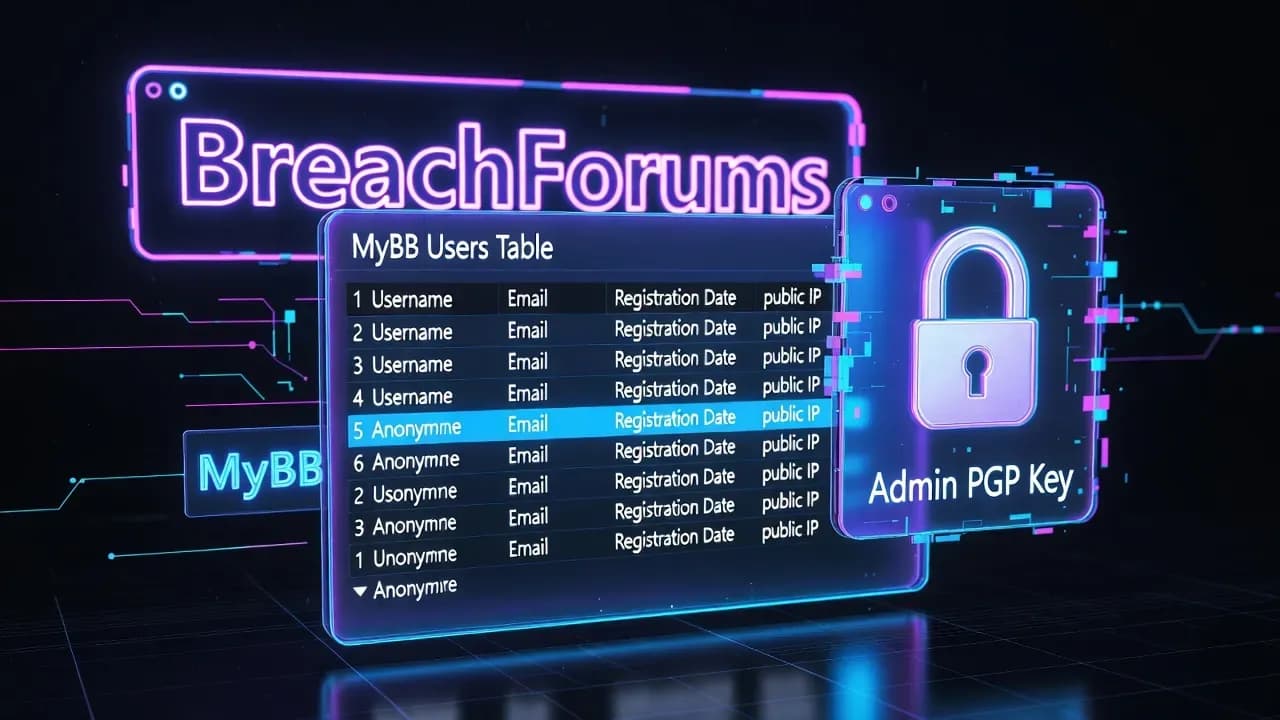
Member records exposed in the leaked MyBB user table
Accounts containing non-loopback public IP addresses
Opening: BreachForums Becomes the Victim Again
BreachForums, one of the most influential hubs for trading stolen data and criminal services, has now become the victim again. A leaked user database tied to the forum's latest incarnation puts tens of thousands of participants at renewed risk of identification, doxxing, and targeted law enforcement interest. For defenders, this is not just underground drama: it is a live example of how operational security collapses in real ecosystems, and how a single exposed backup can reshape an entire threat landscape. The incident also revives an old question that matters to anyone doing threat intelligence collection: when a criminal forum gets "breached," are you looking at a compromise, an internal power play, or the early stages of a controlled monitoring operation?
What Happened: The Technical Breakdown
The leaked material centers on a database export attributed to a MyBB users table, distributed inside a compressed archive that also included a BreachForums administrator PGP private key file. The forum's current administrator acknowledged the exposure publicly and framed it as a historical issue: an "old users-table leak" dating to August 2025, allegedly created during a restoration window when forum data was temporarily placed in an unsecured folder.
Last registration date found in the leaked database table
That distinction matters operationally because it suggests two different risk profiles. If the dump is genuinely "old," some users may have already rotated identities, emails, infrastructure, and access patterns. If it is newer than claimed, it becomes a more direct mapping of current participants and ongoing criminal activity.
Technically, the most sensitive aspect is rarely the headline "account count." It is correlation. User databases allow linking of handles to registration timelines, infrastructure artifacts, and identity reuse across platforms. Even when direct identifiers are limited, the metadata is enough to pivot. Registration dates can be aligned with known law enforcement disruptions or major breaches, potentially identifying bursts of migration from one forum to another. User table artifacts can also reveal how the forum is administered, including default configurations, user group structures, and whether the site uses privacy-preserving controls or merely creates the appearance of them.
A notable detail in this leak is the IP address pattern. Many records reportedly map to a loopback-style address (127.0.0.9) rather than a public endpoint, which reduces immediate attribution value. But a significant subset of accounts still contained public IP addresses. Even a single historical public IP can be enough to connect a persona to an ISP, a geography, a hosting provider, or a VPN exit pattern, particularly when combined with other breaches and logs that defenders and investigators already hold. This is where "old data" can remain dangerous: it is not only about current access, but about the long-term permanence of identity breadcrumbs.
Why This Leak Matters Beyond the Underground
It is tempting to treat criminal-forum leaks as self-contained, but BreachForums has always been an ecosystem node, not an isolated community. The forum model exists to connect data suppliers, access brokers, ransomware affiliates, fraud crews, and buyers who operationalize stolen data at scale. When a forum's membership data leaks, you do not only get a list of usernames. You get a potential index of who was shopping for access, who was selling database dumps, who was brokering initial footholds, and who was acting as an intermediary. That index is valuable to multiple parties: rival threat actors hunting for revenge, intelligence collectors looking for leverage, and law enforcement building long-term attribution cases.
Members cited in prior law enforcement disruption operation (March 2023)
For enterprises, the most immediate concern is employee exposure. Security teams regularly discover that corporate email addresses, reused handles, or recognizable nicknames appear in underground communities. Sometimes it is malicious insiders. More often it is poor judgment: curiosity, "research," or personal activity that collides with corporate identity hygiene. A leaked BreachForums user table becomes a high-signal dataset for spear phishing, blackmail attempts, and reputational coercion. If an attacker can credibly claim "we know you were on BreachForums," they can pressure individuals into installing remote tools, approving MFA prompts, or leaking internal details.
The second-order effect is intelligence distortion. BreachForums has faced repeated disruption, relaunches, and persistent allegations that some incarnations function as monitoring operations. In that environment, a database "leak" can be weaponized as narrative control. Threat actors can use it to delegitimize a forum administration, drive a migration to a competing platform, or trigger paranoia that reduces participation and posting. For defenders, that matters because visibility depends on consistent collection points. If a single event causes the community to fracture, your intelligence coverage can shift overnight, and the most capable actors will move to quieter channels.
BreachForums, Relentless Relaunches, and the Honeypot Question
BreachForums is best understood as a lineage. The brand persists even when the infrastructure and leadership change, because the market demand is durable: a place to monetize stolen data, trade access, and advertise "services." Authorities have repeatedly targeted these forums for precisely that reason. Past law enforcement actions and arrests created disruption windows that forced migrations, triggered internal conflict, and increased paranoia among users. Each disruption also created opportunities for impersonation, hostile takeovers, and strategic deception, which complicates attribution and complicates the reliability of "official" forum communications.
The honeypot allegation is not a single binary claim; it is a spectrum of risk scenarios. At one end, a forum might be directly operated by law enforcement as a controlled environment. At the other end, it might simply be infiltrated, monitored, or intermittently compromised, with no full operational control. The reality can also shift over time. A forum can be legitimate in the sense that criminals run it, while still being heavily surveilled or partially compromised. That is why leaked administrative artifacts, like a PGP key, have outsized psychological impact. Even if a leaked key is passphrase-protected, the event signals that sensitive administrative material is not handled with discipline, and that "official messages" can become contested territory.
From an operational standpoint, the most credible outcome is not that the leak instantly identifies everyone. It is that it increases uncertainty in a community already shaped by disruptions and distrust. Uncertainty changes behavior. Some users will vanish. Some will overreact and make mistakes while "cleaning up," such as rapidly migrating accounts, reusing credentials, or posting panic messages that expose more information than the original leak. In threat ecosystems, these transitional periods often generate the best defensive intelligence because actors behave inconsistently.
How Organizations Can Respond: Practical Defensive Actions
If you lead security for an enterprise, treat this like an exposure event that can enable targeted social engineering and insider-risk pressure. Start with identity hygiene. Run searches across your corporate email domains for presence in known underground datasets through approved threat-intelligence channels and internal governance processes. If any matches are found, handle them as a sensitive HR and security issue, not as an incident-response spectacle. The goal is to reduce blast radius, not to create internal panic. Enforce password resets where appropriate, and validate that phishing-resistant MFA is enabled for privileged roles and high-risk departments.
Second, operationalize monitoring. This type of leak tends to produce follow-on campaigns: password reset scams, "your account is in the leak" extortion emails, and spear phishing that references underground credibility. Your detection engineering team should tune controls for identity-driven attacks, not just malware. Emphasize protections around mailbox rules, OAuth consent, helpdesk-assisted credential resets, and MFA fatigue. Where possible, add guardrails for high-risk user actions, such as new forwarding rules, suspicious token grants, or sudden changes in recovery email and phone attributes.
Third, use the event as a hardening lesson for your own environment. The admin's explanation, if accurate, points to a classic enterprise failure mode: temporarily placed backups or exports in an insecure location during maintenance. This is how real companies leak data as well. Review your backup workflows, staging directories, object storage permissions, and short-lived "migration" infrastructure. Build controls that assume humans will take shortcuts under time pressure. The defensive benchmark is simple: if a file is sensitive enough to cause damage when leaked, it is sensitive enough to require secure-by-default handling during every stage of its lifecycle, including restoration and testing.
Prevention and Detection Strategies
For threat intelligence teams, treat any underground dataset as both valuable and adversarial. Validate provenance before making operational decisions. If the data is positioned as a "ShinyHunters" release but the group denies affiliation, that contradiction itself is a signal: it may indicate impersonation, an attempt to stir conflict, or an effort to launder the origin of the leak. In practical terms, this means you should avoid building analyst playbooks that assume "brand equals operator." Instead, build playbooks that track technical artifacts and cross-source consistency, including timestamps, file naming patterns, and whether claimed leak contents match what is observed.
For incident response and detection engineering, focus on downstream abuse patterns. The highest-probability enterprise impact is not that your infrastructure is directly attacked because of the leak, but that people are. Watch for phishing that references BreachForums membership, uses intimidation, or threatens reputational exposure. Track spikes in targeted password reset attempts, new device enrollment anomalies, and helpdesk impersonation attempts. If you have a SOC playbook for extortion emails, update it to include "underground exposure" narratives. Those narratives often include plausible details that increase click-through rates.
Finally, if you operate online communities or customer portals, treat this as a case study in operational discipline. Implement automated scanning for exposed directories and database dumps, pre-production data leakage checks, and strict separation between restoration environments and public-facing infrastructure. Enforce least privilege on storage, eliminate anonymous directory listing, and require authentication for any artifact staging area. The BreachForums incident demonstrates a basic truth: "temporary" exposures are rarely temporary, because attackers watch for exactly those windows.
Closing
The BreachForums database leak is a reminder that no ecosystem, criminal or otherwise, is immune to exposure. For threat intelligence teams, this is enrichment data wrapped in uncertainty. For enterprise security, this is a trigger event for targeted social engineering and insider-risk scenarios. The most effective response is not to wait for exploitation but to get ahead of it: verify exposure, harden identity controls, and treat downstream phishing as the most likely follow-on. When criminal infrastructure fractures, some of the risk spills outward.
Frequently Asked Questions
Potentially, yes. Even limited metadata can be correlated with other breaches, reused handles, and historical infrastructure. Public IP addresses, when present, can add attribution value, especially if a user made operational mistakes elsewhere.
A leaked private key increases risk, but practical abuse depends on whether the passphrase can be obtained or cracked. Separately, the mere existence of the leak undermines trust in "official" statements and increases confusion, which is often the bigger strategic impact.
Because this kind of data can enable targeted phishing, coercion, and insider-risk pressure, particularly if corporate identities are present. It also shifts threat-actor behavior and can fragment ecosystems, impacting how attacks are planned and advertised.
Not on its own. A leak can occur for many reasons, including misconfiguration, internal disputes, or hostile actors trying to damage the forum's credibility. The correct approach is to treat the ecosystem as high-risk and assume surveillance is possible.
Social engineering. Expect extortion emails, password reset scams, and spear phishing that uses the leak as a credibility anchor. Identity security controls and helpdesk hardening usually provide the highest ROI here.
Related Incidents
View All High
HighGulshan Management Services data breach exposes SSNs and card data for 377,082 people
Gulshan Management Services, a New York-based accounts receivable and debt collection company, has confirmed a significa...
 High
HighInstagram Data Leak Reportedly Exposes 17.5 Million Accounts as Attackers Pivot to Password Reset Abuse
A reported Instagram data leak is being treated by threat analysts as a "high leverage" exposure: not because passwords...
 High
HighBlack Axe Arrests in Spain: 34 Suspects Tied to Long-Running BEC and Man-in-the-Middle Fraud Network
Black Axe arrests in Spain are a timely reminder that the most expensive cyber incidents do not always begin with ransom...
Comments
Want to join the discussion?
Create an account to unlock exclusive member content, save your favorite articles, and join our community of IT professionals.
New here? Create a free account to get started.