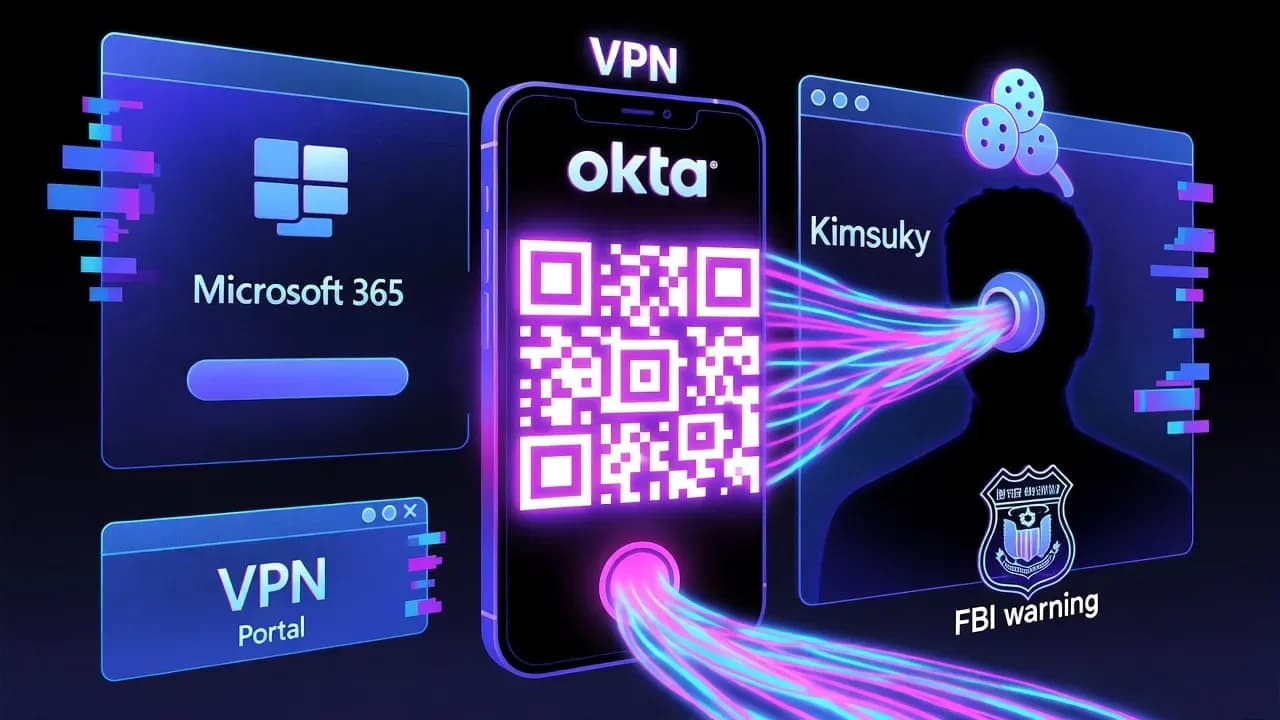
FBI Warning: Kimsuky's QR Code Phishing Targets U.S. Organizations
Kimsuky QR code phishing is no longer a niche tactic—it is now being treated as an enterprise-grade identity intrusion path by U.S. authorities. The latest warning matters because it describes a workflow that deliberately moves the victim away from hardened corporate endpoints and into a less controlled mobile context.

Kimsuky QR code phishing is no longer a niche tactic - it is now being treated as an enterprise-grade identity intrusion path by U.S. authorities. The latest warning matters because it describes a workflow that deliberately moves the victim away from hardened corporate endpoints and into a less controlled mobile context. Once the attacker controls the authentication flow, the objective is not only a password but also the session artifacts that can neutralize multi-factor authentication in practice.
For organizations running Microsoft 365, Okta, and VPN portals, the operational impact is straightforward: a single scan can turn into a persistent mailbox compromise and a secondary wave of internal spearphishing. This is a threat-report incident with direct relevance to CISOs, security operations teams, and anyone accountable for identity security.
What Happened: The Technical Breakdown of Kimsuky QR Code Phishing
The FBI's description of this campaign is notable for how deliberately it blends social engineering with identity tradecraft. The initial contact is not a generic blast; it is tailored outreach that impersonates roles that targets would plausibly engage with, such as advisors, embassy staff, or peers in think tank and policy circles.
Instead of a clickable link that email security controls can rewrite, detonate, or sandbox, the payload is embedded in a QR code delivered as an attachment or graphic. The victim is nudged to scan the code to access a questionnaire, a "secure drive," or a conference registration flow, which creates a psychological pretext for using a phone immediately.
That pivot is the strategic win: many enterprise controls are architected around endpoints and mail gateways, not around mobile browser sessions initiated from camera apps.
Once scanned, the QR code does not simply drop the user onto a single phishing page. The victim is commonly routed through attacker-controlled redirectors designed to profile the device and shape what content is shown next. That profiling stage is important because it enables selective delivery: the attacker can present different experiences depending on whether the request comes from a mobile device, which language and locale it reports, and which network characteristics it exposes.
The next step is a mobile-optimized credential harvesting page that imitates common enterprise identity surfaces, including Microsoft 365, Okta, and VPN login portals. In other words, the "attack surface" is not just email - it is the entire identity plane that sits behind modern productivity and remote access stacks.
Why Quishing Works: Mobile Pivot, Session Tokens, and Practical MFA Bypass
Most defenders understand credential phishing, but quishing succeeds by exploiting gaps between identity controls, endpoint monitoring, and user behavior. When a user scans a QR code, the authentication journey often begins outside the telemetry your SOC expects to see.
The mobile browser session may not be:
- Managed by MDM
- Enforcing the same certificate or device-compliance checks
- Covered by the same EDR instrumentation or network inspection stack
Even when the enterprise has strong email security, the QR code can evade link analysis because the "link" is encoded inside an image. The result is a delivery mechanism that reduces the number of controls that can intervene before the user reaches a counterfeit login experience.
Session Token Theft and Replay
The second reason this technique is operationally dangerous is session token theft and replay. In many real-world compromises, the attacker is not satisfied with capturing a password that might be reset or blocked by conditional access. The more durable objective is to capture session artifacts - tokens or cookies - that can be replayed to inherit a valid authenticated session.
This is where the practical MFA bypass occurs: if the attacker can replay a token after the user has already completed MFA, the attacker may not need to trigger a new MFA prompt at all. That changes your detection logic because you may not see the classic "MFA failed" pattern you associate with brute force or commodity phishing.
For identity teams, the takeaway is that Kimsuky QR code phishing should be treated as an identity intrusion technique, not merely an email hygiene problem.
Threat Actor Profile and Motivation: Why Kimsuky Targets Policy Ecosystems
Kimsuky is generally tracked as a North Korea-linked cyber espionage actor with a long-running interest in intelligence collection. Its targeting patterns often align with strategic information needs:
- Policy research
- Regional security issues
- Diplomatic dynamics
- Organizations that shape or inform government decision-making
This matters for defenders because it influences both victim selection and the quality of pretexting. When the target is a think tank leader, senior fellow, or advisory firm, the attacker can craft lures that look like routine professional correspondence - requests for commentary, invitations to closed events, or access to shared documents. Those lures do not need malware to succeed; they need credibility and timing.
Downstream Exposure and Trust Chain Propagation
From a risk perspective, this targeting also increases downstream exposure. Policy ecosystems sit at the intersection of government, academia, NGOs, and private sector advisors, which creates rich lateral possibilities once a mailbox is compromised.
A single account takeover can be used to send convincing follow-on messages to partners, donors, media contacts, or government counterparts, effectively weaponizing trust relationships. That is why the "secondary spearphishing from a compromised mailbox" angle deserves specific attention: it can turn an initially narrow intrusion into a broader campaign that propagates within a community.
For organizations that handle sensitive policy work, the primary damage is not only credential exposure - it is also the potential compromise of communications, contacts, and strategically valuable documents.
How Organizations Can Respond: Prevention and Detection Strategies
Defending against Kimsuky QR code phishing requires treating QR scans as a first-class security event, not an edge case.
Governance and Training
Start with governance: define when QR codes are acceptable, who can send them, and what verification steps users must take before scanning. Training should explicitly cover "quishing" patterns, including the social engineering cues the FBI highlighted:
- Invitations
- Secure-drive bait
- Questionnaires
- Urgent calls to action that push the user toward their phone
Importantly, training must be paired with reporting pathways that are fast and low-friction; if employees do not know how to report a suspicious QR-based message, the organization loses the opportunity to contain early.
Technical Controls
On the technical side, the strongest controls converge on identity and mobile posture:
- Phishing-resistant MFA is necessary but not sufficient
- You also need controls that reduce the value of token replay and detect session anomalies
- For Microsoft 365 and other cloud identity providers, harden Conditional Access policies to:
- Require compliant devices for sensitive apps
- Restrict high-risk sign-ins
- Enforce reauthentication where practical
This aligns directly with Zero Trust principles - assume compromise, validate device and context continuously - and it complements the operational guidance many teams already follow.
Finally, consider mobile security controls that can analyze QR-linked URLs before navigation, especially for high-risk user populations that are repeatedly targeted by spearphishing.
Closing
Kimsuky QR code phishing should be understood as an identity intrusion technique that exploits the seams between email security, mobile posture, and session-based authentication. The tactical shift to QR codes is not a novelty; it is a practical method for moving users into environments where monitoring is thinner and verification habits are weaker.
Organizations that treat QR scans as "out of band" user behavior will continue to lose visibility at the moment it matters most. The more durable response is to combine strong user verification habits with identity controls that assume token theft is possible and that continuously validate device and context.
If this campaign continues to evolve, the organizations that fare best will be those that operationalize Zero Trust and Conditional Access not as theory, but as measurable friction against session replay and mailbox-driven propagation.
Frequently Asked Questions
Quishing is phishing delivered through QR codes rather than clickable links. It often forces the user onto a mobile device, where enterprise protections and monitoring may be weaker. The encoded URL also reduces the effectiveness of email gateway link inspection because the destination is hidden inside an image. The net result is a higher chance the user reaches a credential harvesting page before controls can intervene.
The most common path is session token theft and replay. If an attacker captures a session token after a user has completed MFA, the attacker may be able to reuse that token to access the account without triggering a new MFA challenge. This shifts detection away from "MFA failures" and toward abnormal session behavior, device posture signals, and suspicious sign-in context. Strong Conditional Access and device compliance checks can reduce the odds that token replay succeeds.
Entities involved in foreign policy, national security research, human rights work, and diplomatic or regional analysis are consistently attractive targets. That includes NGOs, think tanks, academic institutions, advisory firms, and government-adjacent organizations. However, the technique itself is broadly reusable, so any enterprise with high-value cloud identities should assume it could be adapted against them.
Prioritize identity controls that limit what an attacker can do with stolen credentials or tokens. Enforce phishing-resistant MFA where possible, require compliant devices for access to sensitive applications, and tighten Conditional Access around high-risk sign-ins and unfamiliar device contexts. Add mobile security measures (MDM or equivalent) for high-risk roles to reduce unmanaged browsing and scanning.
Treat it as a potential identity compromise event, not merely a "phishing click." Rapidly invalidate sessions, reset credentials, and review sign-in logs for suspicious sessions, unusual device fingerprints, and abnormal geographic or network patterns. Check mailbox rules, OAuth app consents, and forwarding configurations that could indicate persistence.
Comments
Want to join the discussion?
Create an account to unlock exclusive member content, save your favorite articles, and join our community of IT professionals.
New here? Create a free account to get started.