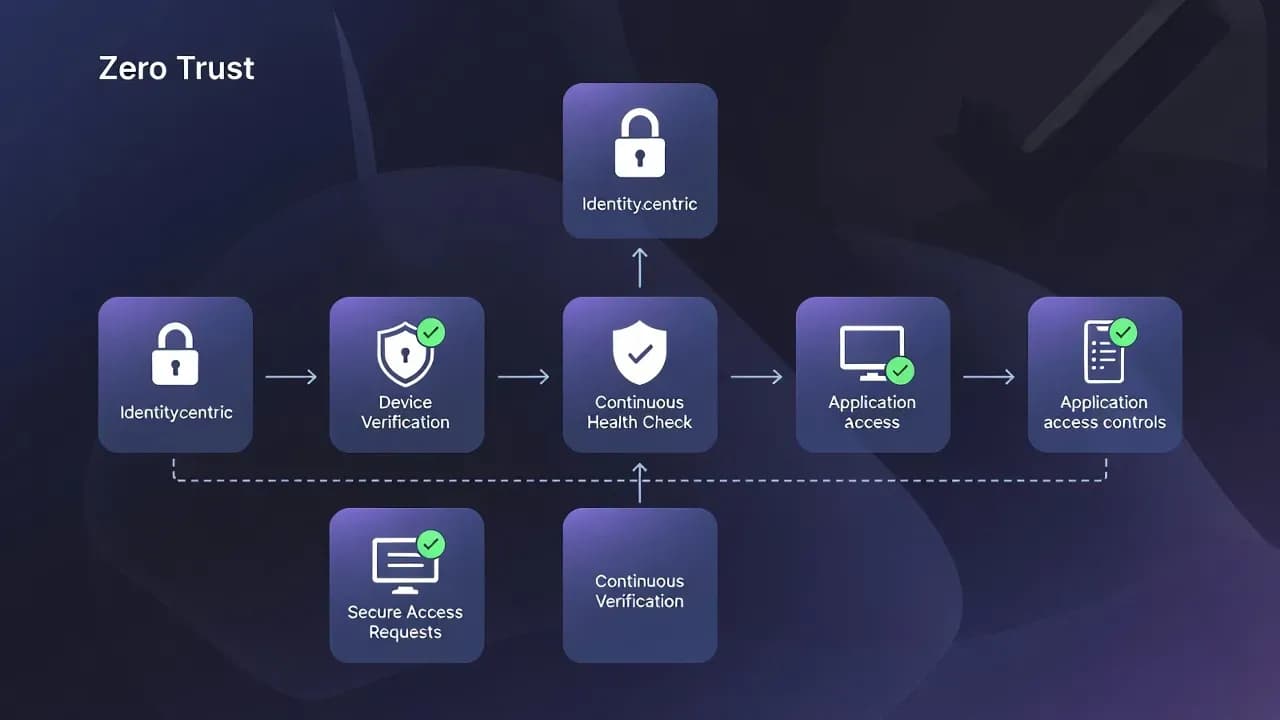
What Is Zero Trust Security and Why It Matters
Zero Trust security has become a reference model for protecting modern IT environments. Built on the principle of continuous verification, it replaces traditional perimeter-based trust with identity-driven controls. This explanation details what Zero Trust security is, how it works in practice, its core principles, and why it is increasingly adopted across cloud, hybrid, and enterprise infrastructures.

What Is Zero Trust Security?
Zero Trust security is a security model that assumes no user, device, or system should be trusted by default. Every access request must be verified continuously, regardless of where it originates.
Instead of relying on network location or perimeter defenses, Zero Trust enforces access based on identity, device state, and contextual risk. The model is designed to reduce lateral movement, limit breach impact, and protect modern cloud-first environments.
Why Zero Trust Was Introduced
Traditional security models were built around trusted internal networks and untrusted external networks. Once inside the perimeter, users and systems often had broad access.
This approach no longer fits modern IT environments. Cloud services, remote work, mobile devices, and third-party integrations have dissolved traditional network boundaries. Zero Trust addresses this shift by removing implicit trust and enforcing continuous verification.
Core Principles of Zero Trust
Zero Trust is built on several fundamental principles that guide access and security decisions.
Never Trust, Always Verify
Access is not granted based on network location. Every request must be authenticated, authorized, and evaluated using contextual signals.
Least Privilege Access
Users and applications receive only the minimum level of access required. Permissions are limited in scope and duration to reduce exposure.
Assume Breach
Zero Trust operates under the assumption that a breach may already exist. Security controls are designed to limit blast radius and prevent lateral movement.
How Zero Trust Works in Practice
Zero Trust is implemented through a combination of identity, device, and access controls rather than a single technology.
Identity-Centric Access Control
Identity becomes the primary security boundary. Users and workloads are verified through strong authentication and identity-based policies.
Device and Context Evaluation
Access decisions consider device health, compliance status, location, and behavior. Unmanaged or high-risk devices may be restricted or blocked.
Continuous Enforcement
Verification does not stop after sign-in. Sessions can be re-evaluated dynamically as conditions change, such as location or detected risk.
Key Technologies Used in Zero Trust
Zero Trust relies on multiple complementary controls working together.
Conditional Access
Conditional Access enforces access policies based on identity, device, and risk signals. It determines when additional verification is required or access is denied.
Multi-Factor Authentication
MFA adds an additional verification layer beyond passwords. It significantly reduces the risk of credential-based attacks.
Endpoint and Device Management
Managed and compliant devices are treated differently from unknown or unmanaged systems. Device posture is a critical trust signal.
Network Segmentation
Network access is segmented to limit lateral movement. Systems are isolated so that compromise of one asset does not expose the entire environment.
Zero Trust vs Traditional Security Models
Traditional models focus on defending a network perimeter. Once access is granted, trust is often assumed.
Zero Trust removes this assumption. Access decisions are dynamic, granular, and continuously evaluated, making it better suited for distributed and cloud-based environments.
Common Misconceptions About Zero Trust
Zero Trust is often misunderstood as a single product or tool. In reality, it is a strategic framework implemented through multiple controls.
It is also not a replacement for all security technologies. Firewalls, monitoring, and endpoint protection remain important but operate within a Zero Trust strategy.
Why Zero Trust Matters Today
Credential theft, cloud adoption, and remote access have made identity the primary attack surface. Zero Trust addresses these risks by enforcing strict access control and reducing reliance on network trust.
Organizations adopting Zero Trust improve visibility, reduce attack impact, and better protect data across modern IT environments.
Frequently Asked Questions
Zero Trust is a security model where no user or device is trusted by default. Every access request must be verified continuously.
Zero Trust is a security framework, not a single product. It is implemented through identity, access, device, and network controls.
Traditional security trusts users inside the network. Zero Trust removes this assumption and evaluates every access request dynamically.
Yes. MFA is a core component of Zero Trust because it strengthens identity verification and reduces credential-based attacks.
No. Zero Trust applies to cloud, hybrid, and on-premises environments, especially where identity-based access is required.


Comments
Want to join the discussion?
Create an account to unlock exclusive member content, save your favorite articles, and join our community of IT professionals.
New here? Create a free account to get started.