ANAVEM
Languagefr
Windows Event Viewer showing system event logs on a monitoring dashboard
Event ID 5617InformationWinlogonWindows

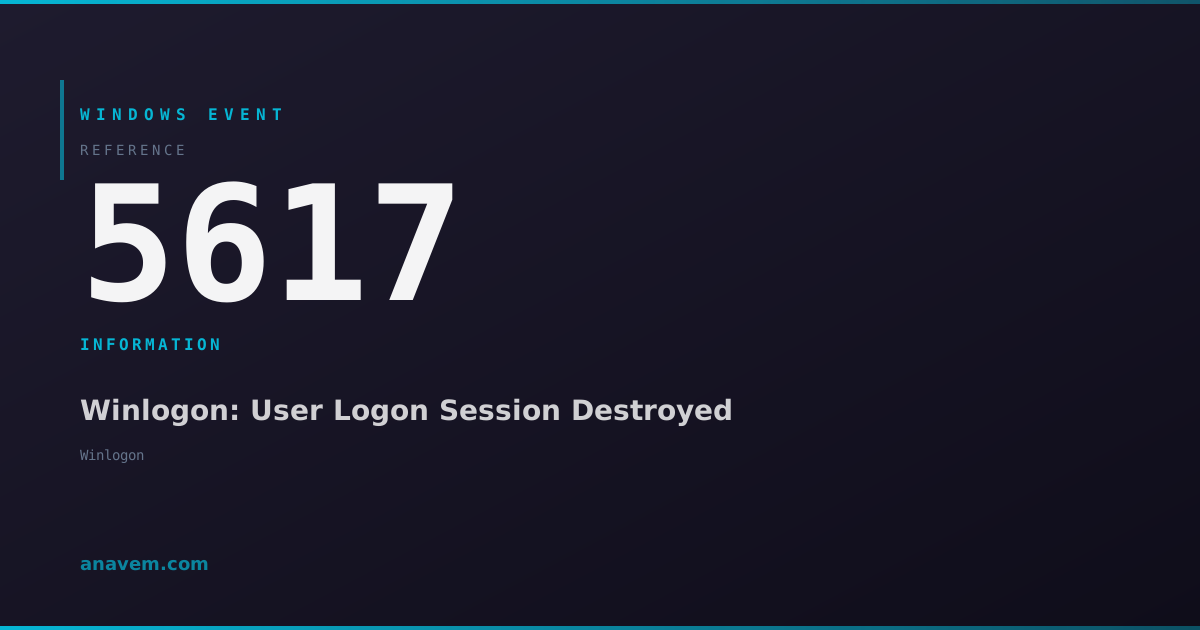
Windows Event ID 5617 – Winlogon: User Logon Session Destroyed

Event ID 5617 indicates that a user logon session has been destroyed by the Windows Logon service, typically occurring during normal user logoff or session termination processes.

Emanuel DE ALMEIDAEmanuel DE ALMEIDA
18 March 202612 min read 0
Event ID 5617Winlogon 5 methods 12 min
Event Reference

What This Event Means

Event ID 5617 represents the final stage of user session cleanup in Windows' logon architecture. When a user session ends through any mechanism—voluntary logoff, administrative termination, system shutdown, or application crash—Winlogon generates this event to document the session destruction process. The event serves as an audit trail for session management and helps administrators understand when and why user sessions terminate.

The event typically includes the session ID, user security identifier (SID), logon type, and termination reason. Session IDs correlate with other Windows events to provide complete session timelines. For example, a session that begins with Event ID 4624 (successful logon) will eventually generate Event ID 5617 when destroyed. This correlation proves invaluable for forensic analysis and user behavior monitoring.

In modern Windows environments, Event ID 5617 has gained importance due to increased remote work scenarios and cloud-hybrid deployments. The 2026 Windows updates introduced enhanced session tracking for Azure Virtual Desktop, Windows 365, and traditional RDP sessions. The event now includes additional context about session types, connection methods, and cloud authentication tokens when applicable.

System administrators use this event to identify session management issues, track user productivity patterns, and investigate security incidents involving unauthorized session access. The event's informational nature means it doesn't indicate problems by itself, but unusual patterns or unexpected session terminations warrant investigation.

Applies to

Windows 10Windows 11Windows Server 2019/2022/2025
Analysis

Possible Causes

  • Normal user logoff through Start menu or Ctrl+Alt+Del
  • System shutdown or restart procedures
  • Remote Desktop Protocol (RDP) session disconnection or termination
  • Administrative session termination using Task Manager or command-line tools
  • Application crashes causing session cleanup
  • Group Policy-enforced session timeouts
  • Windows Update installations requiring session termination
  • Fast User Switching operations
  • Terminal Services session limits being reached
  • Power management events triggering session cleanup
  • Azure Virtual Desktop or Windows 365 session endings
  • Security policy violations forcing session termination
Resolution Methods

Troubleshooting Steps

01

Analyze Event Details in Event Viewer

Start by examining the specific Event ID 5617 details to understand the session termination context.

  1. Open Event Viewer by pressing Win + R, typing eventvwr.msc, and pressing Enter
  2. Navigate to Windows LogsSystem
  3. Filter for Event ID 5617 by right-clicking the System log and selecting Filter Current Log
  4. Enter 5617 in the Event IDs field and click OK
  5. Double-click on recent Event ID 5617 entries to examine details including:
    • Session ID for correlation with other events
    • User SID and account information
    • Logon type (Interactive, Network, Service, etc.)
    • Termination reason and timestamp
  6. Note the frequency and timing patterns of these events
  7. Cross-reference session IDs with Event ID 4624 (logon) entries to build complete session timelines
Pro tip: Use the Details tab in Event Viewer to access XML data containing additional session metadata not visible in the General tab.
02

PowerShell Session Analysis and Correlation

Use PowerShell to analyze Event ID 5617 patterns and correlate with related logon events for comprehensive session tracking.

  1. Open PowerShell as Administrator
  2. Query recent Event ID 5617 entries:
    Get-WinEvent -FilterHashtable @{LogName='System'; Id=5617} -MaxEvents 50 | Select-Object TimeCreated, Id, LevelDisplayName, Message | Format-Table -AutoSize
  3. Analyze session correlation by extracting session IDs:
    $sessions = Get-WinEvent -FilterHashtable @{LogName='System'; Id=5617} -MaxEvents 20
    $sessions | ForEach-Object {
        $xml = [xml]$_.ToXml()
        [PSCustomObject]@{
            TimeCreated = $_.TimeCreated
            SessionId = $xml.Event.EventData.Data[0].'#text'
            UserSid = $xml.Event.EventData.Data[1].'#text'
            LogonType = $xml.Event.EventData.Data[2].'#text'
        }
    } | Format-Table -AutoSize
  4. Cross-reference with logon events for complete session lifecycle:
    $logonEvents = Get-WinEvent -FilterHashtable @{LogName='Security'; Id=4624} -MaxEvents 50
    $logoffEvents = Get-WinEvent -FilterHashtable @{LogName='Security'; Id=4634} -MaxEvents 50
    $sessionDestroyEvents = Get-WinEvent -FilterHashtable @{LogName='System'; Id=5617} -MaxEvents 50
  5. Export session data for analysis:
    $sessions | Export-Csv -Path "C:\temp\session_analysis.csv" -NoTypeInformation
Warning: Large environments may generate thousands of session events daily. Use date filters to limit query scope and prevent performance impact.
03

Monitor Session Termination Patterns

Implement monitoring to identify unusual session termination patterns that might indicate issues or security concerns.

  1. Create a PowerShell script to monitor session patterns:
    # Monitor session termination frequency
    $startTime = (Get-Date).AddHours(-24)
    $sessionEvents = Get-WinEvent -FilterHashtable @{
        LogName='System'
        Id=5617
        StartTime=$startTime
    }
    
    # Group by hour to identify patterns
    $sessionEvents | Group-Object {$_.TimeCreated.Hour} | Sort-Object Name | Select-Object Name, Count
  2. Check for abnormal session termination reasons:
    # Analyze termination contexts
    $sessionEvents | ForEach-Object {
        $xml = [xml]$_.ToXml()
        [PSCustomObject]@{
            Time = $_.TimeCreated
            Reason = $xml.Event.EventData.Data[3].'#text'
            SessionType = $xml.Event.EventData.Data[2].'#text'
        }
    } | Group-Object Reason | Sort-Object Count -Descending
  3. Set up automated monitoring using Task Scheduler:
    • Open Task Scheduler and create a new task
    • Set trigger for daily execution
    • Configure action to run PowerShell script monitoring Event ID 5617
    • Enable email notifications for unusual patterns
  4. Review Terminal Services configuration if RDP sessions terminate unexpectedly:
    • Navigate to HKLM\SYSTEM\CurrentControlSet\Control\Terminal Server
    • Check fDenyTSConnections value
    • Review session timeout policies in Group Policy
04

Investigate Forced Session Terminations

When Event ID 5617 appears frequently or unexpectedly, investigate potential causes of forced session terminations.

  1. Check for administrative session terminations in Event Logs:
    # Look for administrative logoff events
    Get-WinEvent -FilterHashtable @{LogName='Security'; Id=4647} -MaxEvents 20 | Select-Object TimeCreated, Message
  2. Examine system shutdown/restart events that force session cleanup:
    # Check for system shutdown events
    Get-WinEvent -FilterHashtable @{LogName='System'; Id=1074,1076} -MaxEvents 10 | Select-Object TimeCreated, Id, Message
  3. Review Group Policy settings affecting session management:
    • Open Group Policy Management Console
    • Navigate to Computer ConfigurationAdministrative TemplatesWindows ComponentsRemote Desktop Services
    • Check session time limit policies
    • Review User ConfigurationAdministrative TemplatesSystemLogon/Logoff settings
  4. Investigate application crashes causing session cleanup:
    # Check for application error events around session termination times
    Get-WinEvent -FilterHashtable @{LogName='Application'; Level=2} -MaxEvents 50 | Where-Object {$_.TimeCreated -gt (Get-Date).AddHours(-2)} | Select-Object TimeCreated, Id, ProviderName, LevelDisplayName
  5. Verify Terminal Services configuration:
    # Check RDP session limits
    Get-ItemProperty -Path "HKLM:\SYSTEM\CurrentControlSet\Control\Terminal Server\WinStations\RDP-Tcp" | Select-Object MaxInstanceCount, MaxConnectionTime
Pro tip: Correlate Event ID 5617 timestamps with application crashes, system updates, and network disconnections to identify root causes of unexpected session terminations.
05

Advanced Session Forensics and Audit Trail Analysis

Perform comprehensive session forensics using Event ID 5617 in conjunction with other Windows audit events for security investigations.

  1. Enable comprehensive audit logging for session tracking:
    # Enable detailed logon auditing
    auditpol /set /subcategory:"Logon" /success:enable /failure:enable
    auditpol /set /subcategory:"Logoff" /success:enable
    auditpol /set /subcategory:"Special Logon" /success:enable
  2. Create comprehensive session timeline analysis:
    # Build complete session timeline
    $timeRange = (Get-Date).AddDays(-7)
    $allSessionEvents = @()
    
    # Collect logon events (4624)
    $logons = Get-WinEvent -FilterHashtable @{LogName='Security'; Id=4624; StartTime=$timeRange}
    $allSessionEvents += $logons | Select-Object TimeCreated, Id, @{Name='EventType';Expression={'Logon'}}, Message
    
    # Collect logoff events (4634)
    $logoffs = Get-WinEvent -FilterHashtable @{LogName='Security'; Id=4634; StartTime=$timeRange}
    $allSessionEvents += $logoffs | Select-Object TimeCreated, Id, @{Name='EventType';Expression={'Logoff'}}, Message
    
    # Collect session destruction events (5617)
    $destructions = Get-WinEvent -FilterHashtable @{LogName='System'; Id=5617; StartTime=$timeRange}
    $allSessionEvents += $destructions | Select-Object TimeCreated, Id, @{Name='EventType';Expression={'SessionDestroy'}}, Message
    
    # Sort chronologically
    $allSessionEvents | Sort-Object TimeCreated | Export-Csv -Path "C:\temp\complete_session_timeline.csv" -NoTypeInformation
  3. Analyze session duration patterns:
    # Calculate session durations
    $sessionPairs = @{}
    foreach ($event in $allSessionEvents | Sort-Object TimeCreated) {
        if ($event.EventType -eq 'Logon') {
            # Extract session ID and store logon time
            $sessionId = ([xml]$event.Message).Event.EventData.Data[3].'#text'
            $sessionPairs[$sessionId] = @{LogonTime = $event.TimeCreated}
        }
        elseif ($event.EventType -eq 'SessionDestroy') {
            # Calculate duration
            $sessionId = ([xml]$event.Message).Event.EventData.Data[0].'#text'
            if ($sessionPairs[$sessionId]) {
                $duration = $event.TimeCreated - $sessionPairs[$sessionId].LogonTime
                Write-Output "Session $sessionId Duration: $($duration.TotalMinutes) minutes"
            }
        }
    }
  4. Check for security-related session terminations:
    # Look for security events around session destruction
    $securityEvents = Get-WinEvent -FilterHashtable @{
        LogName='Security'
        Id=4625,4648,4672,4720,4726
        StartTime=(Get-Date).AddDays(-1)
    } | Select-Object TimeCreated, Id, LevelDisplayName, Message
  5. Generate session security report:
    # Create comprehensive session security report
    $report = @{
        TotalSessions = ($destructions | Measure-Object).Count
        AverageSessionDuration = ($sessionDurations | Measure-Object -Average).Average
        UnexpectedTerminations = ($destructions | Where-Object {$_.Message -like '*unexpected*'} | Measure-Object).Count
        SecurityAlerts = ($securityEvents | Measure-Object).Count
    }
    $report | ConvertTo-Json | Out-File "C:\temp\session_security_report.json"
Warning: Session forensics can generate large amounts of data. Ensure adequate disk space and consider data retention policies when implementing comprehensive session monitoring.

Overview

Event ID 5617 fires when the Windows Logon service (Winlogon) destroys a user logon session. This informational event occurs during normal session termination processes, including user logoffs, system shutdowns, remote desktop disconnections, and forced session terminations. The event appears in the System log and provides session tracking capabilities for administrators monitoring user activity.

This event is part of Windows' session management framework and works alongside other logon/logoff events like 4624 (successful logon) and 4634 (logoff). Unlike security audit events, Event ID 5617 focuses on the technical session destruction process rather than security implications. The event contains session identifiers, user context information, and termination reasons that help administrators track session lifecycles.

In Windows 11 2026 updates and Server 2025, Microsoft enhanced session tracking with additional metadata fields for hybrid cloud environments and improved correlation with Azure AD sign-ins. The event remains crucial for troubleshooting session-related issues, monitoring user activity patterns, and investigating unexpected session terminations in enterprise environments.

Frequently Asked Questions

What does Event ID 5617 mean and when should I be concerned?+
Event ID 5617 indicates that Windows Logon service has destroyed a user session, which is normal during logoffs, shutdowns, and session terminations. You should be concerned if you see excessive frequency, sessions terminating unexpectedly without user action, or patterns suggesting forced terminations. The event itself is informational and indicates normal session cleanup, but unusual patterns may indicate system issues, security problems, or configuration errors affecting user sessions.
How can I correlate Event ID 5617 with other Windows logon events?+
Event ID 5617 correlates with Event ID 4624 (successful logon) and 4634 (logoff) through session IDs. Use PowerShell to extract session IDs from the event XML data and match them across different event logs. A complete session lifecycle starts with 4624 in the Security log, may include various session events, and ends with 5617 in the System log. This correlation helps track session duration, identify incomplete sessions, and investigate security incidents involving user accounts.
Why am I seeing frequent Event ID 5617 entries in my Windows Server environment?+
Frequent Event ID 5617 entries in Windows Server environments are typically normal, especially on Terminal Servers, Remote Desktop Session Hosts, or servers with multiple concurrent user sessions. Each user logoff, RDP disconnection, or administrative session termination generates this event. However, if frequency suddenly increases, investigate potential causes like Group Policy changes, application crashes, network connectivity issues, or automated scripts terminating sessions. Monitor patterns to distinguish between normal operations and potential issues.
Can Event ID 5617 help with security investigations and user activity monitoring?+
Yes, Event ID 5617 is valuable for security investigations as it provides session termination timestamps and context. Combined with logon events, it helps establish user presence timelines, identify unauthorized access patterns, and investigate security incidents. The event shows when sessions end unexpectedly, which might indicate forced terminations due to security policies or malicious activity. For comprehensive monitoring, correlate 5617 with authentication events, failed logon attempts, and privilege escalation events to build complete user activity profiles.
How do I troubleshoot unexpected session terminations causing Event ID 5617?+
To troubleshoot unexpected session terminations, first examine the Event ID 5617 details for termination reasons and session context. Check for corresponding application errors, system shutdown events (1074, 1076), and security events around the same time. Review Group Policy settings for session timeouts, investigate network connectivity issues for RDP sessions, and examine system resource usage during termination times. Use PowerShell to analyze patterns and frequencies, and consider enabling additional audit logging to capture more detailed session management events for root cause analysis.
Documentation

References (2)

Emanuel DE ALMEIDA
Written by

Emanuel DE ALMEIDA

Senior IT Journalist & Cloud Architect

Microsoft MCSA-certified Cloud Architect | Fortinet-focused. I modernize cloud, hybrid & on-prem infrastructure for reliability, security, performance and cost control - sharing field-tested ops & troubleshooting.

Discussion

Share your thoughts and insights

You must be logged in to comment.

Loading comments...