What Is Quantum Computing and How It Works
Quantum computers aren't faster classical computers - they're fundamentally different machines that exploit quantum physics to solve problems impossible for traditional hardware. Here's what IT professionals need to understand about qubits, superposition, and why your encryption might have an expiration date.

Estimated 50% probability of cryptographically relevant quantum computers existing, according to Global Risk Institute expert survey
Why Quantum Computing Matters to IT Professionals
You've probably heard the headlines: Google achieved "quantum supremacy." IBM has a quantum computer you can access through the cloud. China is investing billions in quantum research. But amid the hype, it's hard to separate what's real from science fiction.
Here's why you should care: quantum computers will eventually break the encryption that protects virtually everything - your VPN connections, your banking transactions, your corporate secrets, your customers' data. RSA, ECC, Diffie-Hellman - the cryptographic foundations of internet security become trivial to crack once sufficiently powerful quantum computers exist.
That day isn't tomorrow. Current quantum computers are experimental, error-prone, and limited. But the data you're protecting today may need to stay protected for decades. An adversary who captures your encrypted traffic now could decrypt it later when quantum computers mature. This is the "harvest now, decrypt later" threat that's already driving government agencies and forward-thinking enterprises to prepare.
Understanding quantum computing isn't about becoming a physicist. It's about understanding what's coming, when it matters, and what to do about it.
Classical Computing: The Foundation
To understand quantum computing, you first need to appreciate what makes it different from the computers you use every day.
Classical computers process information using bits. A bit exists in one of two states: 0 or 1. Every computation ultimately reduces to manipulating vast numbers of bits through logic gates: AND, OR, NOT, XOR.
The power of classical computing comes from doing these simple operations incredibly fast. A modern CPU performs billions of operations per second. Moore's Law has driven exponential improvements for decades.
But classical computers have fundamental limitations for certain problems. Consider factoring a large number into its prime components. For a 2048-bit number (RSA encryption size), a classical computer would need longer than the age of the universe to find the factors through brute force.
These aren't engineering limitations that faster chips will solve. They're mathematical barriers inherent to how classical computation works. Quantum computing takes a fundamentally different approach.
The Qubit: Information Reimagined
The quantum bit - qubit - is the fundamental unit of quantum information. Unlike a classical bit that's either 0 or 1, a qubit can exist in a superposition of both states simultaneously.
A classical bit is like a coin lying on a table - it's either heads or tails. A qubit is like a coin spinning in the air - it's in a superposition of both until it lands. When you measure it, the superposition "collapses" to a definite state.
This isn't a limitation of our knowledge - the qubit genuinely exists in multiple states simultaneously until measurement forces a definite outcome.
Physical Qubit Implementations
Qubits can be implemented in various physical systems:
| Qubit Type | Implementation | Pros | Cons |
|---|---|---|---|
| Superconducting | Electrical circuits at 15 millikelvin | Fast gates, mature fabrication | Extreme cooling required |
| Trapped Ion | Individual atoms in electromagnetic fields | Long coherence, high fidelity | Slower gates, scaling challenges |
| Photonic | Individual photons | Room temperature, good for communication | Harder to make photons interact |
| Topological | Exotic quantum states | Theoretically error-resistant | Still largely experimental |
IBM, Google, and most commercial efforts use superconducting qubits. IonQ and Quantinuum use trapped ions.
Superposition: Parallelism Unlike Any Other
Superposition enables parallelism fundamentally different from classical parallel computing.
A classical computer with 3 bits represents one of 8 possible states at any moment. A quantum computer with 3 qubits represents all 8 states simultaneously in superposition. With 50 qubits: 2⁵⁰ states - more than a quadrillion. With 300 qubits: more states than atoms in the observable universe.
This is why quantum computers aren't universally faster. Quantum advantage exists only for problems with mathematical structure that quantum algorithms can exploit.
Entanglement: Spooky Action, Real Consequences
Entanglement is the second quantum phenomenon powering quantum computing. When qubits are entangled, their states become correlated in ways impossible for classical systems.
Consider two entangled qubits: measuring the first as 0 means the second will also be 0; measuring the first as 1 means the second will also be 1. Before measurement, both are in superposition. But the moment you measure one, you instantly know the other's state - even if they're light-years apart.
Einstein called this "spooky action at a distance." Decades of experiments proved him wrong - entanglement is real.
For quantum computing, entanglement enables algorithms to work. Entangled qubits share information in ways classical bits cannot. Without entanglement, quantum computers would offer no advantage.
Entanglement is also fragile. Interactions with the environment can break entanglement - decoherence. This is the fundamental challenge: qubits must be isolated enough to stay entangled, yet controllable enough to perform computations.
Quantum Gates and Circuits
Just as classical computers use logic gates, quantum computers use quantum gates. But quantum gates must be reversible - no information is ever lost.
| Gate | Function |
|---|---|
| Hadamard (H) | Puts qubit into superposition |
| Pauli-X | Quantum NOT gate - flips 0 to 1 |
| CNOT | Two-qubit gate that creates entanglement |
| Phase gates | Modify probability amplitudes for interference effects |
A quantum algorithm is a circuit - a sequence of gates applied to qubits, beginning with known state, creating superpositions and entanglement, and ending with measurement.
Quantum Algorithms: Where Advantage Lives
Quantum computers aren't universally faster. Their advantage exists for specific problem classes.
Shor's Algorithm: Breaking Cryptography
The same algorithm breaks elliptic curve cryptography (ECC) and Diffie-Hellman key exchange. All widely deployed public-key cryptography becomes vulnerable.
Current quantum computers are far too small to run Shor's algorithm against real keys. We need thousands to millions of error-corrected logical qubits. But "harvest now, decrypt later" attacks are already a concern.
Grover's Algorithm: Searching Faster
Grover's algorithm speeds up unstructured search from N steps to √N steps - a quadratic speedup.
For symmetric cryptography, this effectively halves key strength. AES-256 becomes equivalent to AES-128 against a quantum attacker. The mitigation is straightforward: double key lengths. AES-256 remains secure.
Quantum Simulation
Richard Feynman proposed quantum computers in 1982 specifically to simulate quantum systems. Applications include drug discovery, materials science, and chemistry. These are likely to deliver value earliest - they require fewer qubits and tolerate more errors than cryptographic applications.
The Reality: Current Quantum Computers
Headlines about "quantum supremacy" obscure the current state of technology.
Scale and Error Rates
The largest quantum processors have ~1,000-1,500 physical qubits (early 2025). But raw qubit count is misleading. These are "physical qubits" subject to errors.
Useful quantum computing requires logical qubits constructed from many physical qubits using error correction. Current error rates are ~0.1-1% per gate operation. Error correction schemes require 1,000-10,000 physical qubits per logical qubit.
Translation: A quantum computer capable of breaking RSA-2048 might need millions of physical qubits. The largest current systems have ~1,000. We're at least a decade away.
Coherence Times
Qubits maintain quantum state for limited time - microseconds to milliseconds. Computations must complete before coherence is lost.
NISQ Era
Researchers describe current machines as "Noisy Intermediate-Scale Quantum" (NISQ) devices. They're too noisy for error correction, too small for cryptographic attacks, but potentially useful for problems where approximate answers suffice.
The Cryptographic Threat Timeline
What Breaks
| Affected | Algorithm | Impact |
|---|---|---|
| RSA | Shor's | Completely broken |
| ECC | Shor's | Completely broken |
| Diffie-Hellman | Shor's | Completely broken |
| AES-256 | Grover's | Weakened but secure |
| SHA-384/512 | Grover's | Weakened but secure |
Q-Day Timeline
Expert estimates range from 2030 (optimistic) to 2040+ (conservative). Most experts estimate 50% chance of cryptographically relevant quantum computers by 2035-2040.
Post-Quantum Cryptography: The Response
The cryptographic community hasn't been idle. Post-quantum cryptography (PQC) develops algorithms resistant to both classical and quantum attacks.
NIST Standardization (2024)
| Algorithm | Type | Use Case |
|---|---|---|
| ML-KEM (Kyber) | Lattice-based | Key encapsulation/exchange |
| ML-DSA (Dilithium) | Lattice-based | Digital signatures |
| SLH-DSA (SPHINCS+) | Hash-based | Digital signatures (alternative) |
These algorithms replace RSA and ECC based on mathematical problems believed hard for both classical and quantum computers.
Migration Challenges
Post-quantum algorithms have different performance characteristics. Key sizes and signature sizes are larger - ML-KEM public keys are ~1,500 bytes versus 256 bytes for ECC. This affects protocols, storage, bandwidth.
Migration requires updating protocols (TLS, SSH, IPsec), replacing certificates, updating firmware, testing compatibility. For large organizations, this is a multi-year project.
Hybrid Approaches
Preparing Your Organization
Step 1: Inventory Your Cryptography
Identify where you use cryptography: TLS certificates, VPN configurations, disk encryption, code signing, API authentication. Document which algorithms are in use.
Step 2: Assess Vendor Roadmaps
When will your firewall vendor support post-quantum VPNs? When will your CA issue post-quantum certificates? Factor responses into procurement decisions.
Step 3: Experiment with Post-Quantum
Post-quantum algorithms are available in open-source libraries (liboqs, Open Quantum Safe). Test in lab environments. Build organizational familiarity.
Step 4: Plan for Crypto Agility
Design systems so algorithms can be updated without major rearchitecture. Hard-coded algorithm choices create migration barriers.
The Quantum Computing Landscape
Major Players
| Company | Approach | Status |
|---|---|---|
| IBM | Superconducting | Cloud access, 1,000+ qubit roadmap |
| Superconducting | "Quantum supremacy" 2019 | |
| Microsoft | Topological | Different approach, betting on error resistance |
| IonQ | Trapped ion | Emphasis on quality over quantity |
| Quantinuum | Trapped ion | Honeywell spin-off |
Cloud Access
You don't need to own a quantum computer to experiment. IBM Quantum, Amazon Braket, Google Quantum AI, and Microsoft Azure Quantum provide cloud access. Free tiers allow experimentation.
What Quantum Computing Won't Do
Won't replace classical computers. Quantum computers excel at specific problems. For general computing - OS, graphics, web servers, most neural networks - classical remains superior.
Won't solve all hard problems instantly. NP-complete problems likely remain hard even for quantum computers. Most everyday computing doesn't have the right mathematical structure.
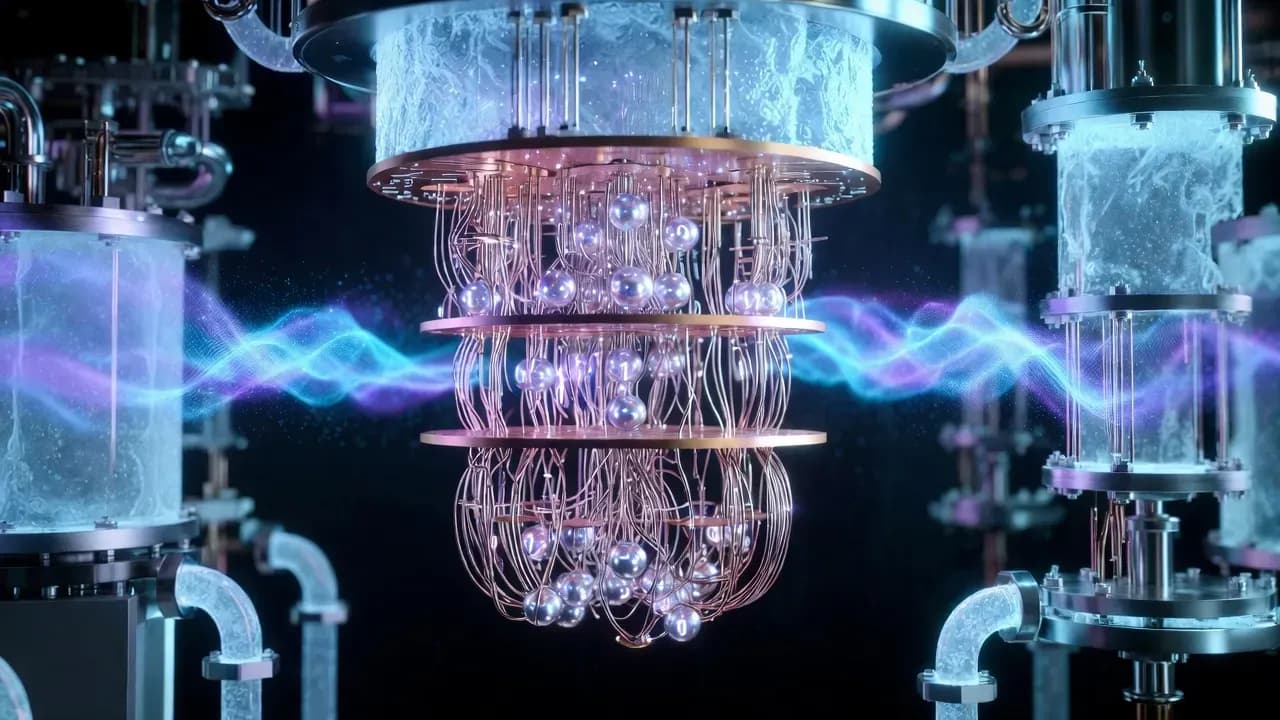
Won't be in your data center soon. Superconducting quantum computers require dilution refrigerators cooling to 15 millikelvin. Quantum computing will be consumed as cloud service.
Won't make classical security obsolete. Post-quantum cryptography provides effective defense. The threat is to organizations that don't migrate.
Realistic Timeline
| Period | Expected Developments |
|---|---|
| Now – 2027 | NISQ era continues, limited commercial applications, PQC migration begins |
| 2027 – 2032 | Early fault tolerance, first logical qubit demonstrations, PQC migration accelerates |
| 2032 – 2040 | Cryptographically relevant machines likely emerge |
| Beyond 2040 | Mature quantum computing, new applications emerge |
These timelines are speculative. Breakthroughs could accelerate; obstacles could delay. The prudent approach is preparing for earlier timelines.
Comments
Want to join the discussion?
Create an account to unlock exclusive member content, save your favorite articles, and join our community of IT professionals.
New here? Create a free account to get started.