

Google patches Chrome V8 zero-day CVE-2026-85046, exploited in the wild
The sixth actively exploited Chrome zero-day of 2026 sits in V8, so every Chromium-based browser inherits it until its own vendor ships the fix.

On this page
Key takeaways
- CVE-2026-85046 is a high-severity type confusion bug in V8, Chrome's JavaScript and WebAssembly engine. Google confirms an exploit exists in the wild.
- Fixed in Chrome 152.0.7977.82/.83 for Windows and macOS and 152.0.7977.82 for Linux, released 3 September 2026.
- CISA added the flaw to the KEV catalog on 4 September 2026 under Binding Operational Directive 26-04.
- Microsoft Edge, Brave, Opera and Vivaldi inherit the same V8 code and need their own vendor updates. Firefox and Safari do not.
- The update carries 12 fixes in total: 10 rated high, including the zero-day, and two rated medium.
What to do now
High urgency- Update Chrome to 152.0.7977.82 or later and confirm the browser has been restarted so the patched binary is running.
- Verify installed build numbers across the fleet rather than trusting Chrome's staged auto-update.
- Track the same fix through Microsoft Edge, Brave, Opera and Vivaldi against each vendor's own release notes.
- Inventory Electron applications that load remote content and chase their vendors for updated Chromium builds.
- Use browser version telemetry for detection, since no indicators of compromise have been published for this exploitation.
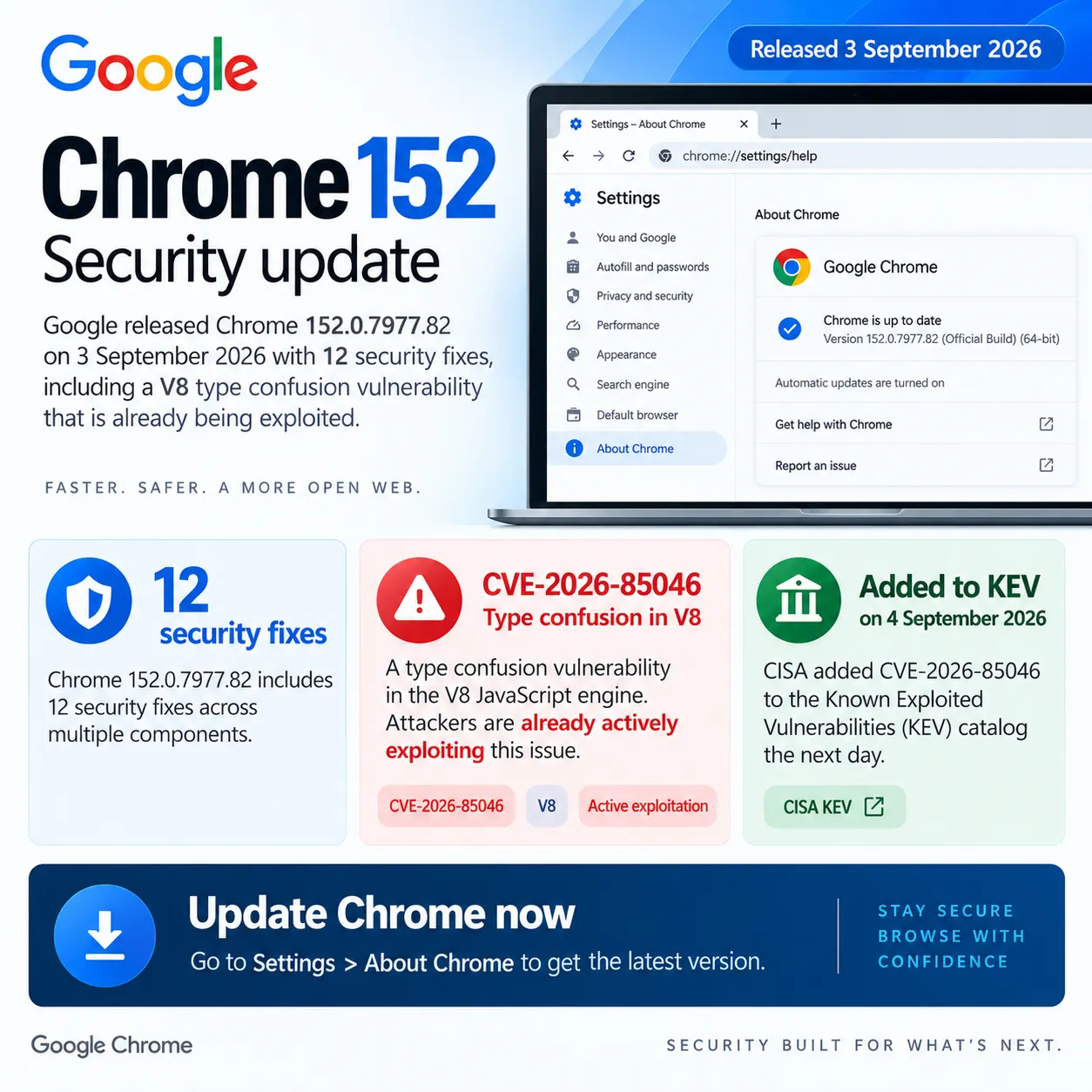
Google has patched Chrome V8 zero-day CVE-2026-85046, a type confusion flaw the company confirms is already being exploited. The fix shipped on 3 September 2026 in Chrome 152.0.7977.82/.83 for Windows and macOS, and 152.0.7977.82 for Linux, alongside 11 other security fixes. CISA added the bug to its Known Exploited Vulnerabilities catalog a day later. It is the sixth actively exploited Chrome zero-day Google has patched this year.
V8 is shared by every Chromium browser, so the exposure extends well past Chrome itself. And because Chrome's update rolls out in stages and only takes effect after a restart, a fleet that trusts auto-update alone can sit unpatched for days.
Google has patched CVE-2026-85046, an actively exploited type confusion vulnerability in Chrome's V8 engine, in Chrome 152.0.7977.82.
Update Chrome to 152.0.7977.82 or later and restart the browser. The V8 type confusion bug behind CVE-2026-85046 is being exploited in the wild, CISA has listed it in KEV, and every Chromium-based browser is exposed until its own vendor ships the fix.
Affected & context
Google released Chrome 152.0.7977.82/.83 for Windows and macOS and 152.0.7977.82 for Linux on 3 September 2026, fixing 12 vulnerabilities. One of them, CVE-2026-85046, is a high-severity type confusion flaw in the V8 JavaScript and WebAssembly engine that Google confirms is being exploited in the wild. CISA added it to the Known Exploited Vulnerabilities catalog the following day.
This is the sixth actively exploited Chrome zero-day of 2026, and it sits in V8, so Microsoft Edge, Brave, Opera and Vivaldi inherit the same bug until each vendor ships its own build. Browsers process hostile content all day, which makes a confirmed in-the-wild browser bug a fast-clock problem.
Anyone running Chrome earlier than 152.0.7977.82 on Windows, macOS or Linux, plus users of other Chromium-based browsers until those vendors publish their own updates. Firefox and Safari use different JavaScript engines and are not affected by this flaw.
- Vendors
- Products
- Google ChromeChromiumV8 JavaScript engine
- Geography
- Global
- Industry
- All sectors
- CVEs
- CVE-2026-85046
What Google shipped
Google moved the Chrome stable channel to 152.0.7977.82/.83 for Windows and macOS, and 152.0.7977.82 for Linux, on 3 September 2026. The release carries 12 security fixes. One of them, CVE-2026-85046, is under active attack.
The advisory is blunt about it: Google states that an exploit for CVE-2026-85046 exists in the wild. It gives no attribution, no targeting detail and no indicators, which is standard practice while a fix is still reaching users. Google also notes that access to the bug report stays restricted until most users have updated.
The flaw was reported on 4 August 2026 by Salvatore Gulizia, who works under the handle Serotav and received a $1,000 bounty. Gulizia also reported a second bug fixed in the same release, CVE-2026-85053, an improper resource exposure issue in CacheStorage.
What Chrome V8 zero-day CVE-2026-85046 actually is
CVE-2026-85046 is a type confusion flaw in V8, the JavaScript and WebAssembly engine that Chrome uses to run every page it loads. Type confusion means the engine handles a chunk of memory as one kind of object when it holds another. In a JIT compiler that optimises aggressively on assumed object shapes, that mismatch turns into read and write access to memory the page should never touch.
The published CVE record puts the outcome plainly: a remote attacker can execute arbitrary code inside the sandbox via a crafted HTML page, in Chrome builds before 152.0.7977.82. The class is CWE-843, access of a resource using an incompatible type.
One nuance matters for triage. Code execution inside the renderer sandbox is not full control of the machine. Turning it into host compromise normally needs a second bug to break out of the sandbox. That does not make this low risk, since credentials, session tokens and everything else in browser memory sit inside that boundary.
Google rates the issue High and publishes no CVSS score of its own. The 8.8 figure circulating in coverage comes from the CVE record's enrichment, not from Google.
CISA listed it within a day
CISA added CVE-2026-85046 to its Known Exploited Vulnerabilities catalog on 4 September 2026, one day after the patch, describing it as a Google Chromium V8 type confusion vulnerability and citing evidence of active exploitation.
One detail is worth getting right, because a lot of coverage still gets it wrong. CISA's alert cites Binding Operational Directive 26-04, Prioritizing Security Updates Based on Risk, as the directive setting vulnerability management requirements for federal civilian agencies. Write-ups that reference BOD 22-01 for this listing are quoting a superseded directive. Reporting puts the federal remediation deadline at 18 September 2026.
Private-sector teams aren't bound by any of this, but the KEV listing is the useful signal. Fewer than one percent of published CVEs make the catalogue, and a listing means someone has confirmed real exploitation rather than modelled it.
Every Chromium browser inherits this
V8 is part of Chromium, not of Chrome alone. Microsoft Edge, Brave, Opera and Vivaldi all ship the same engine, so each one carries CVE-2026-85046 until its maintainer pulls in Google's fix and publishes a build. Patching Chrome across a fleet and calling the job done leaves whatever else is installed exposed.
Firefox and Safari use different JavaScript engines, SpiderMonkey and JavaScriptCore, and are not affected by this particular flaw.
The less obvious exposure is embedded Chromium. Electron applications bundle their own Chromium build and stay on the vulnerable version until the app vendor ships an update, which is usually slower than a browser release. Any Electron app that loads remote web content is worth putting on the same list as the browsers.
Browser versions are only half the inventory
Anything that renders remote web content in embedded Chromium, Electron apps included, belongs in the same patching list as the browsers.
What to do now
Get Chrome to 152.0.7977.82 or later and make sure it has been restarted. The patched binary does not run until the browser process restarts, so a user who leaves 40 tabs open for a week stays exposed after the update downloads.
Don't rely on auto-update timing. Google's own wording is that the release rolls out over the coming days and weeks, in stages. On managed estates, push the version through your existing browser management channel and verify the installed build rather than assuming.
On Windows and macOS, either 152.0.7977.82 or .83 is patched. On Linux the fixed build is 152.0.7977.82. Check the actual version at chrome://settings/help, which also triggers an update check.
After Chrome, work through the rest: Edge, Brave, Opera, Vivaldi and any Electron application in your inventory, each against its own vendor's release notes. There are no published indicators of compromise for this campaign, so detection has to lean on browser version telemetry and post-exploitation behaviour rather than on hashes or domains.
Updating is not patching until the browser restarts
Chrome downloads the fix in the background but keeps running the old binary. Verify build numbers after a restart, not after the download.
The other 11 fixes
The zero-day arrived with nine more high-severity fixes and two medium ones. Google credits its own internal teams and tooling for most of them, with three of the remaining high-severity bugs coming from outside researchers.
The high-severity set covers an out of bounds read in CrashReporting, incomplete cleanup in Network, a use after free in Compositing, a race condition in V8, an out of bounds write in WebGL, improper resource exposure in CacheStorage, use after free bugs in DevTools and Skia, and a second type confusion issue in Compositing. The two medium fixes are improper input validation in the Transactions Platform and use of a released resource in Mobile.
None of these carries an exploitation note. They matter because they ship in the same build: an organisation that patches for the zero-day picks up all 12, and one that delays keeps all 12 open.
Six zero-days in eight months
CVE-2026-85046 is the sixth Chrome zero-day patched in 2026, after CVE-2026-2441, CVE-2026-3909, CVE-2026-3910, CVE-2026-5281 and CVE-2026-11645. Three of the six, counting this one, sat in V8.
That cadence is the planning input. A browser zero-day roughly every six weeks means the question for most teams isn't whether they can respond to this one, it's whether they can compress browser patching to days as a standing capability rather than as an incident each time.
Watch for the Chromium issue to open up once the rollout completes, which usually brings the first real technical detail, and for downstream vendor advisories from the other Chromium browsers.
Timeline
Researcher reports the V8 bug
Salvatore Gulizia, known as Serotav, reports the type confusion issue to Google. The report later earns a $1,000 bug bounty.
Source: Chrome Releases advisory
Confidence: High
Google ships the fix and confirms exploitation
The Chrome stable channel moves to 152.0.7977.82/.83 with 12 security fixes. Google states that an exploit for CVE-2026-85046 exists in the wild.
Source: Chrome Releases advisory
Confidence: High
CISA adds the flaw to KEV
CISA lists CVE-2026-85046 as a Google Chromium V8 type confusion vulnerability in its Known Exploited Vulnerabilities catalog, citing evidence of active exploitation.
Source: CISA alert, 4 September 2026
Confidence: High
Impact
A crafted web page can execute code inside the Chrome renderer sandbox on any build before 152.0.7977.82. Exploitation is confirmed in the wild, and the same V8 code ships in every Chromium-based browser and in embedded Chromium runtimes such as Electron.
Business impact
Browsers are the most exposed application on most endpoints. An unpatched fleet gives attackers a working path to code execution through ordinary web browsing, phishing links or compromised advertising.
Technical impact
Type confusion in V8 gives an attacker read and write primitives on the JavaScript heap, which can be developed into arbitrary code execution in the renderer process. A separate sandbox escape would be needed for full host compromise.
Security impact
Confirmed exploitation in the wild, listed in CISA KEV. Credentials, session tokens and page content held in browser memory sit inside the compromised boundary.
Affected audience: IT administrators and endpoint teams, MSPs managing client browser fleets, Security operations and vulnerability management teams
Action required.
Technical details
- CVEs
- CVE-2026-85046
- CVSS
- 8.8
- Exploitation
- Exploited in the wild
- Attack vector
- Network. The victim loads a crafted HTML page, so user interaction is required.
- Affected versions
- Google Chrome prior to 152.0.7977.82
- Patched versions
- 152.0.7977.82 (Windows, macOS, Linux), 152.0.7977.83 (Windows, macOS)
- CWEs
- CWE-843
Detection methods
- Inventory installed Chrome and Chromium browser build numbers and flag anything below 152.0.7977.82
- Monitor for renderer process crashes and unexpected child processes spawned by browser processes
Mitigations
- Update to Chrome 152.0.7977.82 or later and restart the browser
- Apply the equivalent update for every other Chromium-based browser in use
Technical references
Response
Vendor statement
Google's Chrome Releases advisory confirms that an exploit for CVE-2026-85046 exists in the wild, rates the issue High, and notes that access to the bug details stays restricted until most users have received the fix. Google has not attributed the activity or described the targets.
Authorities
CISA added CVE-2026-85046 to the Known Exploited Vulnerabilities catalog on 4 September 2026, citing evidence of active exploitation and pointing federal civilian agencies to Binding Operational Directive 26-04.
Customer guidance
Google advises updating to the fixed stable build, which rolls out in stages over days and weeks. Coverage of the KEV listing notes that other Chromium-based browsers need their vendors' own updates.
Response status: Patched
Patch available: Yes
Workaround available: No
Updates
Initial report
First publication, based on Google's Chrome Releases advisory read directly, plus CISA's KEV listing and secondary coverage for the zero-day count and federal deadline.
FAQ
Which Chrome version fixes CVE-2026-85046?
Chrome 152.0.7977.82 or 152.0.7977.83 on Windows and macOS, and 152.0.7977.82 on Linux. Check the installed build at chrome://settings/help, which also triggers an update check. The patched binary only runs after the browser is restarted.
Does CVE-2026-85046 give an attacker full control of my machine?
Not on its own. The CVE record describes code execution inside the Chrome sandbox, which is the renderer process. Full host compromise would normally require chaining a second vulnerability that escapes the sandbox. Data held in browser memory is still exposed.
Is Microsoft Edge affected?
Yes. Edge is built on Chromium and ships the same V8 engine, so it carries the flaw until Microsoft releases a build that pulls in Google's fix. The same applies to Brave, Opera and Vivaldi. Firefox and Safari use different JavaScript engines and are not affected.
Is there a workaround if I can't patch immediately?
No vendor workaround has been published. The fix is the update. Reducing exposure by limiting browsing on affected endpoints is a stopgap, not a mitigation, and the practical answer is to force the update and restart.
What did CISA's KEV listing change?
It confirms independently that exploitation is real rather than modelled, and it sets a remediation clock for US federal civilian agencies. Reporting puts that deadline at 18 September 2026. Private organisations aren't bound by it but commonly use KEV listings to escalate priority.
The bottom line
Google patched an actively exploited V8 type confusion flaw, CVE-2026-85046, in Chrome 152.0.7977.82 on 3 September 2026, and CISA listed it in KEV the following day.
Patch and restart, then treat every other Chromium surface you run as unpatched until its own vendor says otherwise.
What happens next
Expect downstream advisories from Edge, Brave, Opera and Vivaldi, and technical detail on the Chromium issue once the rollout completes and Google lifts the access restriction.
What to do
Verify the installed Chrome build across your fleet today rather than waiting for staged auto-update to finish.
Sources
Google Chrome Releases · Sep 3, 2026 · Primary source
Claims supported
- Chrome stable moved to 152.0.7977.82/.83 for Windows and macOS and 152.0.7977.82 for Linux on 3 September 2026
- The release contains 12 security fixes
- Google states that an exploit for CVE-2026-85046 exists in the wild
- CVE-2026-85046 is a high-severity type confusion issue in V8, reported by Salvatore Gulizia on 4 August 2026 with a $1,000 bounty
- The full CVE list and severity split of the 12 fixes
CISA · Sep 4, 2026 · Primary source
Claims supported
- CISA added CVE-2026-85046 to the KEV catalog on 4 September 2026 as a Google Chromium V8 type confusion vulnerability
- CISA's alert cites Binding Operational Directive 26-04 as the governing directive for FCEB agencies
SecurityWeek · Sep 4, 2026
Claims supported
- CVE-2026-85046 is the sixth Chrome zero-day patched in 2026
- The five earlier 2026 Chrome zero-days are CVE-2026-2441, CVE-2026-3909, CVE-2026-3910, CVE-2026-5281 and CVE-2026-11645
The Hacker News · Sep 4, 2026
Claims supported
- The FCEB remediation deadline for CVE-2026-85046 is reported as 18 September 2026
- Users of other Chromium-based browsers should apply their vendors' fixes when available
SOCRadar · Sep 4, 2026
Claims supported
- The CVE record describes arbitrary code execution inside the sandbox via a crafted HTML page in Chrome prior to 152.0.7977.82
- The record carries a CVSS score of 8.8