

ServiceNow patches three CVSS 10.0 flaws and raises a fourth to critical
Advisory KB3152242 covers code injection, improper access control and SQL injection, all unauthenticated, plus a sandbox escape ServiceNow reassessed in early September.

On this page
Key takeaways
- CVE-2026-18885, CVE-2026-18886 and CVE-2026-74820 are each rated CVSS v4.0 10.0 and need no authentication.
- CVE-2026-6876, a Now Platform sandbox escape published at 8.7, has since been raised from high to critical.
- Fixes span the Xanadu, Yokohama, Zurich and Australia release families.
- ServiceNow patched hosted instances; self-hosted and partner-managed customers must apply the updates themselves.
- ServiceNow says it is not aware of malicious exploitation of these four issues.
What to do now
High urgency- Inventory every instance with its release family, patch and hot fix level
- Compare each instance against the current KB3152242 table, not a news summary
- Patch self-hosted and partner-managed instances, internet-reachable ones first
- Include development, test, clone and integration instances in the scope
- Re-check the severity of CVE-2026-6876 in your tracker, since ServiceNow raised it to critical
- Verify the resulting build after patching instead of trusting the change record
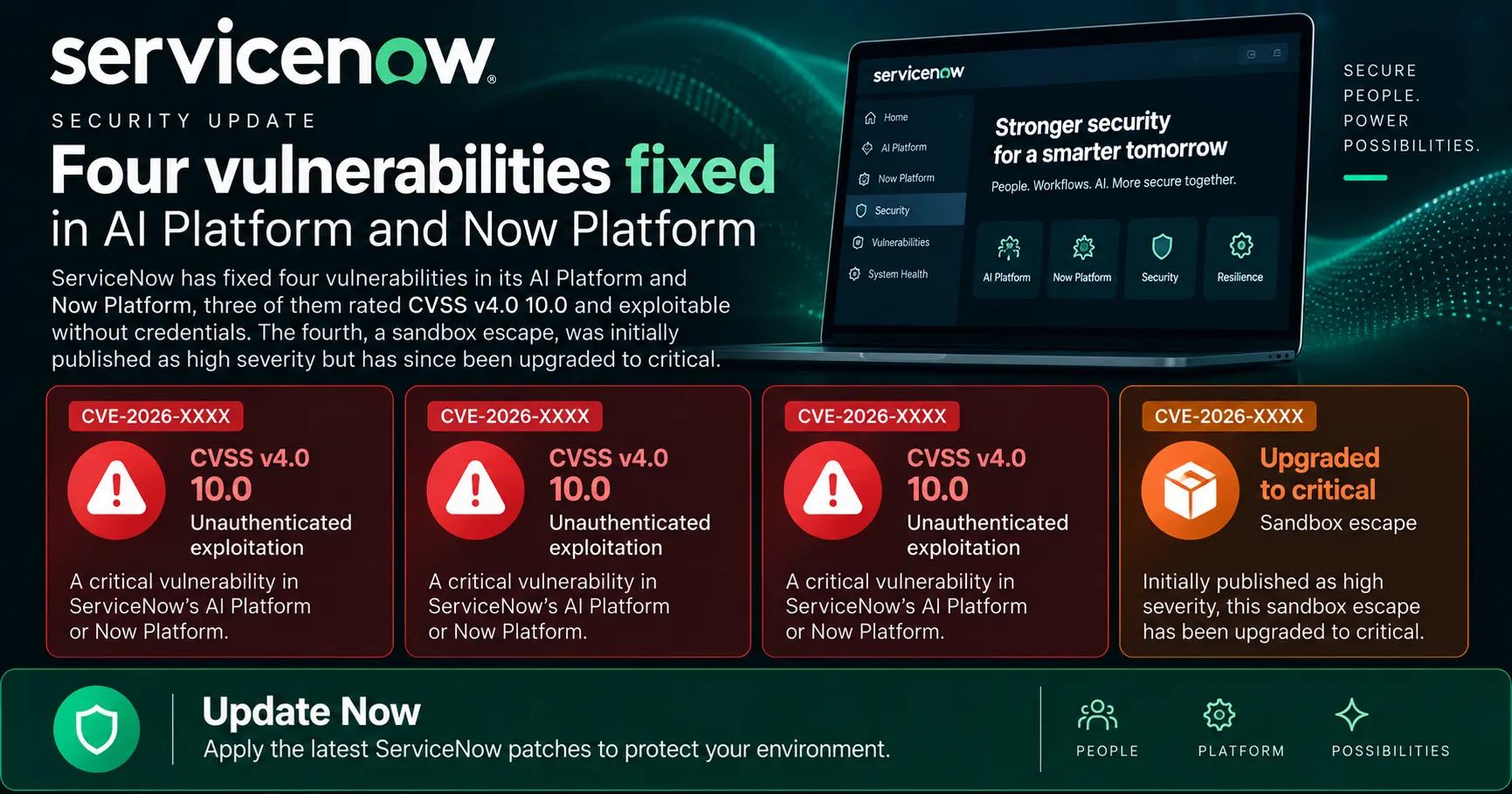
ServiceNow has patched four vulnerabilities across the ServiceNow AI Platform and the Now Platform, three of them rated CVSS v4.0 10.0 and exploitable with no credentials and no user interaction. The advisory, KB3152242, went out on 27 August 2026. Since then ServiceNow has upgraded the fourth flaw, a sandbox escape, from high severity to critical.
ServiceNow patched its own hosted instances, so the exposure sits with self-hosted and partner-managed customers who have to schedule the work themselves. The severity change also means a late-August triage decision may now be wrong.
ServiceNow's August 2026 advisory patches three unauthenticated CVSS 10.0 flaws in its AI Platform and a Now Platform sandbox escape that has since been reclassified as critical.
Check your ServiceNow release, patch and hot fix level against KB3152242 and update self-hosted instances now. Three of the four bugs are CVSS 10.0 with no authentication required, and the fourth is no longer rated high.
Affected & context
On 27 August 2026, ServiceNow published advisory KB3152242, patching four vulnerabilities in the ServiceNow AI Platform and the Now Platform. Three are rated CVSS v4.0 10.0 and need no authentication: a code injection flaw in the GraphQL Composite Data API, an improper access control issue in the system configuration image upload processor, and a SQL injection flaw. ServiceNow later upgraded the fourth, a sandbox escape, from high to critical.
ServiceNow instances hold workflow data and credentials for the systems they automate, so unauthenticated code execution there reaches far beyond the platform itself. Self-hosted customers have to patch on their own schedule.
Organisations running the ServiceNow AI Platform or Now Platform on the Xanadu, Yokohama, Zurich and Australia release families, especially self-hosted and partner-managed instances that ServiceNow does not patch directly.
- Vendors
- ServiceNow
- Products
- ServiceNow AI PlatformServiceNow Now Platform
- Geography
- Global
- Industry
- Enterprise ITManaged service providersPublic sectorFinancial servicesHealthcare
- CVEs
- CVE-2026-18885CVE-2026-18886CVE-2026-74820CVE-2026-6876
Three maximum-severity flaws, all unauthenticated
ServiceNow has patched four vulnerabilities in the ServiceNow AI Platform and the Now Platform, three of them rated CVSS v4.0 10.0. The company published advisory KB3152242, its August 2026 CVE Advisory Notification, on 27 August 2026.
The three maximum-severity bugs are CVE-2026-18885, a code injection flaw in the GraphQL Composite Data API; CVE-2026-18886, an improper access control issue in the system configuration image upload processor; and CVE-2026-74820, a SQL injection flaw reached through a dynamically built schema ORDER BY clause.
CVSS:4.0/AV:N/AC:L/AT:N/PR:N/UI:N/VC:H/VI:H/VA:H/SC:H/SI:H/SA:HNetwork reachable, low complexity, no privileges, no user interaction, and high impact on both the instance and the systems connected to it. ServiceNow says it is not currently aware of malicious exploitation against ServiceNow instances.
The fourth flaw is no longer rated high
CVE-2026-6876 was published as a high-severity sandbox escape in the Now Platform with a CVSS v4.0 score of 8.7. That is the figure the late-August coverage carries, including SecurityWeek's report on 31 August. It is no longer current.
ServiceNow's live advisory now states that the company upgraded CVE-2026-6876 from high to critical after additional analysis from the researcher who discovered it, and that the change affects the severity rating only. The escalation landed in early September, after the first wave of reporting.
Re-rate this one in your tracker
If you triaged KB3152242 in late August and parked the sandbox escape as the lower-priority item, that call was made against a rating ServiceNow has since revised.
What each CVE actually touches
CVE-2026-18885 sits in the GraphQL Composite Data API. An unauthenticated request can lead to arbitrary code execution on the instance, along with access to or modification of instance data beyond the intended boundary.
CVE-2026-18886 is not code injection, despite coverage that groups all three under that label. ServiceNow classifies it as improper access control in the system configuration image upload processor, letting an unauthenticated user create or modify instance data and escalate privileges.
CVE-2026-74820 is SQL injection through a dynamic ORDER BY clause, which hands an unauthenticated attacker arbitrary SQL against the instance's underlying database. On a platform that sits next to HR records, vendor onboarding and finance approvals, that is a direct route to the data.
One inconsistency is worth flagging. For CVE-2026-6876, ServiceNow's text describes an unauthenticated user, while the published CVSS vector records PR:L, meaning low privileges required. The Hacker News and SOCRadar both noted the mismatch. It changes how you model the attacker, not whether you patch.
Hosted instances are done, the rest are not
ServiceNow deployed the fix to its hosted instances, and customers in the ServiceNow Patching Program received the updates through that channel. Everyone else has work to do.
Self-hosted and partner-managed customers need to apply the hotfixes or upgrade to a patched release. ServiceNow lists fixed builds across four release families: Xanadu, Yokohama, Zurich and Australia. Applicability is per CVE and per release, so the exact patch and hot fix level decides whether you are covered, not the family name.
Do not stop at production. Development, test, clone and integration instances often hold production-like data, live credentials and trusted integrations, and those are the ones that quietly miss a patch cycle.
Why a ServiceNow instance is worth more than a ticketing tool
A ServiceNow instance is an integration hub. It holds workflow data plus credentials and trusted connections into the systems it automates, which is what makes unauthenticated code execution there worth more than the same bug in a standalone application.
History supports the concern. BleepingComputer recalls that in 2024 attackers chained three ServiceNow flaws using public exploits to steal data from companies and government agencies worldwide.
The pattern is recent too. CVE-2026-6875, a pre-authentication sandbox escape in the same platform, was patched on 13 July 2026 after Searchlight Cyber reported it in April. The Hacker News notes that Defused first reported in-the-wild exploitation, then corrected itself when the captured payload turned out to match Searchlight's published proof of concept. Even the false alarm shows how quickly payloads circulate once a fix is public.
What to do now
Start with an inventory. List every instance you run, production and non-production, with its release family, patch level and hot fix level, then compare each one against the current KB3152242 table rather than against a summary in a news article.
Self-hosted instances come first, and among them the ones reachable from the internet. ServiceNow's advisory does not offer a compensating control that replaces the patch, so reducing network exposure buys time and nothing more.
No workaround substitutes for the patch
Limiting exposure narrows who can reach the instance. It does not remove the flaw, and there is no documented configuration change that does.
After patching, verify the resulting build rather than trusting the change record. Then review instance logs for unexpected GraphQL calls, unusual admin activity and data exports over the window your instances stayed unpatched.
What to watch next
Watch KB3152242 itself. It has already changed once since publication, and the severity upgrade shows ServiceNow is still revising the record as researchers feed back analysis.
Then watch for proof-of-concept code. The Hacker News found none for the three maximum-severity flaws in the days after disclosure, and Searchlight Cyber had not published a technical write-up at that point. The July timeline for CVE-2026-6875 shows how short the gap between a public PoC and captured payloads can be.
A CISA KEV listing would be the clearest signal to escalate. None of these four CVEs had one at the time of writing.
Timeline
Earlier sandbox escape patched in the same platform
ServiceNow publishes the advisory for CVE-2026-6875, a pre-authentication sandbox escape reported by Searchlight Cyber on 1 April 2026, per The Hacker News.
Source: The Hacker News
Confidence: Medium
ServiceNow publishes advisory KB3152242
The August 2026 CVE Advisory Notification covers four vulnerabilities, three of them rated CVSS v4.0 10.0, and states that ServiceNow is not aware of malicious exploitation.
Source: ServiceNow KB3152242
Confidence: High
Trade press reports the advisory
Coverage from BleepingComputer, The Hacker News and others carries CVE-2026-6876 as a high-severity issue scored 8.7.
Source: BleepingComputer, The Hacker News
Confidence: High
Advisory now lists CVE-2026-6876 as critical
As checked on 11 September 2026, KB3152242 states that ServiceNow upgraded CVE-2026-6876 from high to critical after additional analysis by the researcher who found it. The change affects the severity rating only.
Source: ServiceNow KB3152242
Confidence: High
Impact
Three unauthenticated CVSS 10.0 flaws give an attacker code execution, data manipulation or arbitrary SQL against a ServiceNow instance. Hosted customers are already patched. Self-hosted and partner-managed instances stay exposed until someone schedules the work, and those instances usually connect to HR, finance and IT systems.
Business impact
Self-hosted customers face an unplanned patch cycle on a platform that carries HR, procurement and IT workflows. A compromise would reach the business processes the platform automates, not only the platform itself.
Technical impact
Unauthenticated code execution on the instance, arbitrary SQL against the underlying database, and creation or modification of instance data with privilege escalation.
Security impact
An instance holds credentials and trusted integrations into connected systems, so code execution there is a pivot point rather than an endpoint.
Privacy impact
No data exposure has been reported. The SQL injection flaw does put instance data within reach of an unauthenticated attacker on unpatched systems.
Affected audience: ServiceNow platform owners and administrators, MSPs managing customer ServiceNow instances, Security teams running vulnerability management, Enterprise IT operations teams
Action required.
Technical details
- CVEs
- CVE-2026-18885, CVE-2026-18886, CVE-2026-74820, CVE-2026-6876
- CVSS
- 10
- Attack vector
- Network. CVSS:4.0/AV:N/AC:L/AT:N/PR:N/UI:N/VC:H/VI:H/VA:H/SC:H/SI:H/SA:H for the three flaws rated 10.0. CVE-2026-6876 was published with a vector recording PR:L despite an unauthenticated description.
- Affected versions
- Xanadu release family (per-CVE, see KB3152242), Yokohama release family (per-CVE, see KB3152242), Zurich release family (per-CVE, see KB3152242), Australia release family (per-CVE, see KB3152242)
- Patched versions
- Fixed patch and hot fix levels are listed per CVE and per release family in KB3152242
Detection methods
- Review instance logs for unexpected GraphQL Composite Data API calls
- Audit administrative activity and privilege changes over the unpatched window
- Check for unusual data exports or bulk record access
- Verify the running build of every instance after patching
Mitigations
- Apply the hotfix or upgrade to a patched release on self-hosted and partner-managed instances
- Reduce internet exposure of non-production instances while patching is pending
Technical references
Response
Vendor statement
ServiceNow says it is not currently aware of malicious exploitation against ServiceNow instances and recommends that customers promptly apply the appropriate updates or upgrade to a patched release. The company says the four issues came from internal security research and its responsible disclosure programs, and that each was remediated independently.
Authorities
NHS England Digital issued a cyber alert reproducing the per-CVE details and encouraging affected organisations to review KB3152242 and apply the updates as soon as possible.
Customer guidance
Hosted instances were updated by ServiceNow, and Patching Program customers received the fixes through that channel. Self-hosted and partner-managed customers should compare their release, patch and hot fix level against KB3152242 and apply the update or upgrade to a patched release.
Response status: Patched
Patch available: Yes
Workaround available: No
FAQ
Which ServiceNow vulnerabilities are rated CVSS 10.0?
CVE-2026-18885, CVE-2026-18886 and CVE-2026-74820 each carry a CVSS v4.0 score of 10.0. They are, in order, a code injection flaw in the GraphQL Composite Data API, an improper access control issue in the system configuration image upload processor, and a SQL injection flaw reached through a dynamic schema ORDER BY clause. All three are described as exploitable without authentication or user interaction.
Why is CVE-2026-6876 now critical instead of high?
ServiceNow first published the sandbox escape with a CVSS v4.0 score of 8.7, rated high. Its advisory now states that the severity was upgraded from high to critical after additional analysis from the researcher who discovered the issue, and that the change affects the severity rating only.
Do I need to do anything if ServiceNow hosts my instance?
ServiceNow deployed the security update to its hosted instances, and customers in the ServiceNow Patching Program received the fixes through that channel. It is still worth verifying the build your instances are running, including development, test and clone instances.
Which releases are fixed?
ServiceNow lists fixed builds across the Xanadu, Yokohama, Zurich and Australia release families. Applicability is defined per CVE and per release, so check the exact patch and hot fix level of each instance against KB3152242 rather than relying on the release family alone.
Are these ServiceNow flaws being exploited?
ServiceNow said in each record that it is not currently aware of malicious exploitation. The Hacker News found no public exploit code for the three maximum-severity flaws in the days after disclosure. None of the four CVEs appeared in the CISA KEV catalog at the time of writing.
The bottom line
ServiceNow's August 2026 advisory patched three unauthenticated CVSS 10.0 flaws in the ServiceNow AI Platform and a Now Platform sandbox escape that the company has since reclassified from high to critical.
Hosted customers are covered. Everyone running ServiceNow themselves is holding an unauthenticated code execution path until they patch.
What happens next
Watch KB3152242 for further revisions, and watch for proof-of-concept code or a CISA KEV listing. The advisory has already changed once since publication.
What to do
Compare every instance build against KB3152242, patch self-hosted instances now, and re-rate CVE-2026-6876 as critical in your tracker.
Sources
ServiceNow · Aug 27, 2026 · Primary source
Claims supported
- The advisory covers four CVEs and was published on 27 August 2026
- ServiceNow upgraded CVE-2026-6876 from high to critical after researcher analysis
NHS England Digital · Aug 28, 2026
Claims supported
- Per-CVE classifications and CVSS v4.0 scores: 10.0 for CVE-2026-18885, CVE-2026-18886 and CVE-2026-74820, 8.7 for CVE-2026-6876 as first published
The Hacker News · Aug 28, 2026
Claims supported
- Shared CVSS v4.0 vector for the three maximum-severity flaws
- The PR:L discrepancy in the CVE-2026-6876 vector
- No public exploit code found as of 28 August 2026
- CVE-2026-6875 timeline, Searchlight Cyber report and the Defused correction
SecurityWeek · Aug 31, 2026
Claims supported
- Hotfixes released for self-hosted instances across four release families
- CVE-2026-6876 was reported as high severity at 8.7 in late August
BleepingComputer · Aug 28, 2026
Claims supported
- ServiceNow's statement that it is not aware of malicious exploitation
- The 2024 exploitation of chained ServiceNow flaws against firms and government agencies
SOCRadar · Aug 28, 2026
Claims supported
- Corroborates the scoring inconsistency on CVE-2026-6876 and the per-CVE release applicability