ANAVEM
Languagefr
System administrator analyzing Windows Event Viewer logs on multiple monitors in an IT operations center
Event ID 256ErrorUnknownWindows

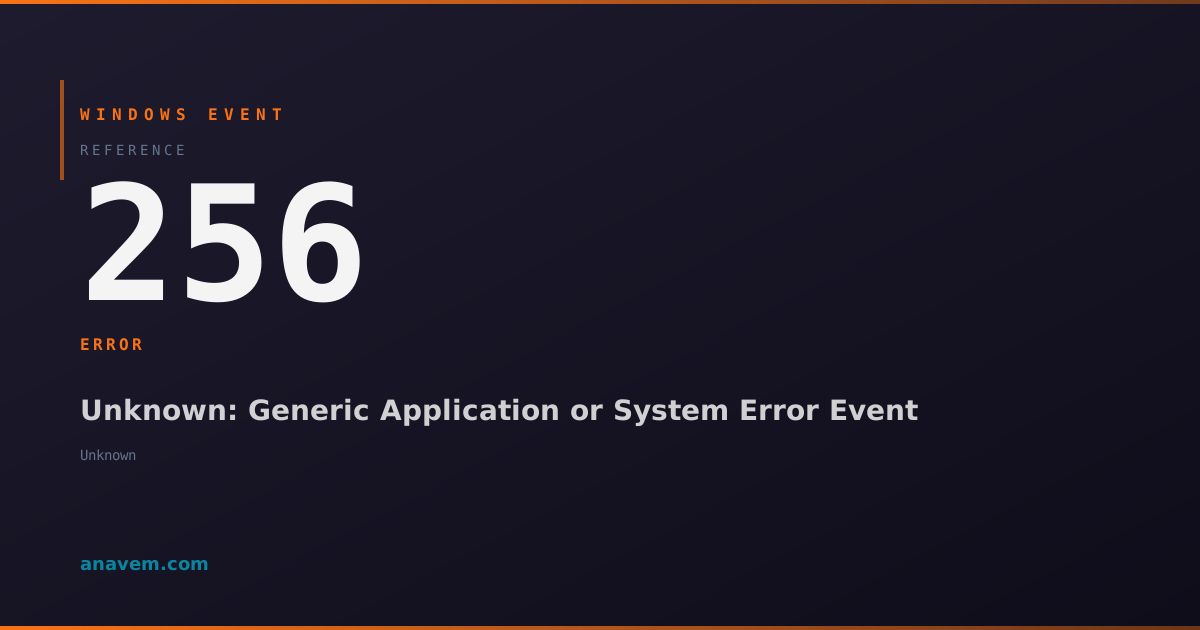
Windows Event ID 256 – Unknown: Generic Application or System Error Event

Event ID 256 represents a generic error condition from an unspecified source, often indicating application crashes, service failures, or system component issues requiring detailed investigation.

Emanuel DE ALMEIDAEmanuel DE ALMEIDA
18 March 202612 min read 0
Event ID 256Unknown 5 methods 12 min
Event Reference

What This Event Means

Event ID 256 from an unknown source occurs when Windows encounters an error condition that cannot be properly categorized or when the originating component fails to register itself correctly in the event logging system. This situation commonly arises during system startup when services attempt to initialize before the event logging subsystem is fully operational, or when applications crash in a way that prevents proper error reporting.

The unknown source designation indicates that either the event source was not properly registered in the Windows Registry, the originating process terminated before completing the event log entry, or the event logging mechanism itself encountered an issue. This creates a diagnostic challenge because traditional event filtering and correlation methods become less effective.

Modern Windows versions attempt to provide additional context through event correlation and enhanced logging, but Event ID 256 events often require administrators to examine process dumps, system file integrity, and application-specific logs. The event frequency and timing patterns often provide more valuable diagnostic information than the event content itself.

In enterprise environments, these events frequently correlate with software deployment issues, group policy application failures, or hardware compatibility problems. The 2026 Windows updates have introduced improved telemetry collection that can help identify patterns, but manual investigation remains essential for resolution.

Applies to

Windows 10Windows 11Windows Server 2019/2022/2025
Analysis

Possible Causes

  • Application crashes during startup or runtime that prevent proper error reporting
  • Service initialization failures before event logging subsystem is fully operational
  • Corrupted or missing event source registrations in the Windows Registry
  • Driver compatibility issues causing system component failures
  • Memory corruption affecting the event logging mechanism
  • Third-party software conflicts interfering with Windows error reporting
  • System file corruption affecting core Windows components
  • Hardware failures causing intermittent system instability
  • Group Policy application errors during system startup
  • Antivirus or security software blocking legitimate system processes
Resolution Methods

Troubleshooting Steps

01

Examine Event Details and Correlate Timestamps

Start by gathering detailed information about the Event ID 256 occurrences and correlating them with other system events.

  1. Open Event ViewerWindows LogsApplication and System
  2. Filter for Event ID 256 using the following PowerShell command:
Get-WinEvent -FilterHashtable @{LogName='Application','System'; Id=256} -MaxEvents 50 | Format-Table TimeCreated, Id, LevelDisplayName, Message -AutoSize
  1. Note the exact timestamps and examine events occurring within 30 seconds before and after each Event ID 256
  2. Look for patterns in the General tab details, particularly any process IDs or thread IDs mentioned
  3. Export the events for analysis:
Get-WinEvent -FilterHashtable @{LogName='Application','System'; Id=256} | Export-Csv -Path "C:\Temp\Event256Analysis.csv" -NoTypeInformation
Pro tip: Event ID 256 often occurs in clusters. Look for the first occurrence in a series to identify the triggering condition.
02

Check Event Source Registrations and System Integrity

Verify that event sources are properly registered and system files are intact.

  1. Check event source registrations in the registry:
Get-ChildItem "HKLM:\SYSTEM\CurrentControlSet\Services\EventLog\Application" | Where-Object {$_.PSChildName -like "*Unknown*" -or $_.PSChildName -eq ""}
  1. Run System File Checker to identify corrupted system files:
sfc /scannow
  1. Check the SFC log for details:
findstr /c:"[SR]" %windir%\Logs\CBS\CBS.log | findstr /c:"Cannot repair"
  1. Run DISM to repair the Windows image if SFC found issues:
DISM /Online /Cleanup-Image /RestoreHealth
  1. Verify event log service status:
Get-Service -Name "EventLog" | Format-List *
Warning: Do not manually delete event source registry entries without proper backup. This can cause additional logging issues.
03

Analyze Process and Application Logs

Investigate running processes and application-specific logs to identify the source of Event ID 256.

  1. Monitor process creation and termination around event occurrence:
Get-WinEvent -FilterHashtable @{LogName='Security'; Id=4688,4689} | Where-Object {$_.TimeCreated -gt (Get-Date).AddHours(-2)} | Format-Table TimeCreated, Id, @{Name='Process';Expression={$_.Properties[5].Value}}
  1. Check Windows Error Reporting logs:
Get-WinEvent -FilterHashtable @{LogName='Application'; ProviderName='Windows Error Reporting'} -MaxEvents 20
  1. Examine application crash dumps in the following locations:
  • %LocalAppData%\CrashDumps
  • %SystemRoot%\Minidump
  • %SystemRoot%\Memory.dmp
  1. Use Process Monitor to capture real-time file and registry access:
# Download ProcMon from Microsoft Sysinternals
# Run: procmon.exe /AcceptEula /Minimized /BackingFile C:\Temp\ProcMon.pml
  1. Check for third-party application logs in Event ViewerApplications and Services Logs
Pro tip: Enable process creation auditing via Group Policy to get better visibility into process lifecycle events.
04

Advanced Diagnostics with WPA and ETW Tracing

Use advanced Windows diagnostic tools to capture detailed system behavior during Event ID 256 occurrences.

  1. Enable ETW tracing for kernel events:
wpr -start GeneralProfile -start CPU -start DiskIO -start FileIO
  1. Reproduce the issue or wait for Event ID 256 to occur, then stop tracing:
wpr -stop C:\Temp\SystemTrace.etl
  1. Analyze the trace using Windows Performance Analyzer (WPA) or convert to readable format:
tracerpt C:\Temp\SystemTrace.etl -o C:\Temp\TraceReport.xml -of XML
  1. Enable detailed event logging for troubleshooting:
wevtutil sl Microsoft-Windows-Kernel-General/Analytic /e:true
wevtutil sl Microsoft-Windows-Kernel-Process/Analytic /e:true
  1. Create a custom event collection for correlation:
$Events = @()
$Events += Get-WinEvent -FilterHashtable @{LogName='Application'; Id=256; StartTime=(Get-Date).AddDays(-1)}
$Events += Get-WinEvent -FilterHashtable @{LogName='System'; Id=1074,6005,6006,6008; StartTime=(Get-Date).AddDays(-1)}
$Events | Sort-Object TimeCreated | Export-Csv -Path "C:\Temp\CorrelatedEvents.csv"
Warning: ETW tracing can generate large files. Ensure adequate disk space and stop tracing promptly to avoid performance impact.
05

Registry Analysis and Event Source Reconstruction

Perform deep registry analysis and attempt to reconstruct missing or corrupted event source information.

  1. Export the complete EventLog registry hive for analysis:
reg export "HKLM\SYSTEM\CurrentControlSet\Services\EventLog" "C:\Temp\EventLogRegistry.reg"
  1. Search for orphaned or corrupted event source entries:
Get-ChildItem "HKLM:\SYSTEM\CurrentControlSet\Services\EventLog\Application" | ForEach-Object {
    $sourceName = $_.PSChildName
    $eventMessageFile = Get-ItemProperty -Path $_.PSPath -Name "EventMessageFile" -ErrorAction SilentlyContinue
    if (-not $eventMessageFile -or -not (Test-Path $eventMessageFile.EventMessageFile)) {
        Write-Output "Potentially corrupted source: $sourceName"
    }
}
  1. Check for duplicate or conflicting event source registrations:
$AllSources = @()
@('Application', 'System', 'Security') | ForEach-Object {
    $LogName = $_
    Get-ChildItem "HKLM:\SYSTEM\CurrentControlSet\Services\EventLog\$LogName" | ForEach-Object {
        $AllSources += [PSCustomObject]@{
            LogName = $LogName
            SourceName = $_.PSChildName
            RegistryPath = $_.PSPath
        }
    }
}
$AllSources | Group-Object SourceName | Where-Object {$_.Count -gt 1}
  1. Rebuild event source registration if corruption is detected:
# Example for recreating a missing source (replace with actual application name)
$SourceName = "YourApplicationName"
$LogName = "Application"
New-EventLog -LogName $LogName -Source $SourceName
  1. Verify the fix by testing event generation:
Write-EventLog -LogName "Application" -Source "YourApplicationName" -EventId 1001 -EntryType Information -Message "Test event after source recreation"
Pro tip: Always backup the registry before making changes. Use reg export to create restore points.

Overview

Event ID 256 with an unknown source represents one of the more challenging events to troubleshoot in Windows environments. This generic error event fires when applications, services, or system components encounter failures but fail to properly identify themselves in the event log entry. The event typically appears in the Application or System logs and requires correlation with other events to determine the root cause.

Unlike specific event IDs that clearly identify their source and nature, Event ID 256 acts as a catch-all for various error conditions. This makes it particularly frustrating for administrators who need to quickly identify and resolve issues. The event often coincides with application crashes, service startup failures, driver problems, or corrupted system files.

In Windows 11 2026 builds and Windows Server 2025, Microsoft has improved event correlation capabilities, but Event ID 256 still requires manual investigation. The key to resolving these events lies in examining the event details, correlating timestamps with other system events, and using advanced diagnostic tools to identify the actual failing component.

Frequently Asked Questions

What does Event ID 256 with unknown source actually mean?+
Event ID 256 with an unknown source indicates that Windows encountered an error condition but the originating component failed to properly identify itself in the event log. This typically happens when applications crash before completing their error reporting, when event sources aren't properly registered in the registry, or when the event logging subsystem itself experiences issues. The 'unknown' designation makes troubleshooting challenging because traditional filtering methods become less effective.
How can I identify which application or service is causing Event ID 256?+
To identify the source, correlate Event ID 256 timestamps with other system events occurring within 30 seconds. Use Process Monitor to capture real-time system activity, examine Windows Error Reporting logs, and check for application crash dumps in %LocalAppData%\CrashDumps. Enable process creation auditing through Group Policy for better visibility. Often, the pattern of when these events occur (startup, specific user actions, scheduled tasks) provides clues about the originating component.
Are Event ID 256 errors dangerous to my system?+
Event ID 256 errors themselves aren't inherently dangerous, but they indicate underlying issues that could affect system stability. The severity depends on the frequency and what's actually causing them. Occasional occurrences might indicate minor application glitches, while frequent events could signal serious problems like corrupted system files, failing hardware, or malware. The key is identifying and addressing the root cause rather than just dismissing the events.
Can I prevent Event ID 256 errors from occurring?+
Prevention strategies include maintaining system health through regular updates, running SFC and DISM scans to fix corrupted files, ensuring proper event source registrations, and monitoring for software conflicts. Keep applications updated, avoid installing untrusted software, and maintain good system hygiene. However, some Event ID 256 occurrences are unavoidable due to the nature of complex software interactions. Focus on quick identification and resolution rather than complete prevention.
Should I contact Microsoft support for persistent Event ID 256 errors?+
Contact Microsoft support if Event ID 256 errors persist after exhausting standard troubleshooting methods, especially if they correlate with system instability, blue screens, or critical application failures. Before contacting support, gather comprehensive logs including Event Viewer exports, SFC scan results, system information, and any crash dumps. Microsoft support can analyze advanced diagnostics and may request ETW traces or memory dumps for deeper investigation. For business-critical systems, don't hesitate to escalate if the errors impact operations.
Documentation

References (2)

Emanuel DE ALMEIDA
Written by

Emanuel DE ALMEIDA

Senior IT Journalist & Cloud Architect

Microsoft MCSA-certified Cloud Architect | Fortinet-focused. I modernize cloud, hybrid & on-prem infrastructure for reliability, security, performance and cost control - sharing field-tested ops & troubleshooting.

Discussion

Share your thoughts and insights

You must be logged in to comment.

Loading comments...