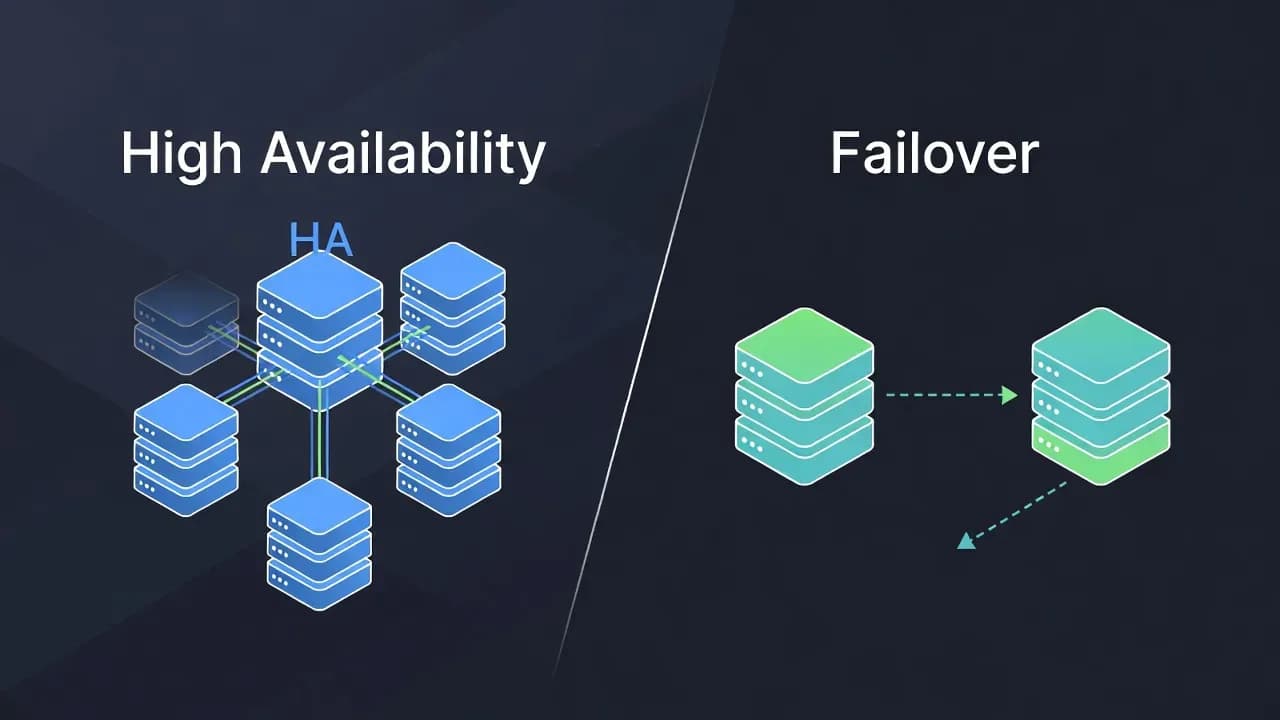
High Availability vs Failover: What’s the Difference?
High Availability and failover are closely related concepts, but they are not the same. Both aim to reduce downtime, yet they rely on different design principles and operational behaviors. This explanation clarifies what High Availability and failover mean, how they differ, common implementation models, and how administrators decide which approach fits a given workload or infrastructure.

What Is High Availability (HA)?
High Availability is a design approach focused on keeping services continuously available with minimal or no interruption. Instead of reacting to failures, HA systems are built to tolerate them.
HA typically relies on redundancy, load distribution, and automatic health monitoring. Multiple components run simultaneously so that if one fails, others continue serving requests without noticeable downtime.
High Availability aims to reduce or eliminate service interruption altogether.
What Is Failover?
Failover is a recovery mechanism that shifts a service from a failed component to a standby component. Unlike HA, failover assumes that an interruption may occur, but that recovery will be fast and controlled.
In failover scenarios, one system is active while another waits in standby mode. When a failure is detected, the standby system takes over.
Failover focuses on rapid recovery rather than continuous operation.
Key Differences Between HA and Failover
Although both concepts improve resilience, they differ in intent and behavior.
Availability Model
High Availability is proactive. Services are already running on multiple components.
Failover is reactive. A backup system activates only after a failure is detected.
Downtime Expectations
High Availability aims for near-zero downtime.
Failover accepts brief interruptions during detection and switchover.
Architecture Complexity
HA architectures are generally more complex and resource-intensive because multiple systems operate concurrently.
Failover architectures are simpler and often less costly, using standby resources.
How High Availability Works in Practice
HA systems rely on continuous monitoring and load distribution.
Requests are spread across multiple nodes. If one node becomes unhealthy, traffic is redirected automatically to remaining nodes. This process happens transparently for users.
Common HA patterns include clustering, load balancing, and redundant services.
How Failover Works in Practice
Failover systems monitor the health of a primary component.
When a failure occurs, the system triggers a switchover to a secondary component. This may involve starting services, mounting storage, or updating routing and DNS records.
Failover usually introduces a short delay while the transition occurs.
Common Use Cases for High Availability
High Availability is typically used for:
- Critical production services
- Customer-facing applications
- Real-time systems
- Environments with strict uptime requirements
In these cases, even brief outages may be unacceptable.
Common Use Cases for Failover
Failover is commonly used for:
- Infrastructure services
- Internal systems
- Disaster recovery scenarios
- Cost-sensitive environments
Failover provides resilience without the overhead of full HA designs.
HA vs Failover in Enterprise IT
Many enterprise environments use both approaches together.
For example, a service may run in a high-availability cluster within a site, while failover mechanisms handle site-level or regional outages.
Understanding the difference allows administrators to design layered resilience strategies.
Common Misconceptions
High Availability does not mean failure never occurs. It means failures do not result in service interruption.
Failover does not guarantee zero downtime. It minimizes downtime by automating recovery.
Confusing the two can lead to incorrect expectations and poor design decisions.
Why the Difference Matters
Choosing between High Availability and failover affects cost, complexity, and operational behavior.
Understanding these concepts helps administrators align infrastructure design with business availability requirements and risk tolerance.
Frequently Asked Questions
High Availability prevents downtime by running services on multiple active components, while failover restores service after a failure occurs.
No. HA reduces downtime significantly, but maintenance or large-scale failures can still cause interruptions.
Often yes. Failover typically uses standby resources, while HA requires multiple active systems running at all times.
Yes. Many infrastructures combine HA within a site and failover between sites or regions.
The choice depends on business requirements, acceptable downtime, and cost constraints.


Comments
Want to join the discussion?
Create an account to unlock exclusive member content, save your favorite articles, and join our community of IT professionals.
New here? Create a free account to get started.