

Cisco FMC Flaws CVE-2026-20079 and CVE-2026-20316 Exploited by Ransomware, State Hackers
Cisco Talos ties three separate intrusion clusters, including a Qilin ransomware affiliate and a Sandworm-linked actor, to two Secure FMC bugs Cisco has already patched.

On this page
What happened with Cisco's FMC flaws
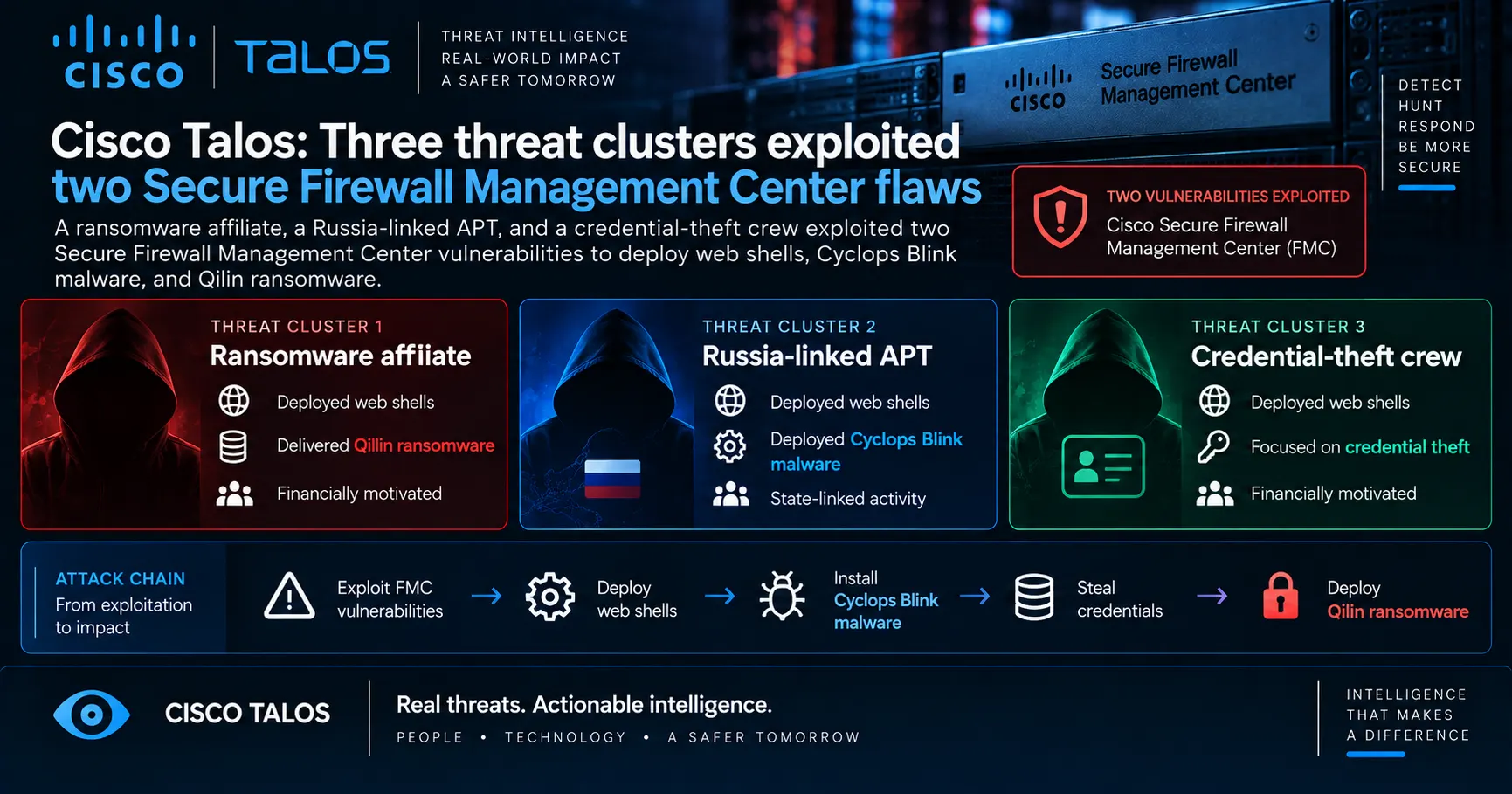
Cisco Talos is tracking three separate intrusion clusters that abused two vulnerabilities in Cisco's Secure Firewall Management Center (FMC) software. Per Talos's September 9, 2026 advisory, CVE-2026-20079 is a maximum-severity authentication bypass that lets an unauthenticated remote attacker execute scripts as root on unpatched FMC instances. CVE-2026-20316 lets a remote attacker log in using a static, low-privileged account credential.
CVE-2026-20079 carries a CVSS score of 10.0. CVE-2026-20316 scores 5.3, but Cisco rates it High severity because attackers can chain it with other FMC flaws to escalate privileges. Cisco has already released hotfixes for both bugs and, per its advisories, plans a broader hardening release covering additional internally found vulnerabilities the week of September 14, 2026.
Patch now
Talos confirmed in-the-wild abuse of both flaws before publishing. Cisco and Talos both urge customers to apply the hotfixes immediately rather than wait for next week's hardening release.
Why the FMC exploitation matters
FMC is the central console that manages an organization's fleet of Cisco Secure Firewall appliances. An attacker who gains root on FMC can see and touch the configuration of every firewall it manages, making it a high-value target rather than a single point of failure.
The three clusters Talos describes show that a Russia-linked APT and a ransomware affiliate found and weaponized the same two bugs independently, within weeks of Cisco's July disclosure. That pattern, an internet-facing management appliance exploited by unrelated actors for different goals (espionage and extortion), is now a routine part of how quickly perimeter security software gets targeted once a serious flaw becomes public.
Cluster UAT-12197: web shell and credential theft
The first cluster, tracked by Talos as UAT-12197, exploited CVE-2026-20079 to drop a JSP-based web shell into the Cisco Security Manager Tomcat webroot directory. The web shell then installed a JAR file named cmd.jar that worked as a command executor.
/var/jre/bin/java -jar cmd.jar '/var/sf/bin/OmniQuery.pl -db mdb -e \'SELECT name, auth_data FROM users;\''The attackers used that JAR file to query FMC's internal database directly and pull user authentication data and credentials, according to Talos's technical writeup.
Cluster UAT-11823: Sandworm-linked actor deploys Cyclops Blink
Talos attributes the second cluster, UAT-11823, with high confidence to an advanced persistent threat whose tooling overlaps with Sandworm, the Russian GRU-linked group. The actor got in by exploiting either CVE-2026-20079 or the static credentials tied to CVE-2026-20316, then modified a legitimate license.tmp file on disk and had it executed as root through Cisco's own package_info.pl utility, opening a Netcat-based reverse shell to its command-and-control server.
Talos assesses with high confidence that UAT-11823 exploited both CVEs during the intrusion. The final payload was a variant of Cyclops Blink, a modular Linux backdoor previously linked to Sandworm by US and UK authorities, giving the operator persistent access, credential theft, and network traffic sniffing on compromised devices.
Cluster UAT-11988: from FMC access to Qilin ransomware
The third cluster, UAT-11988, which Talos assesses with high confidence is a Qilin ransomware affiliate, logged into an FMC device using CVE-2026-20316's static credentials. The operator then abused legitimate, built-in FMC tools to map the victim's network: hostnames, IP addresses, Active Directory service-account credentials, MySQL credentials, and domain account data.
- Staged stolen data in publicly accessible files on the FMC server and exfiltrated it over HTTP GET requests
- Set up a Python SOCKS5 proxy and a reverse SSH tunnel, forwarding LDAP, LDAPS, Kerberos, SMB, NetBIOS, and WinRM
- Ran post-exploitation tools including Impacket, Invoke-TheHash, and custom EDR killers before deploying Qilin ransomware on selected endpoints
What Cisco has fixed, and what admins should do
Cisco published hotfixes for CVE-2026-20079 and CVE-2026-20316 shortly after the July disclosure and is shipping a wider hardening release the week of September 14, 2026 that folds in other internally discovered issues. Talos also published Snort signature IDs and indicators of compromise on its GitHub repository.
- Apply Cisco's hotfixes for both CVEs now rather than waiting for the hardening release
- Check for unexpected modifications to license.tmp and unfamiliar JAR files under the Tomcat webroot
- Rotate any credentials that may have been exposed through FMC, including AD service accounts and MySQL accounts
- Compare outbound connections and DNS activity against the IPs and hashes Talos published for UAT-12197, UAT-11823, and UAT-11988
How does this connect to July's disclosure?
Cisco first disclosed CVE-2026-20316 as actively exploited on July 29, 2026, and separately updated its CVE-2026-20079 advisory with the same license.tmp indicator of compromise, without confirming at the time that the two flaws were linked. Talos's report now closes that gap: it confirms UAT-11823 chained both CVEs using the license.tmp mechanism.
The open question going forward is whether other actors follow once exploitation details and IOCs are public, and how effective Cisco's September 14 hardening release is at closing off the additional internally discovered issues it will patch.
Response
Response status: No response
Patch available: No
Workaround available: No
FAQ
What are CVE-2026-20079 and CVE-2026-20316?
They are two vulnerabilities in Cisco's Secure Firewall Management Center software. CVE-2026-20079 is a maximum-severity (CVSS 10.0) authentication bypass that lets an unauthenticated remote attacker run scripts as root. CVE-2026-20316 (CVSS 5.3) lets an attacker log in with a static, low-privileged account credential, and Cisco rates it High severity because it can be chained with other FMC flaws.
Who is exploiting the Cisco FMC vulnerabilities?
Cisco Talos tracks three separate clusters: UAT-12197, which deployed a web shell and stole credentials; UAT-11823, an APT actor whose tooling overlaps with the Russia-linked Sandworm group and who deployed Cyclops Blink malware; and UAT-11988, a Qilin ransomware affiliate.
Has Cisco released a patch for these flaws?
Yes. Cisco released hotfixes for both CVE-2026-20079 and CVE-2026-20316 shortly after their July 2026 disclosure. Cisco also plans a broader hardening release the week of September 14, 2026, covering additional internally discovered vulnerabilities.
What should FMC administrators do right now?
Apply Cisco's hotfixes for both CVEs immediately rather than waiting for the hardening release. Check for unauthorized changes to license.tmp, unfamiliar JAR files in the Tomcat webroot, and rotate any credentials that may have transited FMC. Compare network activity against the indicators of compromise Cisco Talos published.
Is Cyclops Blink linked to a known threat actor?
Yes. Cyclops Blink is a modular Linux malware family that US and UK authorities previously attributed to Sandworm, a Russian state-sponsored group linked to the GRU military intelligence agency. Talos observed a variant of it deployed by cluster UAT-11823 on compromised FMC devices.
Sources
Cisco Talos · Sep 9, 2026 · Primary source
Claims supported
- Three intrusion clusters
- CVE details and CVSS scores
- Cyclops Blink and Qilin ransomware deployment
- IOCs and Snort SIDs
Cisco · Primary source
Claims supported
- CVE-2026-20079 severity and patch availability
Cisco · Primary source
Claims supported
- CVE-2026-20316 severity and patch availability
BleepingComputer · Sep 10, 2026
Claims supported
- Confirms link between the two CVEs and the July disclosure timeline
- Cisco's non-answer to BleepingComputer's July questions
Reader feedback
Written reviews
Loading reviews…