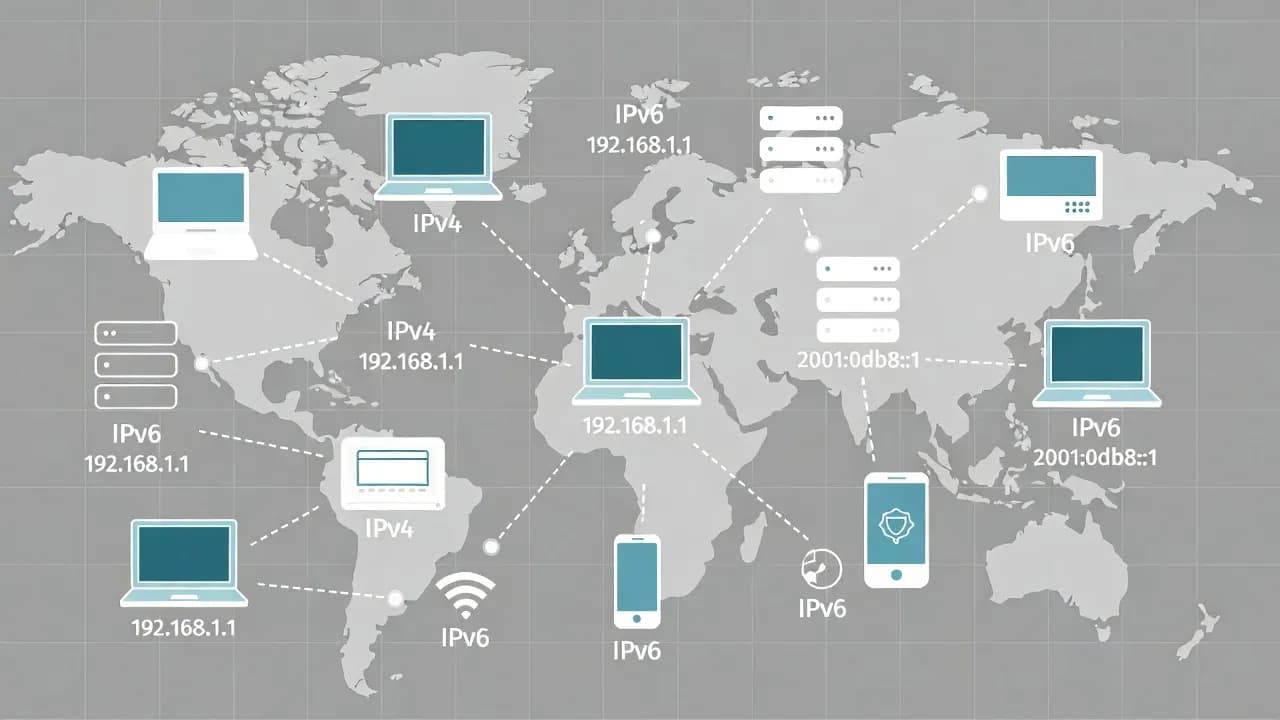
IP Addresses Explained: How Networking Identifiers Work
An IP address uniquely identifies devices on a network, enabling communication across local systems and the internet. This comprehensive guide explains IPv4, IPv6, subnetting, public vs private addressing, and why IP addressing remains foundational to modern networking.

Introduction
An Internet Protocol (IP) address is a numerical label assigned to every device participating in a computer network that uses the Internet Protocol for communication. From desktops and laptops to smartphones and servers, IP addresses enable devices to locate and communicate with each other both locally and across the global Internet. Understanding IP addresses is foundational for network administration, cybersecurity, cloud systems, and virtually any modern IT infrastructure.
This guide explains how IP addressing works, explores the differences between IPv4 and IPv6, discusses public vs private addressing, and outlines key concepts like subnetting that help organize and scale networks effectively.
What is an IP address
An IP address serves two primary functions:
- Identification: Each device on a network must have a unique identifier so that data packets can be delivered to the correct destination.
- Location addressing: IP addresses help routers determine where devices reside and how to forward traffic between networks.
IP addresses are fundamentally used by the Internet Protocol suite (IPv4, IPv6) and are expressed as sequences of numbers separated by dots (IPv4) or colons (IPv6).
IPv4 vs IPv6
IPv4
IPv4 is the original version of the Internet Protocol and uses 32-bit address spaces. An IPv4 address appears as four decimal numbers separated by periods, e.g., 192.168.1.1.
- Structure: 32 bits
- Address format: Dot-decimal notation (e.g., 192.168.0.1)
- Total addresses: ~4.3 billion
- Common uses: LAN addressing, public Internet addressing (when available)
With the explosive growth of internet-connected devices, IPv4 addresses became scarce, leading to workarounds such as Network Address Translation (NAT) and the development of IPv6.
IPv6
IPv6 was developed to address IPv4 exhaustion and uses a 128-bit address space.
- Structure: 128 bits
- Address format: Eight groups of hexadecimal numbers separated by colons (e.g.,
2001:0db8:85a3::8a2e:0370:7334) - Address capacity: 2^128 (≈3.4×10^38)
- Benefits: Vast address space, simplified header, improved routing and autoconfiguration
IPv6 adoption continues to grow as network hardware and service providers update infrastructure to support modern addressing requirements.
Public vs Private IPs
Not all IP addresses are routable on the internet.
Public IP addresses
Public IPs are assigned by Internet Service Providers (ISPs) or cloud providers and are reachable from outside a local network.
Private IP addresses
Private IPs are reserved for internal network use and cannot be directly reached from the internet without translation (e.g., via NAT).
Common IPv4 private ranges:
- 10.0.0.0/8
- 172.16.0.0/12
- 192.168.0.0/16
IPv6 also defines unique local addresses (ULAs) for internal use, analogous to private IPv4 ranges.
Subnetting and Network Segmentation
Subnetting enables network administrators to divide larger networks into smaller, manageable segments.
Why subnet?
- Efficient address use
- Traffic isolation
- Security boundaries
- Simplified routing
In IPv4, subnetting uses prefix notation (e.g., /24 for 255.255.255.0), indicating how many bits describe the network portion of the address.
Example:
- 192.168.1.0/24 → 256 possible addresses
IPv6 subnetting follows a similar prefix system (e.g., /64) optimized for hierarchical routing.
How IP routing works
Routers and Layer 3 switches make forwarding decisions based on IP addresses. When a device sends data:
Why IP addressing still matters
Despite decades of evolution, IP addressing remains the foundation of how networks function:
- Device reachability across local and wide area networks
- Security policies tied to IP-based access controls
- Cloud scaling and multitenancy require careful address planning
- Performance and segmentation rely on precise subnet boundaries
Whether administering a corporate LAN, configuring cloud VPCs, or troubleshooting connectivity issues, a solid grasp of IP addressing is indispensable.
Conclusion
IP addresses are more than just numbers - they define how computers and services find one another in a sea of connected devices. From the legacy limits of IPv4 to the an almost infinite capacity of IPv6, and from public internet routing to private network segmentation, IP addressing shapes how modern networks are built, managed, and secured.
Frequently Asked Questions
Private IP addresses are used within local networks where public internet reachability is not required. They conserve public IPv4 address space and improve internal segmentation.
Not natively. IPv4 and IPv6 use incompatible formats, requiring translation or transition mechanisms for intercommunication.
Subnetting divides a network into smaller parts using prefix lengths (like /24), improving address efficiency, security, and management.
IPv4 uses 32-bit addresses with a limited pool of unique identifiers, while IPv6 uses 128-bit addresses offering vastly more address space and improved routing capabilities.

Comments
Want to join the discussion?
Create an account to unlock exclusive member content, save your favorite articles, and join our community of IT professionals.
New here? Create a free account to get started.